Entity SEO & Structured Data for AI Agentic Web Readiness
How Entity-Based SEO and Structured Data Improve Agentic Web Readiness for AI Discovery
The Dawn of the Delegate Economy: Why Traditional SEO is No Longer Enough
The landscape of digital discovery is undergoing a tectonic shift, one that renders the traditional "search-first" mindset not just incomplete, but potentially obsolete for high-growth brands. We are witnessing the transition from human-led search to what we now call the "delegate economy." In the previous era of the web, discovery was a manual, labor-intensive process. A user identified a need, typed a keyword-based query into a search engine, and was met with a list of blue links. The burden of research, comparison, and evaluation sat entirely on the user's shoulders. They were the ones clicking through to five different tabs, weighing pricing, reading reviews, and checking feature sets.
Today, that burden is being shifted. In the delegate economy, the user has moved from the role of "primary researcher" to the role of "final approver." We define agentic search as AI that retrieves, evaluates, and acts on information on behalf of users. It is an evolution beyond mere Answer Engine Optimization (AEO). An agent doesn't just provide a synthesized answer; it executes a workflow. It might compare software vendors, plan a complex itinerary, or stage a purchase. According to Microsoft, agentic-browser traffic has grown by a staggering 8,000% year-over-year as of early 2026. This is no longer a future-looking trend; it is a live, high-volume traffic source that is fundamentally rewriting the marketing funnel.
When discovery and consideration are delegated to an AI agent, the awareness-to-purchase window is compressed from days or weeks into mere seconds. A brand that isn't machine-readable is effectively invisible. If an agent cannot find your price, verify your credentials, or understand your industry-specific use cases, it will filter you out of the consideration set before the human user ever knows you existed. This creates a "validation layer," where the user encounters your brand for the first time only moments before a decision is finalized.
Semrush is leading the charge in helping brands navigate this transition. By unifying traditional SEO health with AI-driven visibility metrics through Semrush One, we are giving marketers the tools to diagnose their "agentic readiness." The goal is to move beyond "ranking" for keywords and toward being "chosen" for actions in the delegate economy.
The Spectrum of Agentic Behavior: From Queries to Delegated Actions
To optimize for the agentic web, we must move past the idea that all AI search is created equal. Agentic behavior exists on a spectrum of complexity, moving from simple information retrieval to fully autonomous execution. At each stage, the agent engages in different cognitive loops, and for a brand, the "decisive layers" of visibility shift accordingly. Research from Google's SAGE initiative shows that AI agents now take an average of 4.9 steps per query, searching, comparing, and evaluating across dozens of sources before delivering a single recommendation.
Stage 1: The Simple Query (Retrieval-Augmented Generation)
At this entry level, the agent acts as a sophisticated answer engine. A user might ask, "What are the best off-site venues in Austin for a team of 15?"
The Agent’s Workflow: The agent uses Retrieval-Augmented Generation (RAG) to pull from its training data and live web sources. It sifts through content to find direct answers to the user’s specific constraints.
The Decisive Layer: Brand Discovery. This is the baseline. If your technical health is poor, or if your site is blocked by crawlers like GPTBot or ClaudeBot, the agent cannot pull your content into its "context window." You must be indexable and authoritative at the page level to even enter the conversation.
Stage 2: The Comparison Request (The Evaluation Loop)
The complexity escalates when the user asks for a judgment call. "Compare three Austin venues for my team offsite under $8,000 with outdoor space and guest reviews."
The Agent’s Workflow: The agent initiates a multi-step evaluation. It doesn't just read your site; it cross-references your claims against third-party platforms like G2, Yelp, or Reddit. It weighs signals across multiple source types to rank options.
The Decisive Layers: Brand Clarity and Brand Authority. Here, the agent builds a "coherent picture" of your brand. If your pricing is clear on your site but outdated on a directory, the agent encounters a "muddy" entity. Clarity is the absence of contradiction. Authority is the presence of validation from independent sources.
Stage 3: The Research Brief (Multi-Step Strategic Planning)
The user delegates a project rather than a question. "Plan a two-day Austin offsite for 15 people. Find the venue, hotel group rates, three restaurant options, and build a cost-estimated itinerary."
The Agent’s Workflow: This is a reasoning-heavy workflow. The agent visits dozens of sites, extracts specific data points (proximity, menu types, availability), and makes a chain of judgment calls. It acts as a concierge, managing logistics and logistics-based trade-offs.
The Decisive Layers: Clarity, Authority, and Brand Trust. At this stage, the agent is shaping a user's entire plan around its findings. It requires "high-confidence" data. Trust is the signal that your brand is credible enough to be the foundation of a structured plan.
Stage 4: Delegated Action (The Execution Frontier)
The final stage is the "Book it" moment. The user says, "Reserve the venue and send the invites."
The Agent’s Workflow: The agent commits resources, money, time, and identity. It navigates booking flows, pre-fills forms, and interacts with APIs or checkout systems like Perplexity’s "Buy with Pro."
The Decisive Layer: Brand Trust. Trust is the absolute threshold. If an agent cannot verify your reputation or if your technical infrastructure (like a booking button) isn't agent-accessible, the agent will move to a competitor it can work with to avoid a "failed outcome" for the user.
The Agentic Execution Loop and Memory
Underpinning all of this is the "Agentic Execution Loop": Reasoning -> Action -> Observation -> Refinement. The agent receives a goal, makes a plan (Reasoning), takes an action like browsing a URL (Action), observes the HTML or data returned (Observation), and refines its next step based on what it found.
Furthermore, agents possess "memory." They retain context across sessions. If an agent consistently finds your data to be well-structured and accurate, its "opinion" of your brand, effectively a digital confidence score, improves over time. Conversely, a site that consistently delivers broken layouts or contradictory info will be flagged as unreliable in the agent's long-term context.
Entity-Based SEO: Creating a Machine-Readable Identity
In the age of agents, the concept of a "keyword" is evolving into the concept of an "Entity." Traditional SEO focused on matching strings of text; Entity-Based SEO focuses on declaring things, their attributes, and their relationships. To achieve Brand Clarity, a brand must ensure its identity is explicitly "declared" rather than merely "inferred" by a machine.
Moving from Keyword Matching to Entity Declaration
Agents do not just read your headlines; they try to understand the "what" and "who" of your business. If you describe your product in generic marketing language ("the best CRM for growth"), the agent has to perform a high-effort "inference" to determine if you match a user’s specific industry. If you explicitly declare your entity's attributes, you become "matchable."
Consistency is the currency of Clarity. If an agent analyzes five sources and three of them provide contradictory information about your services, the agent’s "confidence score" drops. Agents are trained to avoid providing hallucinations or bad recommendations; when they encounter confusion, they skip the brand.
Case Study: Salesforce and the Power of Industry Declaration
Salesforce is a masterclass in Entity-Based SEO, boasting an AI Visibility Score of 82 out of 100 in recent Semrush data. They don't just target "CRM." They have dedicated architecture for "Salesforce for Healthcare," "Salesforce for Automotive," and "Salesforce for Retail." By creating these dedicated entity hubs, they ensure that when an agent is tasked with finding a solution for a specific vertical, the relevance is "declared." The agent doesn't have to guess if Salesforce works for a dealership; there is an industry-specific entity ready to be matched.
Case Study: Patagonia and Rich Attribute Data
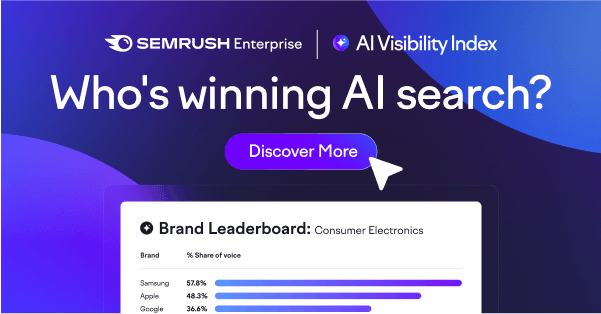
Patagonia is another top performer on the Semrush AI Visibility Index. Their strategy focuses on creating rich, structured customer data that agents crave. In their review forms, they prompt users to provide attributes like "height," "weight," and "primary activity." This turns a subjective review into a piece of structured entity data: "Durable hiking pants for a 5’10” person who does scrambling." When an agent is looking for a specific fit for a specific user, it can match Patagonia with a degree of confidence that a generic product description can never reach.
Structured Data: The Technical Bridge to Agentic Readiness
If Entity-Based SEO is the "what," Structured Data is the "how." It is the technical foundation for Agentic Search Optimization (ASO). While agents are increasingly capable of parsing visible page content, they still rely on Schema and structured paths as a "verification layer" to catalog entities and their relationships.
Critical Schema Types for ASO
To improve your agentic readiness, you must prioritize Schema that describes your business’s core capabilities:
Product Schema: Declare not just the name, but the SKU, availability, price, and specific attributes (color, size, material).
LocalBusiness and Restaurant Schema: Essential for "transactable" local intent, providing the coordinates, hours, and contact details that an agent needs to stage a booking.
Organization Schema: This provides the administrative "Proof of Life" that agents use to verify the legitimacy of a business.
The Semantic HTML Baseline: The Strategy of "Least Friction"
One of the most critical, yet un-glamorous, requirements for agentic visibility is the Semantic HTML Baseline. Modern AI agents don't just read code; they often navigate via "accessibility trees" or by taking screenshots of the page and using visual coordinate systems. To ensure an agent can interact with your site, you must prioritize:
Server-Rendered Content: Agents often struggle with heavy client-side JavaScript. If your price only appears after three seconds of JS execution, the agent may record it as "not found."
Clean, Standardized HTML: Use proper <button> and <a> tags. If you use a <div> with an "onClick" handler for a primary action, an agent might not recognize it as an actionable tool.
Stable Layouts: Avoid layout shifts. If an agent is attempting to "click" a button based on a visual coordinate and the page jumps, the action fails.
In the delegate economy, the path of least friction wins. If Brand A and Brand B are equal in quality, but Brand A’s site is easier for a machine to parse and navigate, the agent will choose Brand A every single time.
The Pillars of Brand Visibility: Discovery, Clarity, Authority, and Trust
We use a four-pillar framework to diagnose a brand’s readiness for the agentic web. These pillars are not sequential; they are a diagnostic grid that shows where your visibility is failing.
Pillar 1: Brand Discovery (The Baseline)
Discovery answers the question: "Can the agent find you?" This is driven by technical SEO hygiene. If your robots.txt file is blocking AI crawlers, you have zero visibility. Semrush research indicates that sites with a high technical health score and clear page-level authority signals are 4.4x more likely to be cited in AI-generated answers. Discovery is about being in the agent’s "shortlist" during the initial RAG retrieval.
Pillar 2: Brand Clarity (The Representation)
Clarity answers the question: "Does the agent understand you correctly?" This requires consistency across first-party and third-party sources. If your website says one thing and your LinkedIn or YouTube channel says another, you have a clarity gap. Agents pull from multiple sources to build a summary. When sources agree, the agent represents you accurately. When they disagree, you are represented with "low confidence," which often leads to exclusion.
Pillar 3: Brand Authority (The Validation)
Authority answers the question: "Why should the agent choose you?" This is defined by validation from independent, third-party sources. Clarity is what you say about yourself; Authority is what the world says about you. Agents look for your brand on Reddit, G2, industry publications, and Wikipedia. Semrush data shows that including citations and statistics in your content can boost your AI visibility by over 40% because it provides the agent with the "proof" it needs to back up a recommendation.
Pillar 4: Brand Trust (The Threshold for Action)
Trust is the decisive threshold for delegated action. When an agent is asked to spend a user's money, it runs a high-stakes calculus. It evaluates sentiment, cross-source corroboration, and historical reliability. Trust is what gives the agent "permission" to move from recommending you to transacting with you. If an agent encounters negative sentiment on forums or cannot verify your physical location, it will skip the "Delegated Action" step to protect the user's resources.
Strategic Implementation with Semrush One
Semrush One is the only platform designed to bridge the gap between traditional SEO and the emerging demands of agentic discovery. It provides a technical manual for the strategist to optimize for both humans and machines.
Technical Audit for AI Search Health
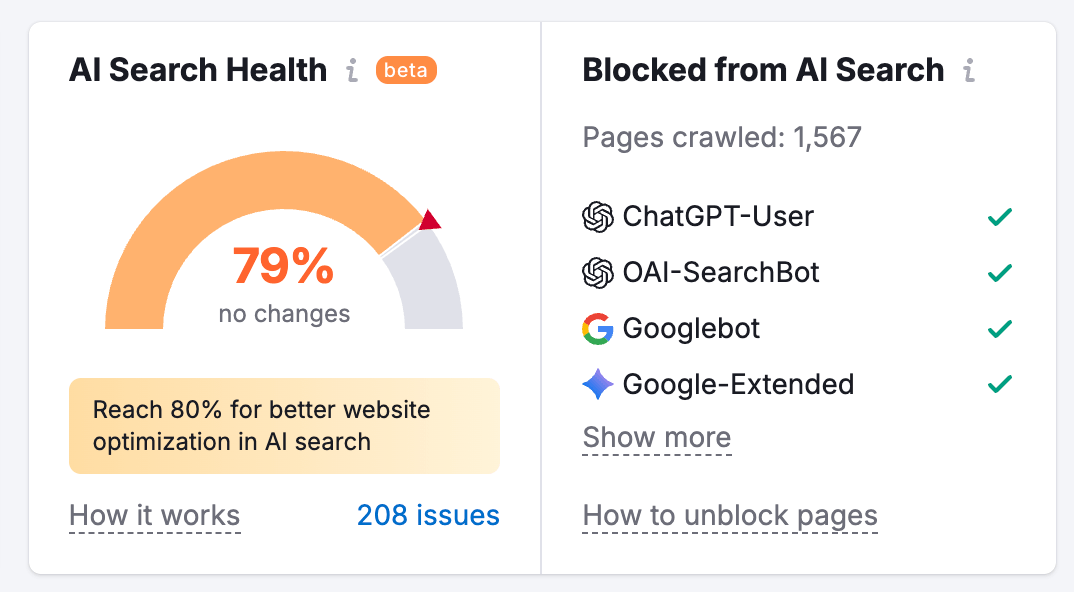
Within the Site Audit tool, you must prioritize the "AI Search Health" score.
Blocked from AI Search: Monitor the dedicated widget to ensure you aren't inadvertently restricting GPTBot, ClaudeBot, or OAI-SearchBot.
Remediation Grit: Look for specific issues like "links with no anchor text" or "llms.txt not found." An llms.txt file is a new standard that provides a "cheat sheet" for agents to understand your site's most important content. Site Audit will flag if this is missing.
Analyzing Bot Behavior in the Logs
The Log File Analyzer is your window into the agentic world.
Filter for AI User-Agents: Specifically look for GPTBot and ClaudeBot. Are they hitting your "transactable" pages (pricing, contact, demo)?
Success vs. Failure: If these bots are encountering 4xx errors on your key entity pages, you are effectively invisible to those platforms. Use this data to prioritize server-side fixes.
Optimization for Machine Readability
Use the On-Page SEO Checker to ensure your content structure supports "question-and-answer" extraction.
H2/H3 Headers: These should mirror the questions your audience asks. Use the "Questions" tab in the Keyword Magic Tool to identify these.
Direct Answers: Place a clear, concise answer immediately following a question-based header. This makes it easy for an agent to "extract and cite" without high processing costs.
Monitoring AI Visibility
The AI Visibility Toolkit is the cornerstone of your ASO strategy.
AI Visibility Score: Benchmark your brand (like the 82/100 score for Salesforce) against your top three competitors.
Cited Pages Report: Identify which specific URLs are being used by ChatGPT, Perplexity, and Gemini. If your key product pages aren't appearing, you have an authority or clarity gap that needs immediate investment in off-site mentions.
Answer Engine Optimization (AEO) vs. Agentic Search Optimization (ASO)
It is critical to distinguish between these two disciplines to allocate budget correctly.
Answer Engine Optimization (AEO)
AEO is about being mentioned. It is the process of getting your brand cited in a synthesized answer, like a Google AI Overview or a Perplexity response. It is primarily about visibility.
Best Practices: Target question-based queries and demonstrate E-E-A-T (Experience, Expertise, Authoritativeness, and Trustworthiness). Pages with a clear "last updated" timestamp receive 1.8x more citations than those without one.
Agentic Search Optimization (ASO)
ASO is about being chosen. It is a broader discipline that encompasses the entire lifecycle of an agent’s behavior, from research to commerce. ASO requires your site to be not just citable, but "callable" and "transactable."
The ROI of ASO: Semrush data reveals that AI search visitors are 4.4x more valuable than traditional search visitors. Why? Because the agent has already handled the research and comparison stages. By the time the user clicks through or approves the agent's action, they are pre-qualified and ready to convert.
The Infrastructure of the Future: WebMCP and UCP
The technical standards of the web are shifting to accommodate the 1,300% growth in agentic traffic. Brands that ignore these protocols will find themselves behind a "technical wall" within the next 24 months.
Model Context Protocol (MCP) and WebMCP
Created by Anthropic and backed by the W3C, Google, and Microsoft, WebMCP allows your website to declare its "capabilities" as structured, callable tools. Instead of an agent scraping your page and guessing what a "Book Now" button does, your site "tells" the agent how to interact with that function programmatically.
Universal Commerce Protocol (UCP)
UCP is the standard for agent-mediated shopping. Co-developed with Shopify, Etsy, Target, and Walmart, and backed by Visa, Mastercard, and Stripe, UCP ensures that product information, availability, and payment protocols are standardized across the agentic web. This is what allows an agent to "stage" a transaction with 100% confidence in the price and shipping terms.
The Agentic AI Foundation (AAIF)
These standards are governed by the AAIF, a consortium of the world's leading AI companies. This institutional weight confirms that the move toward a machine-readable web is not a fad, it is the new architectural baseline.
Measuring Success in the Age of Agents
As traditional "rankings" become less predictive of revenue, we must adopt new success metrics that reflect our standing in the delegate economy.
AI Visibility Score: This 0-100 score should be your primary KPI for brand health in the AI era. It reflects your share of voice across ChatGPT, Perplexity, Gemini, and Google AI Mode.
Cited Pages Metric: Monitor which URLs are being pulled into context windows. If your high-margin products aren't being cited, you have a structural problem in your content delivery.
Branded Search Volume: Use Google Search Console to track branded queries. When an agent mentions your brand, users often perform a "validation search" to see your site for themselves. An increase in branded search is a leading indicator that your ASO efforts are working.
Agentic Conversion Rate: Track the conversion value of traffic coming from AI agents. As noted, these visitors are 4.4x more valuable, and your analytics should reflect this premium.
Conclusion: Turning Agentic Search into a Competitive Advantage
The "Delegate Economy" is the most significant shift in digital marketing since the transition to mobile-first indexing. As AI agents take on the roles of researcher, evaluator, and purchaser, the brands that win will be those that are findable, understandable, and transactable.
Agentic Search Optimization is not a replacement for traditional SEO; it is its logical conclusion. The hygiene we have practiced for years, clean code, clear structure, and authoritative content, is now being tested by the most demanding audience we have ever faced: non-human agents with the power to divert or deliver millions in revenue.
By using Semrush One to audit your technical AI health, monitor your AI visibility, and align your entity data across the web, you can ensure that your brand isn't just an answer in a text box, but the chosen solution for the agentic web. The time to build your machine-readable identity is now. Those who wait for the standards to "settle" will find that the agents have already moved on to the competitors who were ready to be delegated to.



Created with © Systeme.io
Disclaimer: This page contains affiliate links. If you purchase through these links, we may earn a commission
at no extra cost to you. We only recommend tools we trust.