Semrush vs Ahrefs: Which SEO Tool Reigns Supreme?
Semrush vs Ahrefs: Which SEO Tool Reigns Supreme?
Introduction: The SEO Landscape of 2026
In 2026, the digital marketing ecosystem has moved past the era of simple keyword density and backlink counts. We are operating in a reality defined by Search Generative Experience (SGE), AI-driven answer engines, and a hyper-fragmented user journey. For the CMO or agency lead, the choice of an SEO platform is no longer a tactical decision, it is a strategic investment in a data moat. Choosing the wrong tool doesn't just result in missed rankings; it results in a fundamental misunderstanding of how your brand is perceived by the Large Language Models (LLMs) that now dictate consumer behavior.
For over a decade, the industry has been locked in a duopoly. On one side, we have Semrush, the undisputed "all-in-one marketing suite" that has expanded its reach into every facet of digital visibility, from PPC and social media to pioneering the tracking of brand sentiment within AI chatbots. On the other side is Ahrefs, the "backlink-specialist-turned-competitor" that built the industry’s gold standard for link analysis and has since attempted to scale its technical SEO and keyword research capabilities to match its rival.
The purpose of this guide is to move beyond surface-level feature lists. We will analyze these platforms through the lens of performance data, database size, and, most importantly, strategic ROI. Whether you are managing a boutique agency’s profit margins or an enterprise’s multi-channel growth, this side-by-side comparison will determine which tool is equipped to fuel your next big win in the age of AI.
At a Glance: Feature Comparison Matrix
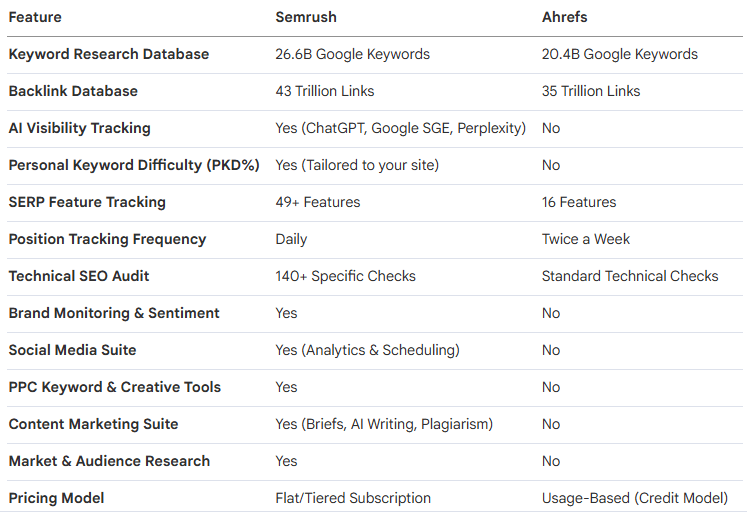
The following matrix represents the state of the art in 2026. Note the stark divergence in capabilities as we move beyond traditional SEO into brand monitoring and AI visibility.
Deep Dive: Keyword Research and Analysis
Database Supremacy: The Power of 26.6 Billion
In the zero-click SERP environment of 2026, finding high-volume keywords is easy; finding the profitable long-tail clusters that AI engines haven't yet monopolized is the real challenge. Data volume is the fundamental bedrock of this insight. Semrush currently leads the market with a staggering 26.6 billion Google keywords. Ahrefs maintains a robust, yet significantly smaller, database of 20.4 billion.
For an enterprise-level strategist, that 6.2-billion-keyword gap represents untapped market share. When we tested the head-term "Semrush" across both platforms, the results were telling: Semrush generated 9,438 related keywords, while Ahrefs returned only 4,440. This 112% increase in data richness allows for more nuanced content mapping and the identification of "low-hanging fruit" that competitors using smaller databases will simply never see.
Metric Granularity and Intent Intelligence
Semrush doesn't just provide volume; it provides context. In 2026, understanding Search Intent (Informational, Navigational, Commercial, Transactional) is the difference between a high bounce rate and a conversion. Semrush integrates intent analysis directly into its primary workflow, alongside Global Volume, CPC, and Competitive Density.
Ahrefs remains focused on its proprietary Keyword Difficulty (KD), Volume, and Clicks. While these are useful for quick checks, they lack the multi-dimensional depth required for complex campaign planning. Ahrefs provides related questions, which is helpful for "People Also Ask" optimization, but it fails to provide the same level of holistic overview that defines the Semrush experience.
The Game Changer: Personal Keyword Difficulty (PKD%)
One of the most significant strategic additions in 2026 is Semrush’s Personal Keyword Difficulty (PKD%). Standard KD scores are generic; they tell you how hard a keyword is for anyone to rank for. PKD% is tailored specifically to your website’s existing authority, content depth, and backlink profile. This allows SEO directors to allocate budget with surgical precision, targeting keywords where their specific site has a high probability of success rather than chasing unattainable high-volume terms.
Automated Clustering: Reducing Manual Labor
For a boutique agency, manual keyword clustering is a productivity killer. Semrush’s ability to automatically cluster keywords into logical themes and topical pillars saves dozens of manual labor hours per project. This isn't just a convenience, it is a direct boost to your agency’s profit margins, allowing you to move from research to execution in minutes rather than days.
The Battle of the Backlinks: Quality and Quantity
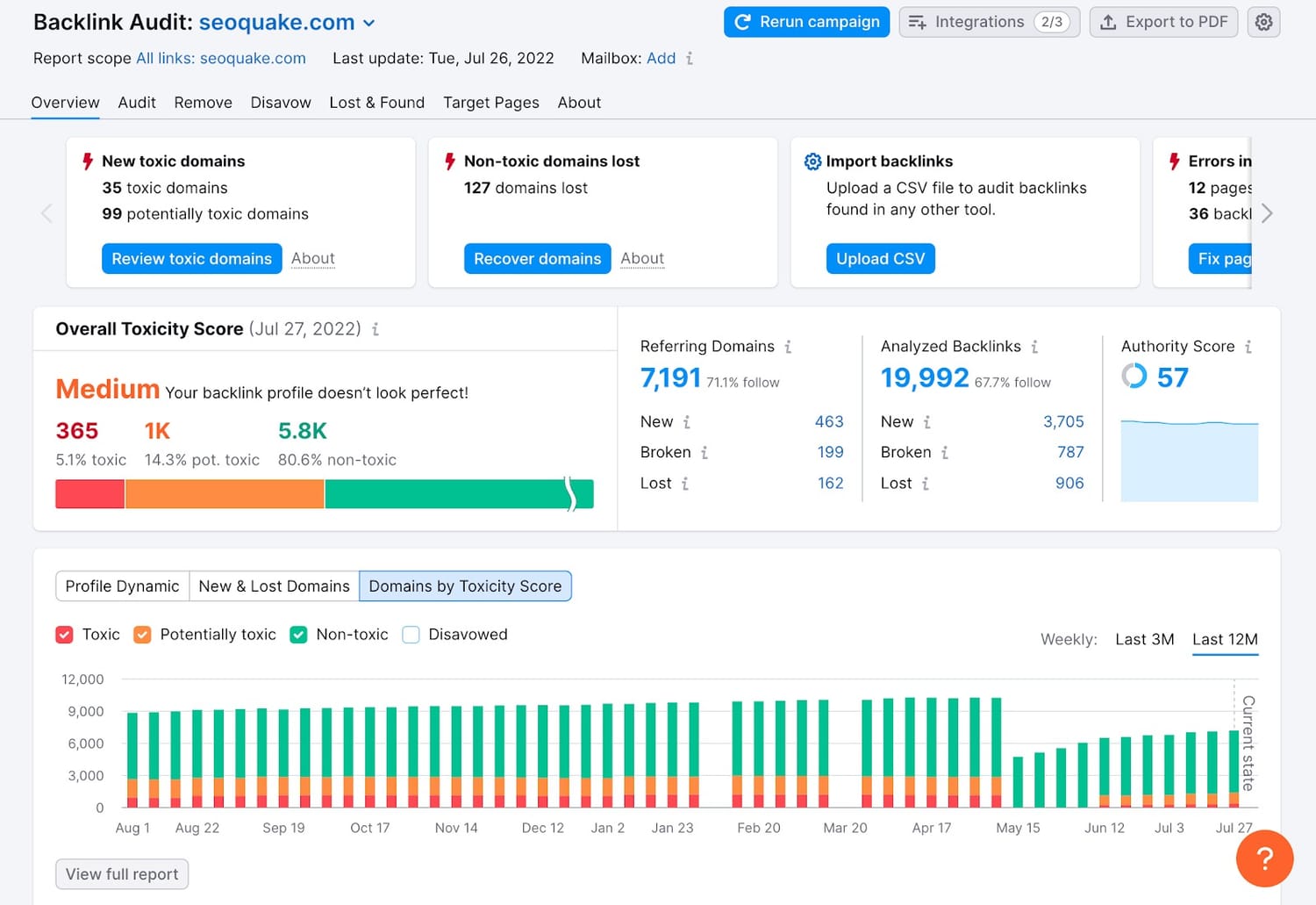
Analyzing the Trillions
For years, Ahrefs was the undisputed king of the backlink. However, the 2026 landscape shows that Semrush has not only caught up but, in terms of raw scale, has overtaken its rival.
Semrush: 43 trillion links.
Ahrefs: 35 trillion links.
Quantity, however, must be met with quality. When we ran a live analysis of a competitive domain, Semrush identified 2.2 million backlinks across 68.5k referring domains. Ahrefs identified 2.1 million backlinks across 65.4k referring domains. The margin is slim, indicating that both tools are now performing at the highest tier of crawling efficiency.
Functionality and User Experience
Ahrefs’ origins as a dedicated backlink checker are still visible in its streamlined, highly intuitive interface. For a specialist whose entire day is spent in "Site Explorer," Ahrefs offers a cleaner, more focused experience. It is arguably easier to navigate for quick backlink audits.
Semrush, conversely, offers a "better and deeper" analysis. It integrates link building directly into an outreach CRM, allowing you to find backlink gaps (where your competitors have links but you don't) and immediately launch an email campaign to those prospects without leaving the platform. This workflow integration is where Semrush provides superior ROI for growth-focused teams.
Technical SEO and Site Auditing
140+ Checkpoints of Site Health
Technical SEO is the infrastructure upon which all other efforts are built. A site that cannot be crawled cannot rank. Semrush’s Site Audit tool is arguably the most comprehensive on the market, performing over 140 specific SEO checks.
These checks cover:
Crawlability and Indexability: Identifying "orphan" pages and robots.txt conflicts.
Core Web Vitals: Direct integration of Google's performance metrics.
Security: Scanning for HTTPS implementation errors.
International SEO: Hreflang tag verification for global enterprises.
The Health Score Discrepancy
In our audit of comtechies.com, Semrush returned a health score of 79%, while Ahrefs gave the site an 85%. To a CMO, the Ahrefs score might look "better," but the strategist knows that the lower Semrush score is often a result of more rigorous, granular checking. Semrush identifies issues that Ahrefs occasionally overlooks, providing clear, step-by-step guidance on how to fix each problem.
Advanced Technical Features
Ahrefs has countered with its "Structure Explorer," a powerful visual tool that allows you to see how your site’s folders and subdomains are performing. This is excellent for deep page analysis and improving site architecture. However, Semrush's holistic reporting and its ability to track technical "log file analysis" and "JavaScript rendering" issues give it the edge for enterprise-level technical deployments.
Position Tracking and SERP Presence
Daily Granularity vs. Bi-Weekly Updates
In a volatile market, data that is three days old is obsolete.
Semrush: Provides daily ranking updates as standard.
Ahrefs: Updates rankings twice a week.
If you are managing a high-stakes launch or reacting to a Google Core Algorithm update, you cannot wait three days to see the impact. Semrush’s daily updates allow for real-time agility, enabling you to pivot strategies immediately when volatility hits.
The 2026 Frontier: The AI Visibility Toolkit
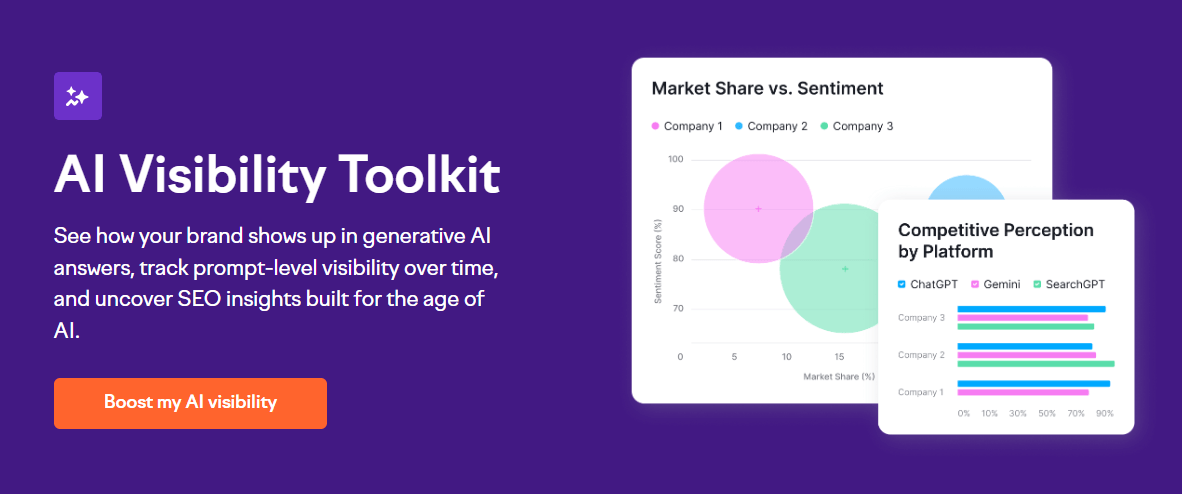
The most critical differentiator in 2026 is visibility in the "Answer Engine" landscape. As search becomes more conversational, brands need to know if they are being cited by AI. Semrush’s AI Visibility Toolkit is the only solution in this comparison that allows you to:
Track brand mentions within ChatGPT, Google SGE, and Perplexity.
Analyze brand sentiment across AI-generated responses.
Benchmark your AI visibility against competitors.
Ahrefs, at this time, remains focused on traditional SERP rankings. For a brand looking to "future-proof" its presence, the lack of AI tracking is a significant strategic risk.
SERP Feature Dominance
The modern search page is no longer just ten blue links. It is a mosaic of Featured Snippets, Video Carousels, Local Packs, and Indented Links. Semrush tracks 49+ SERP features, giving you a complete picture of your "pixel real estate." Ahrefs tracks only 16. If your strategy relies on capturing Featured Snippets to drive zero-click authority, Semrush is the only tool that provides the necessary tracking depth.
Beyond SEO: The "All-in-One" Advantage
The most compelling argument for Semrush is its role as a centralized marketing operating system. While Ahrefs focuses on search, Semrush provides a 360-degree view of the digital landscape.
Content Marketing Ecosystem
The Semrush Content Toolkit replaces three or four separate subscriptions. It includes:
Topic Finder: Identifying what your audience is actually searching for in real-time.
Content Brief Generator: Automatically creating SEO instructions for writers based on top-ranking competitors.
AI Article Generator & Content Optimizer: Speeding up the drafting process while ensuring technical SEO compliance.
Plagiarism Checker: Ensuring original content to protect your brand's integrity.
Social Media and PPC Integration
For many agencies, the ability to manage Social Media Analytics and Post Scheduling within the same tool as their SEO data is a major efficiency gain. Furthermore, Semrush’s Advertising Toolkit is a powerhouse for PPC. It offers competitor ad campaign analysis, PLA (Product Listing Ads) research, and an AI-powered ad creative generator. As Brian Dean, Founder of Backlinko, famously noted: "When it comes to pure value, Semrush wins... you get a fully-featured SEO software suite AND Google Ads software for the same monthly price."
Pricing, Value, and Complexity
The Price of Entry
Semrush: The SEO Toolkit starts at $139.95 per month. This provides a comprehensive suite of tools with predictable monthly costs.
Ahrefs: Offers a "Starter" plan at $29 per month, with main subscriptions starting at $129 per month.
The Usage-Based Model: A Budgeting Nightmare
In 2022, Ahrefs introduced a usage-based pricing model that remains one of the most controversial shifts in the industry. Instead of unlimited access within a tier, users are charged based on "credits" and specific data usage.
For an enterprise agency or a high-volume user, this model is a budgeting nightmare. It is difficult to predict monthly costs when every click in the "Site Explorer" could potentially trigger an additional charge. This "pay-as-you-go" approach can quickly become significantly more expensive than Semrush's flat-rate tiered model, effectively punishing power users for being thorough.
ROI and Total Value
When you factor in that Semrush includes social media tools, PPC research, market research, and the AI Visibility Toolkit, the "pure value" proposition leans heavily toward Semrush. You aren't just buying an SEO tool; you are consolidating your marketing tech stack, which reduces tool fatigue and centralizes your data reporting.
Frequently Asked Questions
1. What Are the Key Differences Between Semrush and Ahrefs?
The primary difference lies in their scope: Semrush is an all-in-one marketing suite that covers AI visibility, SEO, social media, PPC, and content marketing, whereas Ahrefs focuses more heavily on backlinks and rankings, though it is expanding into other areas.
Key technical differences include:
Data Volume: Semrush maintains a larger database with 26.6 billion Google keywords and 43 trillion links, compared to Ahrefs' 20.4 billion keywords and 35 trillion links.
Update Frequency: Semrush updates keyword positions daily, while Ahrefs typically updates them twice a week.
Feature Availability: Semrush includes tools for brand monitoring, social media tracking, and PPC research, which are currently absent in Ahrefs.
2. When Should You Use Semrush Over Ahrefs?
You should opt for Semrush when your strategy requires a 360-degree view of digital marketing beyond just organic search. Specifically, Semrush is the better choice when:
Daily Tracking is Critical: You need to monitor keyword fluctuations every day rather than twice a week.
Running PPC Campaigns: You require specialized tools for PPC keyword research and ad campaign analysis.
Managing Social Media: You want to schedule posts and track social performance within your SEO platform.
Focusing on Content Marketing: You need built-in tools like a plagiarism checker, content brief generator, or topic finder.
3. Why Choose Semrush Instead of Ahrefs?
Marketers often choose Semrush for its comprehensive value; it provides both SEO and Google Ads software for a single monthly price. It is also favored for its AI visibility tracking, allowing users to see how their brand appears in AI-generated responses like ChatGPT, Google, and Perplexity. Additionally, Semrush is often cited as being more effective for technical SEO audits, offering over 140 checks and clear guidance on how to fix issues.
4. Where Can You Find the Best Tools: Semrush or Ahrefs?
Both platforms are industry leaders, but the "best" tool depends on your specific needs:
Semrush is the superior choice for those seeking a growth-oriented platform that unifies SEO authority with AI visibility and market research.
Ahrefs is highly regarded for its ease of use, particularly in backlink analysis, as it originally launched as a dedicated backlink checker.
For keyword research, Semrush is often preferred because it tends to provide more keyword variations and deeper data on search intent and competitive density than Ahrefs.
5. How Do Semrush and Ahrefs Compare in SEO Analysis?
In direct SEO analysis, both tools are powerful but excel in different ways:
Keyword Research: In a direct comparison, Semrush identified over 9,000 keywords for a query where Ahrefs found roughly 4,400, providing a more comprehensive overview of metrics like search intent and global volume.
Backlink Analysis: While both are competitive, Semrush's database is larger. In test cases, Semrush analyzed slightly more backlinks (2.2M vs 2.1M) and referring domains than Ahrefs.
Site Audit: Semrush is noted for its high-quality Technical SEO features, identifying broken links, HTTPS issues, and site performance problems while providing a "health score" and actionable fixes.
Rank Tracking: Semrush is considered the winner in this category due to its daily updates and its ability to track a wider range of SERP features (49+ for Semrush vs. 16 for Ahrefs).
Final Verdict: Which Tool Wins in 2026?
The Case for Semrush: The Strategic Choice
Semrush is the winner for the marketer who plays to win in the total digital landscape. It dominates in database size, update frequency, and technical depth. Most importantly, it has recognized that 2026 is the year of AI visibility. Its ability to track brand mentions in ChatGPT and Perplexity makes it the only choice for forward-thinking CMOs who need to protect their brand’s "answer engine" share.
Choose Semrush if: You are an agency or in-house team managing multi-channel growth (SEO, PPC, Social, AI) and require daily data updates and a predictable pricing model.
The Case for Ahrefs: The Specialist Choice
Ahrefs remains a formidable tool for those whose work is strictly confined to the "mechanics" of backlinks and traditional search. Its user interface is exceptionally clean, and for those who prefer a specialized, narrower toolset, it remains a high-performance option.
Choose Ahrefs if: Your primary focus is backlink monitoring, you have a lower initial budget, and you do not require integrated social media, PPC, or AI visibility tracking.
The battle between Semrush and Ahrefs is ultimately a choice between a specialized scalpel and a comprehensive command center. In the 2026 search environment, where AI is rewriting the rules of engagement, we believe the command center approach offers the most sustainable competitive advantage.
What has your experience been with the Ahrefs usage-based model? Have you begun tracking your brand's visibility in AI search results? We invite you to share your strategic insights in the comments below.
If you are ready to experience the most powerful database in the industry, Semrush offers a 7-day free trial alongside a library of beginner-friendly tutorials to help you master the 140+ tools at your disposal.



Created with © Systeme.io
Disclaimer: This page contains affiliate links. If you purchase through these links, we may earn a commission
at no extra cost to you. We only recommend tools we trust.