How to Analyze Your Share of Voice vs. Semrush AI Visibility Score
How to Analyze Your Share of Voice vs. Semrush AI Visibility Score
Introduction: The New Frontier of Brand Discovery
The search landscape has shifted from a list of blue links to a paradigm of synthesized answers. As users migrate toward ChatGPT, Perplexity, Gemini, and Google’s AI Mode, the "Generative Gap", the space between being indexed and being recommended, has become the most significant risk to brand equity.
In this new ecosystem, traditional "ranking" is being superseded by "Visibility." It is no longer enough for your brand to exist on a page; it must be synthesized into the actual response generated by a Large Language Model (LLM). For senior marketing leaders, the challenge is moving from keyword monitoring to protecting brand authority. To lead this transition, you must master two fundamental metrics within the Semrush AI Visibility Toolkit: AI Visibility Score and Share of Voice (SoV).
Decoding the Metrics: AI Visibility Score vs. Share of Voice
While these metrics are often used interchangeably, a senior strategist must distinguish between a benchmark of presence and a measure of market dominance.
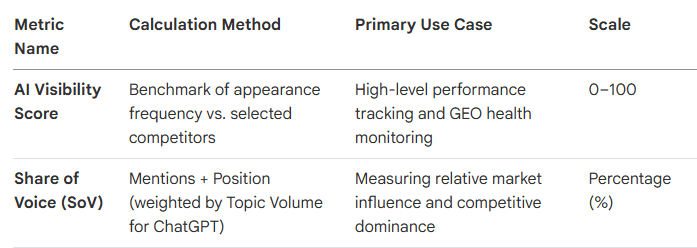
AI Visibility Score: This is your high-level "health check." It is a benchmark score (0–100) representing how often your brand appears in AI-generated answers compared to your selected competitors. It is the primary KPI for assessing whether your Generative Engine Optimization (GEO) efforts are successfully moving you into the LLM "inner circle."
Share of Voice (SoV): This is a granular measure of relative influence. Unlike traditional SEO SoV, AI SoV is calculated based on the number of mentions and the specific position of your brand within the response. For platforms like ChatGPT, this calculation is further weighted by topic search volume, providing a sophisticated view of your brand’s actual reach in the generative market.
Deep Dive: The AI Visibility Toolkit Architecture
Synthesizing a brand’s presence requires a multi-layered analytical approach. The Semrush toolkit is organized into five key reporting areas:
Visibility Overview: This benchmarks your overall presence and identifies "Topic Opportunities", strategic prompts where your competitors are currently being cited but your brand is absent.
Competitor Research: This report moves beyond your own domain to compare "Audience" reach. It identifies "Missing Sources", the external third-party sites that LLMs trust to validate your competitors.
Prompt Research: This helps in resource allocation by quantifying "AI Topic Volume" (how often a topic is queried) and "Topic Difficulty" (0-100%). This score estimates the competitive effort required to dislodge incumbent brands from AI responses.
Brand Performance: This is where you monitor "Narrative Drivers." It tracks the specific topics or sources responsible for shaping how an LLM summarizes your brand to a user.
Prompt Tracking: This monitors "Average Position" (e.g., are you the first or third citation?) and provides a "Visibility" percentage. In this context, a 100% Visibility score means your domain holds the first citation for all tracked prompts.
The Analytical Workflow: Measuring Your AI Presence
To move from data to strategy, follow this three-step workflow:
Step 1: Setting the Baseline: Initialize your analysis in the Brand Performance report by entering your domain, target location, and language. Accuracy here is vital, as LLM responses vary significantly by region.
Step 2: Platform Segmentation: Use the platform toggle to audit performance variance across ChatGPT, Google AI Mode, Gemini, and Perplexity. A brand may dominate in Perplexity's citation-heavy environment while remaining invisible in Gemini’s conversational summaries.
Step 3: Calculating Influence (Prioritization): Use the Monthly Audience metric to prioritize your GEO roadmap. Rather than chasing every mention, focus your content and PR efforts on topics with the highest estimated query volume to maximize actual brand exposure.
Pro Tip: Don't treat all platforms equally. Use the "Monthly Audience" metric to identify which AI engine is driving the most potential eyes to your brand narrative, then prioritize your technical fixes for that specific crawler.
Gap Analysis: Spotting What You’re Missing
The Competitor Research report is your primary tool for identifying "blind spots" in your authority.
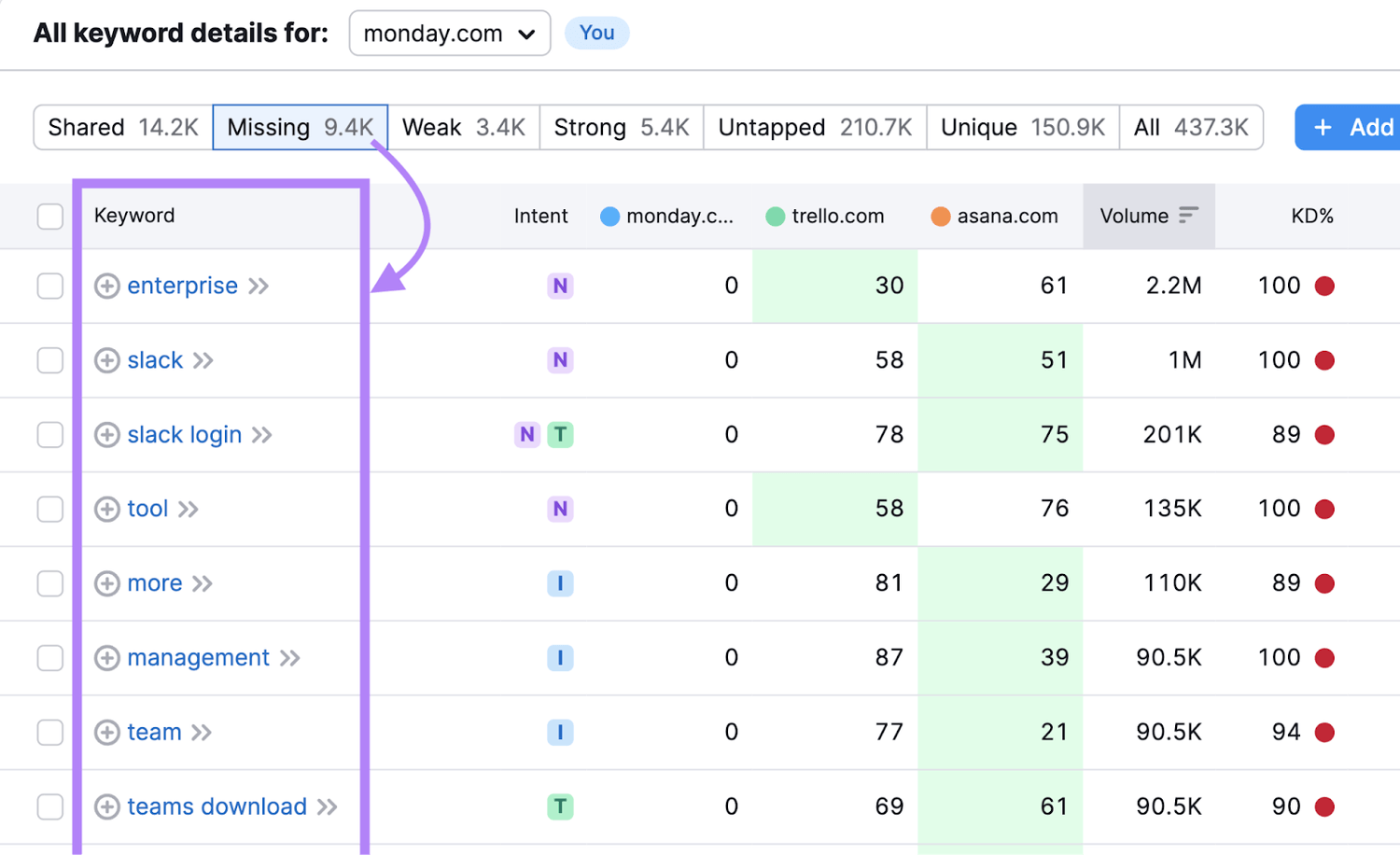
Topics & Prompts: Distinguish between Weak Topics (where you are mentioned less frequently than rivals) and Missing Topics (where you are entirely absent). Missing topics represent a total loss of brand influence for that specific user intent.
Sources Analysis: AI systems do not generate facts in a vacuum; they rely on "Trusted Sources." The toolkit categorizes these as:
Strong Sources: Sites where your brand leads the conversation.
Unique Sources: Platforms that mention only your brand.
Missing Sources: High-authority websites (review sites, forums, publications) that cite your rivals but not you. These are your primary PR targets.
Technical Readiness & The AI Search Site Audit
Visibility is contingent on crawlability. The AI Search Health score in the Site Audit tool summarizes your technical readiness.
To defend your position, you must execute the following:
Implement llms.txt: Provide a dedicated roadmap for LLM crawlers to identify your most important context and data.
Audit Anchor Text: LLMs use anchor text to understand relationship context. You must eliminate "empty or missing anchors" that strip context from links and replace vague "learn more" text with descriptive, keyword-rich anchors.
Structured Data Schema: Ensure your site uses robust structured data to help AI crawlers quickly parse your product features, pricing, and reviews.
Sentiment and Narrative Control
LLMs do not just report your existence; they characterize your brand. Within the Perception report, you can monitor "Key Sentiment Drivers", the themes that define your brand’s reputation in generative answers.
Consider the example of Monday.com: The Perception report might identify "ease of use" and "no-code automations" as positive narrative drivers. Conversely, it might flag a "steep learning curve" for custom setups as a negative driver. For a strategist, this is actionable intelligence: positive sentiment reinforces credibility, which increases the mathematical likelihood of the AI featuring the brand in future recommendations.
Strategic Growth: Improving Your Scores
To improve your AI Visibility Score and SoV, implement this three-pillar strategy:
Content Expansion: Map your editorial calendar to "Missing Topics." Create high-context, authoritative pages that answer the exact prompts where competitors are currently the sole source of truth.
Cross-Channel Authority: Use the "Missing Sources" list and prioritize them based on citation frequency. Focus your PR and backlink efforts on the specific external sites that AI engines cite most often for your category.
Narrative Correction: Use sentiment data to guide your support and product content. If AI characterizes your product as "expensive," create a value-comparison page that the AI can scrape to provide a more balanced summary.
Enterprise Considerations: Large-Scale Monitoring
For mid-to-large scale teams, Enterprise AIO provides the necessary depth for global brand management.
Historical Trend Tracking: This allows you to visualize how SoV fluctuates over months, identifying if an AI model update or a competitor's campaign has eroded your position.
Weighted Calculations: In Enterprise AIO, Share of Voice is calculated with higher precision, incorporating brand mentions, citation position, and, for ChatGPT, the topic’s actual search volume.
Shopping Metrics: It also includes metrics for ChatGPT Shopping, essential for retail brands looking to own the "Product Discovery" phase of the buyer journey.
FAQs
1. What Is the Semrush AI Visibility Score and Why Does It Matter?
The AI Visibility Score is a benchmark metric, ranging from 0 to 100, that measures how frequently your brand appears in AI-generated answers relative to your competitors. It is a critical metric because it allows you to:
Benchmark Presence: It provides an overall view of your brand's presence across AI platforms like ChatGPT, Gemini, and Google’s AI Mode.
Identify Growth Opportunities: The score helps spot "Topic Opportunities", prompts where your competitors are visible, but your brand is not.
Measure Technical Readiness: It is often tied to your AI Search Health, which reflects how well AI bots can crawl and interpret your site content.
2. How Does Share of Voice Impact Your Marketing Strategy?
AI Share of Voice (SoV) is the percentage of total mentions your brand receives in AI responses compared to the total for your market. It impacts your strategy by:
Indicating Influence: A higher SoV suggests your brand has more influence on prospective customers who use AI for research.
Validating Optimization Efforts: It serves as a direct indicator of whether your Generative Engine Optimization (GEO) and content updates are translating into a stronger presence.
Establishing Baselines: By tracking SoV over time, you can establish a performance benchmark to determine if your visibility is improving or declining relative to market shifts.
3. Why Should You Track Both AI Visibility Score and Share of Voice?
Tracking both metrics provides a 360-degree view of your brand’s performance in the AI landscape. While the AI Visibility Score acts as a health check for your overall reach and frequency, Share of Voice provides a competitive context by showing exactly how much of the "market conversation" you own. Together, they help you understand not just if you are appearing, but how dominant you are compared to others in your niche.
4. What Are the Differences Between Semrush AI Visibility Score and Share of Voice?
The primary differences lie in their calculation and scale:
Measurement Scale: AI Visibility is a benchmark score (0–100). Share of Voice is a percentage (%), where the total mentions across all brands in a category add up to 100%.
Calculation Factors: AI Visibility focuses on the frequency of mentions and estimated audience reach. Share of Voice considers the number of mentions and, in advanced tools like Enterprise AIO, it also factors in the position of the brand within the response and the topic’s search volume.
Focus: AI Visibility is often used to identify specific gaps (like missing topics or sources). SoV is primarily used to track market share and competitive dominance.
5. When Should You Focus on AI Visibility Score vs. Share of Voice?
Focus on AI Visibility Score when: You are in the discovery or optimization phase. It is best for identifying technical blockers, finding missing topics/prompts, and determining which external sources (like review sites or forums) you need to be featured in to improve your AI footprint.
Focus on Share of Voice when: You are in the monitoring or reporting phase. It is the ideal metric for proving ROI, comparing performance across different AI platforms (e.g., ChatGPT vs. Perplexity), and measuring the long-term success of your brand's narrative and authority in your industry.
Conclusion: Moving Beyond the Scoreboard
AI Share of Voice is a fluid metric. It reflects your brand’s authority in a landscape where "rankings" change with every model update. Consistent monitoring via the Prompt Tracking tool is required to protect your citations and respond to daily shifts in how LLMs synthesize your industry.
The goal is to move from being a brand that is "found" to a brand that is "recommended." By treating GEO as a core strategic pillar, you ensure your organization doesn't just survive the shift to AI discovery but dominates it.
Pro Tip: For enterprise reporting, connect your GA4 data to "My Reports." Use the "AI Referral Traffic" filters to measure how your improvements in AI Visibility Score and SoV correlate to actual sessions and conversions. Protecting your position in ChatGPT is only valuable if it moves the needle on the bottom line.



Created with © Systeme.io
Disclaimer: This page contains affiliate links. If you purchase through these links, we may earn a commission
at no extra cost to you. We only recommend tools we trust.