AI Visibility Strategy for SaaS Companies: Win In The AI Search
AI Visibility Strategy for SaaS Companies: Win In The AI Search
The Dawn of the Generative Search Era
For the better part of two decades, the SaaS growth playbook was synonymous with one name: Google. We obsessed over keywords, backlink profiles, and SERP positions. We built entire departments around the art of climbing from position four to position one. But the landscape has shifted beneath our feet. We have officially moved past the era of the "list of blue links" and entered the Generative Search Era.
Today’s buyers are no longer just "Googling" their problems; they are chatting with them. Whether it’s through ChatGPT, Claude, Gemini, or Google’s own AI Overviews (AIO), the buyer's journey now begins, and often ends, within an AI-generated interface. This isn't a niche trend for early adopters or tech enthusiasts. Recent data indicates a seismic shift in consumer behavior: 71.5% of U.S. consumers are already using AI tools for at least some of their searches.
In this new reality, the traditional metric of organic rank is being joined by a more critical, nuanced KPI: AI Visibility.
AI Visibility is defined as the frequency and quality of brand mentions, citations, and recommendations within Large Language Model (LLM) responses.
It is the measure of how often an AI assistant chooses to include your SaaS product in its "shortlist" when a user asks for a recommendation or a solution to a specific pain point. If you aren't visible in these models, you are effectively invisible to a massive and growing segment of your target market. As a growth strategist, I see this as the ultimate "zero-click" challenge: how do you win the narrative when the user never even visits a search engine results page?
Why AI Visibility is the New North Star for SaaS Growth
For SaaS companies, where the competition is fierce and the "Winner Takes Most" dynamic is real, AI Visibility is not just a marketing vanity metric. It is a fundamental business necessity that impacts the entire funnel, from top-of-mind awareness to the final procurement decision.
The "Shortlist" Exclusion Risk
When a user asks an AI, "What is the best project management tool for a mid-market manufacturing firm with a remote engineering team?" the AI synthesizes millions of data points to provide a curated list of three or four options. It explains why these tools fit the specific use case. If your brand is left out of that response, you are excluded from the buyer's consideration set before they even visit a single website. In a traditional search, you might be result #6 and still get a click. In an AI response, if you aren't in the synthesis, you don't exist.
The Conversion Multiplier
The business case for prioritizing AI Visibility is backed by staggering performance data that should make every CMO take notice. Research shows that AI search visitors convert 4.4x better
than traditional organic search visitors.
Why the massive delta? It comes down to the quality of the lead. A traditional searcher might land on your blog post through a broad keyword, still early in the "what is this?" phase. An AI search user, however, has already had their specific needs matched to your features by a neutral, authoritative assistant. They arrive at your site "pre-sold", more informed, having already seen your brand validated and recommended by an LLM they trust. They aren't looking for information; they are looking for a demo.
The 2027 Horizon
We are looking at a permanent shift in how value is distributed online. It is projected that by 2027, LLM channels will drive as much business value as traditional search. Shortly thereafter, they are expected to surpass it. For SaaS leaders, the choice is clear: adapt your strategy today to ensure AI discovery, or risk losing your market share to competitors who are already optimizing for the generative era. This is a first-mover advantage play; the models are training on today's data to decide who to recommend tomorrow.
AI Visibility vs. Traditional SEO: Understanding the Delta
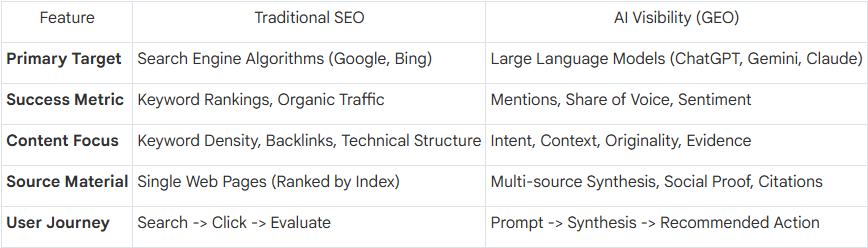
While traditional SEO and AI Visibility (often called Generative Engine Optimization or GEO) share some foundational DNA, the strategies required to succeed in each are distinct. Traditional SEO is about pleasing an algorithm that ranks pages based on popularity and technical signals; AI Visibility is about influencing a model that synthesizes information based on intent and context.
One of the most disruptive findings in recent months comes from researcher Kevin Indig, who noted a massive "delta" in how AI chooses its sources. His study found that the top 10% of most cited pages across AI platforms have significantly less traffic, rank for fewer keywords, and earn fewer total backlinks than traditional SEO winners. This turns the old playbook on its head: you don't need to be the biggest site on the web to be the most visible in AI. You need to be the most authoritative for the specific query.
The Hybrid Reality
Despite these differences, traditional SEO is not "dead", it has evolved into a prerequisite. Google’s AI Overviews, for example, are inextricably linked to traditional search results. Our research shows that AI Overviews frequently include links from the top 10 organic results. Specifically, the #1 organic result appears in 46% of desktop AI Overviews and 34% of mobile
AI Overviews.
This means that while you must optimize for the "synthesis" (the way the AI talks about you), you cannot ignore the "index" (the way Google finds you). A hybrid strategy that maintains technical SEO health while leaning heavily into generative authority is the only path forward for modern SaaS growth.
The 5 Pillars of LLM Ranking Factors
How does an LLM decide which SaaS brands to mention? While the "black box" of model training is complex, five key pillars have emerged as the primary drivers of visibility in the generative landscape.
1. Brand Mentions & Authority
There is a direct correlation between how often your brand is discussed across the broader web and how often an AI recommends you. If your brand is frequently mentioned in industry newsletters, podcasts, and trade journals, the LLM "notices." Studies show that brand search volume is the second strongest predictor of AI mentions. If users are searching for you by name on Google, LLMs view you as a high-authority entity worth citing.
2. Content Quality & Expertise
LLMs prioritize sources they perceive as trustworthy and authoritative. This is where "E-E-A-T" (Experience, Expertise, Authoritativeness, and Trustworthiness) becomes tactical. Content that demonstrates real-world experience, such as an engineer explaining a specific API integration or a Founder discussing a failed pivot, is significantly more likely to be used as a source. AI tools prioritize sources that offer "uniquely valuable" insights rather than recycled listicles.
3. Citations & Statistics
Data is the lifeblood of LLM synthesis. LLMs are built to predict the next logical token, and they "prefer" to back up claims with evidence to avoid hallucinations. Adding well-sourced quotes, original statistics, or unique citations to your content can boost visibility in AI results by up to 40%. By providing the "facts" the AI needs to answer a prompt, you move from being a competitor to being an indispensable source.
4. Structured Data (Schema)
Using schema markup (such as FAQPage, Product, or HowTo) acts as a technical roadmap for LLMs. It helps models parse your content accurately and understand the context of your data. Microsoft has explicitly confirmed that using schema markup helps its LLMs (like those powering Bing Chat and Copilot) better understand and cite content. For SaaS, this means marking up your pricing, features, and documentation to ensure the AI describes your product correctly.
5. Content Freshness & RAG
Many modern LLMs use Retrieval-Augmented Generation (RAG). Unlike older models that were "frozen" in time based on their training data, RAG allows models like GPT-4 and Claude to pull in the most up-to-date information from the web at the moment a user asks a question. Ensuring your content contains recent "last-modified" headers and frequently updated data signals to the AI that your information is the most relevant for trending or time-sensitive SaaS topics.
Measuring Your Baseline: A Two-Pronged Audit
You cannot optimize what you do not measure. For a SaaS company to succeed in the AI era, it must perform a comprehensive audit that looks at both manual qualitative feedback and automated quantitative data.
Phase 1: Manual Analysis (The Pulse Check)
The first step is a "pulse check" using direct prompts. Identify the core questions your target audience asks during the discovery phase and enter them into ChatGPT, Gemini, and Perplexity.
Prompt Examples: "What are the best [Category] tools for [Specific Use Case] in 2025?" or "Compare [Your Brand] vs [Competitor] for [Specific Workflow]."
Evaluation Criteria:
Mentions: Is your brand included in the text?
Citations: Are you directly linked as a source?
Perception: Is the reference positive, neutral, or negative?
Narrative: Does the AI accurately describe your core value proposition, or is it using outdated information?
Phase 2: Automated Intelligence with Semrush
For a scalable, data-driven view, you need a specialized toolkit. The Semrush AI Visibility Toolkit is the industry standard for this analysis.
The Visibility Overview Report
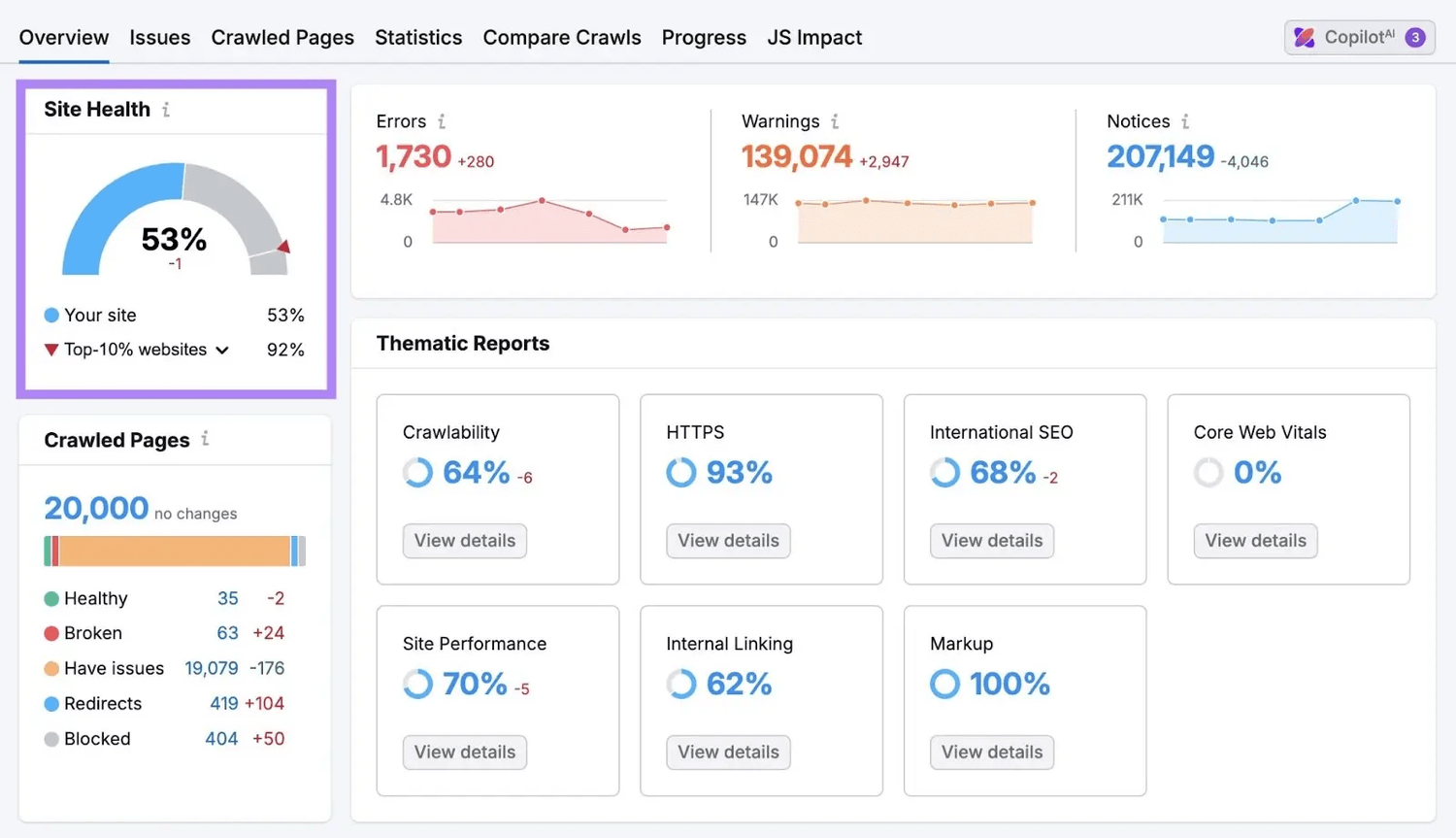
This is where you get your AI Visibility Score, a metric on a scale of 0 to 100. This score reflects how often your brand is mentioned in AI-generated answers compared to the median number of mentions for your top industry competitors. It provides an immediate benchmark of your "Share of Voice."
The Competitor Research Report
Enter your domain and up to four competitors. This report identifies Topic & Prompt Gaps, specific questions where your rivals are getting cited but you are absent. For a SaaS strategist, this is a roadmap of exactly what content needs to be created next to steal visibility.
The Prompt Research Report
Think of this as keyword research for the AI era. It allows you to see AI Topic Volume, difficulty, and Intent. Crucially, it reveals the specific questions users ask AI about your industry. Since 70% of AI queries don't match traditional search patterns, this report is essential for uncovering the conversational "long-tail" of your market.
The "GEO" Playbook: Strategic Actions for SaaS Dominance
Increasing your share of voice in AI responses requires a proactive Generative Engine Optimization (GEO) strategy that moves beyond the website.
Strategy 1: Grow Authority via the "Third-Party Loop"
LLMs do not just crawl your website; they look for social proof and external validation.
The Wikipedia Factor: ChatGPT pulls nearly 48% of its citations from Wikipedia. If your brand isn't notable enough for an entry, focus on getting mentioned on pages related to your category or industry pioneers.
The Reddit Connection: Reddit is a primary source for Perplexity (46.7% of citations) and Google AI Overviews (21%). To win here, your team must engage in subreddits like r/SaaS or r/ProductManagement. Don't spam; provide high-value, technical answers that include your brand name. LLMs aggregate these "human" conversations to determine sentiment.
SME Empowerment (The 5-Step Social Proof Workflow):
Extract: Have your lead engineer or Product Head record a 10-minute voice memo on a complex industry problem.
Transcribe & Polish: Convert this into a high-authority "contrarian" opinion piece.
Distribute: Publish on LinkedIn and high-authority industry publications (where AI bots crawl for expertise).
Seed: Mention the findings in relevant Reddit threads or developer forums.
Monitor: Track if LLMs begin using these "unique takes" as the definitive answer for related prompts.
Strategy 2: Identify High-Intent LLM Queries
As mentioned, 70% of ChatGPT queries require new search intent categories. Users aren't searching "best CRM"; they are prompting "How can I automate lead scoring for a small SaaS team with limited dev resources?"
Action: Use the Prompt Research Report to find these complex workflows. Create "Product-Led Content" that walks through these specific solutions. When you answer a complex prompt directly, you become the AI's preferred "source of truth."
Strategy 3: Create Original "Evidence-Based" Content (3 Blueprints)
To be cited, you must provide data that the LLM cannot find elsewhere. Here are three high-impact "Evidence-Based" blueprints for SaaS:
Blueprint 1: The Macro-Data Study (Cybersecurity SaaS).
Concept: Analyze 1 million anonymized log files to identify the "Top 5 Most Common LLM Data Leaks in Corporate Environments."
Methodology: Use internal data to show a trend no one else is talking about.
Expected Result: When a user asks an AI about "AI security risks," the AI cites your study as the primary evidence, boosting your visibility and authority simultaneously.
Blueprint 2: The Efficiency Benchmark (Project Management SaaS).
Concept: Conduct a controlled experiment on "The Correlation Between Asynchronous Communication and Developer Velocity."
Methodology: Compare two internal teams or use customer survey data to prove a specific outcome.
Expected Result: Your brand becomes the cited authority for the concept of "developer velocity," a high-intent term for your buyers.
Blueprint 3: The "Failed Experiment" Case Study (CRM SaaS).
Concept: "Why We Shut Down Our AI Cold-Calling Experiment: What 5,000 Calls Taught Us About Human Connection."
Methodology: Be transparent about what doesn't work.
Expected Result: LLMs prioritize high-transparency, high-expertise content. This positions your brand as a "trustworthy" advisor in the eyes of the model's sentiment analysis.
Strategy 4: Structure for Discoverability
Optimize your page layout so AI bots can easily extract information:
The "Direct Answer" Rule: Use H2s that mirror real user prompts (e.g., "How does [Product] integrate with Slack?"). Answer the question clearly in the very first sentence of the section. LLMs are trained to find the most efficient answer; don't bury the lead.
Trust Signals: Explicitly include statistics, expert quotes, and "named entities" (mentions of other reputable brands or organizations). This helps the model map your brand within a network of trusted entities.
Technical Readiness: Breaking Through AI Crawl Blockers
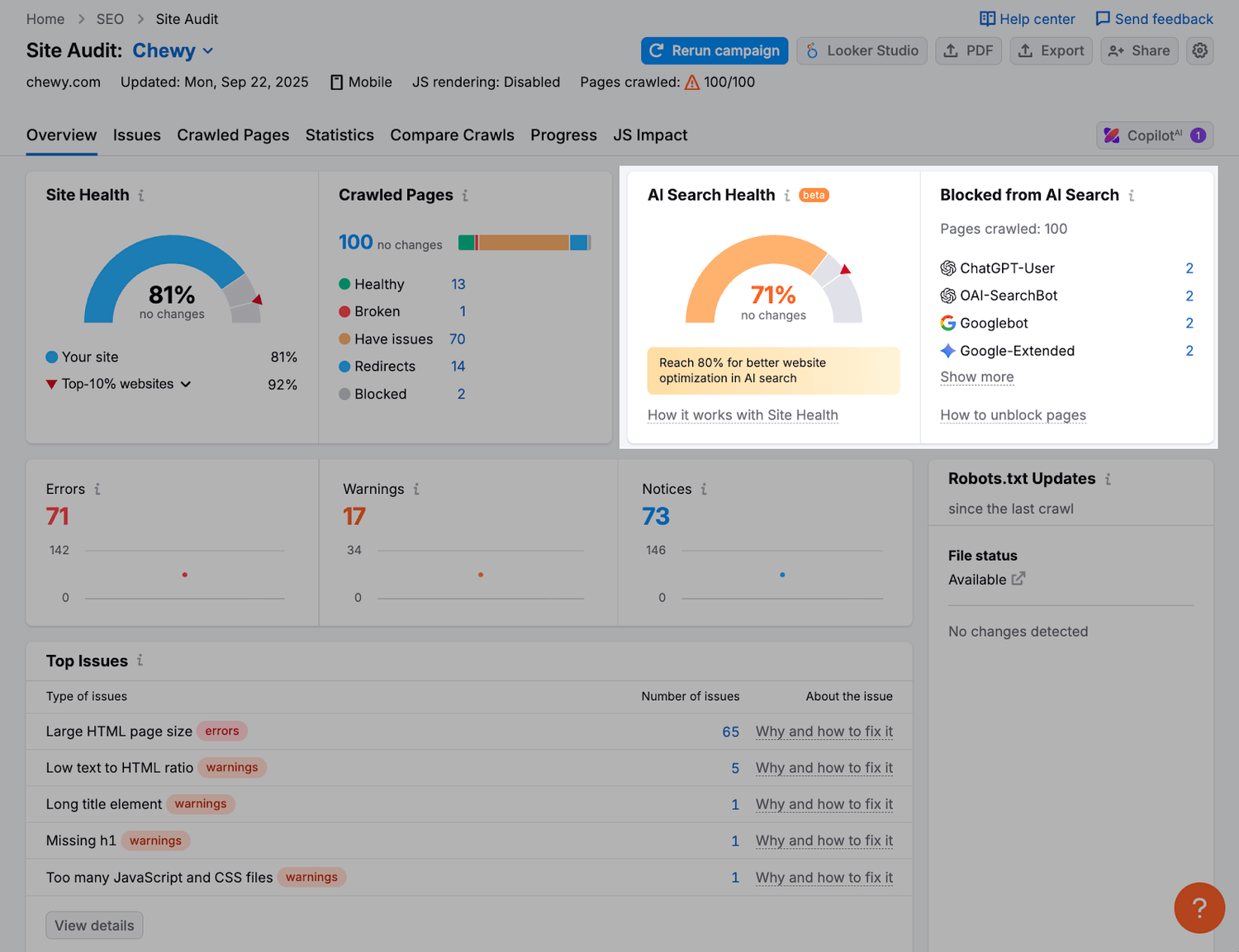
Your content strategy is only as good as the AI's ability to read it. A technical site audit using the AI Search Health widget in Semrush Site Audit is essential to ensure you aren't invisible to the bots.
The Technical "Search Health" Checklist:
llms.txt Files: Create a dedicated file to provide instructions and context specifically for LLM crawlers. This is the "robots.txt" of the AI era.
Crawl Accessibility: Ensure you aren't accidentally blocking key AI bots (like GPTBot) in your robots.txt. While some brands block bots to protect data, for a SaaS looking for growth, blocking these bots is a form of "digital suicide."
Content Length Audit: Some LLMs struggle to process overly long pages effectively. Audit your site for pages that are too verbose; break them into structured, sub-headed sections that are easier for a model to ingest.
"Last-Modified" Headers: Ensure your server sends correct headers so RAG-based systems know your pricing or feature lists are the most current version available.
Advanced Monitoring: Tracking Progress and Sentiment
AI Visibility is not a one-and-done project. It requires continuous monitoring of both volume (how often you're mentioned) and perception (how you're described).
Narrative Management & Perception
It is not enough to be mentioned; you must be mentioned positively. The Brand Performance suite in Semrush allows you to track Brand Sentiment and Perception.
Perception Report: Monitor sentiment trends over time. If a model starts describing your software as "expensive" or "buggy," this report flags it.
Narrative Drivers Report: Discover the specific questions and top-cited domains shaping your brand's story. If a competitor's blog is the "Narrative Driver" for your brand, you know exactly where you need to counter-program.
Prompt Tracking
Identify 20-50 "priority prompts", the high-value queries that drive your MQLs. The Prompt Tracking feature allows you to monitor your visibility for these prompts daily in "AI Mode" across platforms like ChatGPT and Google. This allows you to see the immediate impact of your GEO efforts and react quickly if a competitor begins to take over your share of voice.
Frequently Asked Questions
What Is an AI Visibility Strategy and Why It Matters for SaaS Companies?
An AI visibility strategy is a plan to manage how often your brand is mentioned, cited, or recommended in responses generated by Large Language Models (LLMs) such as ChatGPT, Claude, Perplexity, and Google’s AI Overviews. For SaaS companies, this matters because appearing in these AI answers allows potential customers to discover your product during key moments of their research. Furthermore, research indicates that AI search visitors convert 4.4x better than traditional organic search visitors, as they often arrive at your site better informed.
When Should SaaS Companies Invest in AI Visibility Strategies?
SaaS companies should invest in these strategies immediately, as the landscape of search is rapidly shifting toward AI-driven discovery. By 2027, LLM channels are projected to drive as much business value as traditional search, and they are expected to surpass it shortly after. Currently, 71.5% of U.S. consumers already use AI tools for at least some of their searches, making it a critical channel for reaching modern buyers.
Why Is AI Visibility Crucial for the Success of SaaS Companies?
AI visibility is essential because AI assistants now shape the buyer’s journey by selecting which brands to include in their answers and explaining why they matter. If your SaaS product does not appear in these generated responses, your brand is effectively excluded from the buyer's shortlist before they even make a decision. Ensuring visibility in AI results places your brand in front of high-value audiences who are ready to act, providing a significant competitive edge.
Who Can Benefit from an AI Visibility Strategy in SaaS?
Several roles within a SaaS organization can benefit from implementing an AI visibility strategy:
Marketing and SEO Teams: They can use it to benchmark their brand against competitors, spot visibility gaps, and refine content to better suit AI discovery.
Full-Stack Marketers: These professionals can monitor AI search trends and resolve technical blockers that might prevent AI bots from crawling their content.
Business and Product Managers: They can use AI data to keep a pulse on brand perception and sentiment while uncovering new market opportunities.
Where to Start with AI Visibility Strategies for Your SaaS Product?
To begin building your AI visibility, you can follow these foundational steps:
1. Conduct a Manual Analysis: Start by prompting platforms like ChatGPT and Gemini with questions your target audience would realistically ask to see if your product is mentioned or cited.
2. Get a High-Level Benchmark: Use tools like the AI Visibility Toolkit to establish an AI Visibility Score, which measures your brand's presence compared to industry competitors.
3. Analyze Competitor Gaps: Identify specific prompts and topics where your rivals are being cited but your brand is missing.
4. Perform Prompt Research: Discover the high-volume questions and "hot topics" your audience is asking AI to guide your content creation.
5. Audit Technical Readiness: Ensure your website is accessible to AI crawlers by checking for blockers in your robots.txt file or missing llms.txt files through a technical site audit.
6. Close Visibility Gaps: Create or update content that directly answers high-intent user queries and signals relevance to both traditional search engines and AI models.
Conclusion: The SaaS First-Mover Advantage
The shift from traditional search to AI-driven discovery is the most significant change in digital marketing since the advent of the search engine itself. SaaS companies that continue to rely solely on 2019-era SEO tactics will find themselves increasingly sidelined as buyers flock to conversational assistants.
By optimizing for AI Visibility today, focusing on brand authority, original data, and technical readiness, you aren't just chasing a new algorithm. You are owning the narrative of your brand in the era of intelligence.
The brands that lead the industry tomorrow are the ones that are optimizing for discovery today. While your competitors are still guessing how AI works, you can be the brand that the AI recommends. It’s time to move beyond the search bar and into the conversation. Lead the industry while others are still guessing.



Created with © Systeme.io
Disclaimer: This page contains affiliate links. If you purchase through these links, we may earn a commission
at no extra cost to you. We only recommend tools we trust.