Master AI Visibility Tracking for Small Business with Semrush
Master AI Visibility Tracking for Small Business with Semrush
For over two decades, the digital marketing world operated under a simple, undisputed law: find the right keywords, climb to the top of Google’s "Ten Blue Links," and watch the traffic flow. But as someone who has lived and breathed search strategy for fifteen years, I’m telling you plainly: that era is over.
We have entered the age of Generative Engine Optimization (GEO). In this new world, visibility isn't about being a link on a list; it’s about being the answer a machine provides. If you are a small business owner or a lean marketing team, you might feel like the goalposts just moved to another stadium. They did. But here is the secret most "enterprise" experts won't tell you: AI doesn't care about your massive ad budget or your 500-person marketing department. It cares about authority, clarity, and trust.
This guide is your masterclass in navigating this shift. We’re moving beyond "clicks" and into the realm of "mentions," "citations," and "brand sentiment." Let’s dive in.
The Great Search Shift: Why Traditional SEO is No Longer Enough
Look, the SEO playbook we’ve all been using since 2010 isn’t just dusty, it’s becoming dangerous. In my experience, the biggest mistake a small business can make right now is assuming that "ranking #1 on Google" is still the ultimate prize.
The core difference between traditional SEO and AI-driven discovery comes down to the transition from Retrieval to Discovery.
From Keywords to Prompts
In the "old world," search was a simple retrieval task. A user typed "best boutique bakery in Austin," and Google retrieved a list of URLs. In the "new world," users are providing Prompts, complex, conversational queries that demand a synthesized answer. Instead of clicking five links to compare bakeries, a user asks ChatGPT: "I’m hosting a vegan wedding in Austin and need a bakery that specializes in gluten-free sourdough, who should I call, and what are their price ranges?"
The AI doesn't just give a list; it performs what I call "Query Fan-out." It scours the web, identifies the most trusted sources, compares them, and generates a single, authoritative response. If your brand isn’t optimized for this fan-out effect, you don't just drop to page two; you become invisible.
The Data Don't Lie
The scale of this shift is staggering. According to the AI Visibility Index:
Massive Adoption: ChatGPT alone handles 2.5 billion prompts every single day from over 190 million users.
The 2028 Tipping Point: AI-generated results are projected to overtake traditional organic search traffic by 2028.
This isn't a "future trend." It’s happening right now. Every time a user gets an answer from an AI without clicking a link, that’s a "clickless search." To survive, you must stop measuring clicks and start measuring Visibility.
The Stakes for Small Businesses: Visibility vs. Invisibility
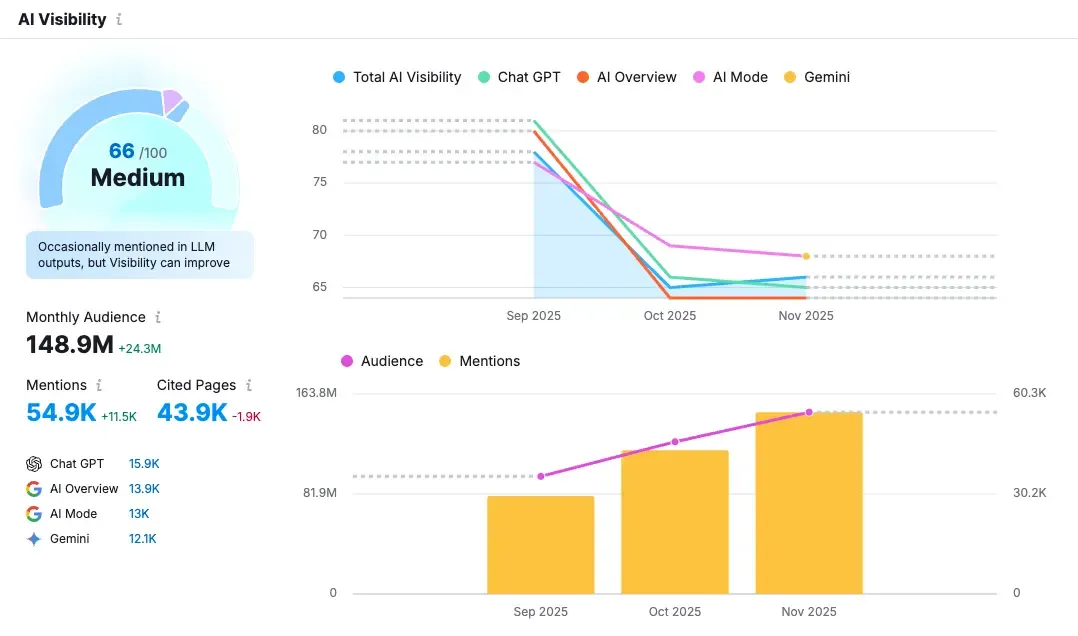
I often hear small business owners say, "I’ll wait and see how this AI thing shakes out." That is a luxury you cannot afford. For a lean team, ignoring AI visibility is a high-stakes gamble with three major risks:
1. The Competitor Citation Gap: While you’re perfecting your Meta Descriptions, your competitors are securing citations in LLM (Large Language Model) responses. Once an AI "learns" that a competitor is the authority in your niche, it becomes incredibly difficult to displace them.
2. Losing the High-Intent "Gold": This is the statistic that should keep you up at night: Users who search via LLMs are 4.4x more likely to convert than traditional search engine users. Why? Because an AI user is further down the funnel. They aren't just "browsing"; they are asking for a specific recommendation to solve a specific problem.
3. The Spread of Digital "Hallucinations": If you aren't tracking your AI presence, you won't know if ChatGPT is telling customers you’re closed on Tuesdays or that your consulting fees are double what they actually are. AI pulls from the entire web, including that outdated PDF from 2019 you forgot to delete.
The First-Mover Prize
There is, however, a massive upside. I call it the First-Mover Prize. Because AI models prioritize "Source Diversity" and "Topical Authority" over raw domain age or backlink count, a nimble small business can displace an enterprise giant.
[Real-World Application: The Local Bakery vs. The National Chain] Imagine a national cupcake franchise. They have thousands of backlinks but generic content. Now imagine a local bakery that publishes deep-dive guides on "The Science of High-Altitude Vegan Baking" and has active, authentic discussions on niche forums. In a "Query Fan-out" scenario, the AI is far more likely to cite the local bakery as the authority for a specific, complex prompt because the content is more "LLM-friendly."
Decoding AI Visibility Metrics: What to Track
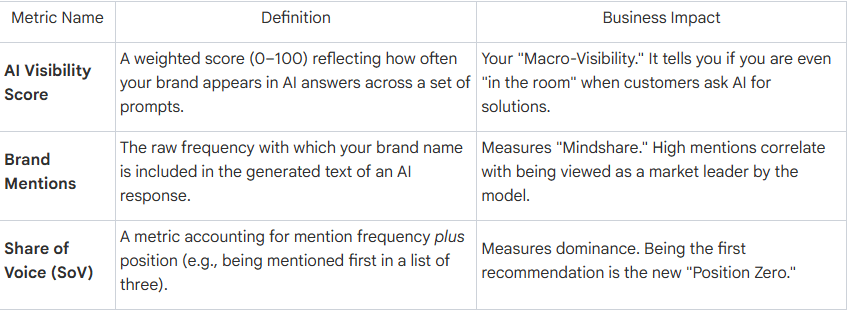
To win, you need to think like a data analyst. You cannot manage what you do not measure. In the AI era, we move past "Rankings" and embrace three critical KPIs.
The New Metrics of Success
Beyond the Basics: Overlap and Citations
Expert strategists look deeper. You must track Cited Pages, the specific URLs the AI lists as sources (often in sidebars or footnotes). These are the "Gold Standard" because they are the only remaining bridge for a "click" in a clickless world.
Furthermore, pay attention to Overlap Metrics:
Source-Source Overlap: How often does ChatGPT and Google AI Mode (Gemini) use the same websites to build an answer?
Mention-Mention Overlap: How similar are the lists of brands recommended by different AI models?
If you see low overlap between ChatGPT and Perplexity, it means you need a targeted strategy for each. One model might prefer your technical blog, while another prefers your Reddit presence.
Step-by-Step: Conducting Prompt Research with Semrush
In traditional SEO, you do keyword research. In GEO, we do Prompt Research. You need to understand the conversational "strings" your customers use. Using Semrush’s database of over 239 million prompts, you can map your visibility to the actual customer journey.
The 5 Prompt Types You Must Master
Based on my analysis of the AI search landscape, you must categorize your research into these five buckets:
1. Awareness Prompts: Broad queries (e.g., "How do I improve my small business's cash flow?").
2. Interest Prompts: Seeking specific types of solutions (e.g., "What are the best AI tools for lean marketing teams?").
3. Consideration Prompts: Comparing options (e.g., "Is Semrush better than its competitors for AI tracking?").
4. Intent Prompts: Final validation (e.g., "Show me reviews for [Your Brand]’s consulting services.").
5. Post-Purchase Prompts: Support and loyalty (e.g., "How do I integrate [Your Brand] with my existing CRM?").
[Real-World Application: The Boutique Law Firm] A small personal injury law firm shouldn't just track "car accident lawyer." They should track Comparison Prompts like: "Who are the top-rated personal injury lawyers in Seattle who offer free consultations and have experience with bicycle accidents?"
By analyzing these prompts, the firm can see if AI is recommending them or their rivals. If the AI says, "Firm A is great, but Firm B has better reviews for bicycle cases," you’ve just found your content gap.
Managing Your Brand Narrative in AI Answers
AI isn't a search engine; it's a "consensus engine." It builds a narrative based on what it finds. If that narrative is wrong, you need to intervene.
Checklist for Fixing AI Misinformation:
1. Identify the "Source of Infection": Use the Semrush AI Visibility Toolkit to see which "Cited Sources" the AI is using. Is it an old Yelp review? A 2017 press release?
Strategic Note: AI treats "Owned Properties" (your site) as the primary truth, but "Earned Media" (news/reviews) as the validation.
2. Sanitize Owned Properties: Ensure your FAQ pages, About Us, and Product pages use clear, declarative sentences. Avoid marketing fluff. AI prefers: "Our price is $50," not "We offer value-driven pricing tailored to your unique journey."
3. Bridge the "Information Gap": If AI is hallucinating details about your business, it’s usually because the data doesn’t exist in a readable format. Create a Comparison Page or a Fact Sheet specifically designed for LLM ingestion.
4. The "Correction" Outreach: If a third-party industry blog has your pricing wrong, and the AI is citing it, reach out to that blog. In the AI era, a correction on a high-authority site is worth ten guest posts.
The "Source Diversity" Strategy: Getting Featured on the Platforms AI Trusts
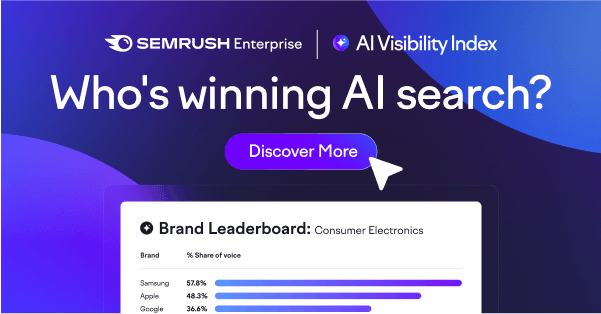
One of the most profound insights from the AI Visibility Index is that winning in AI search isn't just about your website. It’s about Source Diversity.
The Math of Authority: We calculate a Source Diversity Score by taking the number of Unique Brands appearing in a vertical and dividing it by the Total Number of Prompts.
High Diversity Score: The AI is open to many different sources (Great for small businesses!).
Low Diversity Score: The AI only trusts a few "monopoly" sources.
The Reddit Factor
LLMs deeply trust community-driven platforms like Reddit and niche forums. Why? Because they represent "human consensus."
[3-Step Forum Strategy for Small Teams]
1. Identify Brand Amplifiers: Find which Reddit threads or niche blogs are being cited for your target prompts.
2. Seed Authority: Don’t spam. Have your experts answer questions authentically in those threads. Use your brand name naturally.
3. Create "Citation-Worthy" Content: If a Reddit thread asks a question you can answer better, write a blog post titled with that exact question and link it. AI crawlers will see the "Human + Link" connection and treat your site as the ultimate authority.
Technical SEO for the AI Era: Making Your Site "LLM Gold"
If your site is a mess of unstructured text, AI models will ignore it. You need to provide "LLM Gold."
The "Number One Issue"
Expert Leigh McKenzie points out that the #1 issue holding sites back isn't keywords, it's crawlability and indexability. If your robots.txt is blocking AI agents, or if your site architecture is a labyrinth, the AI won't even find your "Gold."
Technical Optimizations:
Header Hierarchy as Anchors: Use H1, H2, and H3 tags not just for style, but as logical anchors. AI uses these to "jump" to the relevant section during retrieval.
Content Chunking: This is critical. Instead of one 3,000-word "Ultimate Guide," break your content into 300-500 word "chunks" that each answer a specific question.
Example: A boutique law firm should "chunk" a post on personal injury law into: "What is the statute of limitations?" "How are settlements calculated?" and "What to bring to your first meeting."
The Pillar/Cluster Model: Use a main "Pillar" page for broad topics and link it to "Cluster" pages that dive into specifics. This creates a "Map" that an AI can follow to understand your depth of knowledge.
AI-Preferred Formats: Use Markdown-style tables, Q&As, and step-by-step numbered lists. These are the easiest formats for an LLM to "copy-paste" into an answer.
Tools for the Lean Team: Experimenting Without an Enterprise Budget
You don't need a $10,000/month agency to start tracking this. There are powerful "Starter" tools:
Semrush One: This is the game-changer for small teams. It’s a unified solution where you can track traditional Google rankings and AI Visibility in one dashboard. No tool-switching.
AI Visibility Toolkit (Semrush): Specifically built to track your brand across ChatGPT, Gemini, and Perplexity. It even offers sentiment analysis to tell you if the AI "likes" your brand.
Free/Starter Options: Tools like Otterly AI, Peec AI, and Nightwatch offer free trials or basic plans to monitor brand mentions and share of voice.
Success Stories: Real-World AI Visibility Wins
These aren't just theories; they are proven growth drivers.
The Sure Oak Story: By pivoting to an AI-first content strategy, this agency saw a 286% increase in appearances in Google AI Overviews. Most importantly, 40% of their new leads now come through AI visibility. They stopped chasing "traffic" and started chasing "presence."
Coalition Technologies: They focused on becoming the "Trusted Source" for LLMs. The result? A 429% boost in AI referral traffic and a 547% increase in conversions from users coming via AI platforms. As President Jordan Brannon says, the AI visibility score is now the "core piece" of how they report success to stakeholders.

Conclusion: Securing Your Future in the AI Search Landscape
The search landscape is changing, but the fundamental law of business remains: you must go where your customers are. Today, they are in the chat box.
Visibility is the new click. If you are mentioned, cited, and recommended by AI, you aren't just surviving the search evolution, you are leading it.
Your First Step: Don't let your competitors claim the territory while you're still reading about it. Start with a 7-day free trial of the AI Visibility Toolkit or dive into the Semrush One ecosystem. Audit your current presence. Find out what the AI is saying about you today, so you can shape what it says about you tomorrow.
Become an AI search optimization pioneer. The "First-Mover Prize" is waiting.



Created with © Systeme.io
Disclaimer: This page contains affiliate links. If you purchase through these links, we may earn a commission
at no extra cost to you. We only recommend tools we trust.