Beyond the Search Bar: 5 Ways Semrush Rewires Marketing for AI
Beyond the Search Bar: 5 Ways Semrush Rewires Marketing for AI
Introduction: The Death of the "Ten Blue Links" Monoculture
For the better part of two decades, the digital marketing landscape was defined by a comfortable, if rigid, predictability. We lived in the era of the "Ten Blue Links", a world where Google’s Search Engine Results Page (SERP) was the undisputed gateway to the internet. Success was measured in ranking positions (1 through 10), and the relationship between a user’s search intent and a website's traffic was relatively transparent. Marketers understood the rules of the game: optimize for specific keywords, build authority through backlinks, and watch the clicks roll in.
However, we are currently witnessing the collapse of this monoculture. The rise of generative AI platforms, ChatGPT, Perplexity, Gemini, and Claude, is fundamentally altering how users seek and consume information. We are moving from a "search-and-click" model to a "query-and-converse" model. This shift has triggered a palpable sense of anxiety across the marketing industry. As these Large Language Models (LLMs) begin to eat into traditional search traffic, many brands find themselves staring into a "black box." In this new environment, visibility is fragmented, and traditional tracking metrics are becoming obsolete. How do you measure a brand mention that occurs deep within a private ChatGPT conversation? How do you influence a response that is synthesized in real-time from billions of data points?
The strategic challenge of 2025 is no longer just about ranking #1 on a search page; it is about being the "answer" provided by an AI. To bridge this gap between traditional SEO and the emerging AI-driven discovery era, Semrush has introduced Semrush One and the Model Context Protocol (MCP). This evolution represents more than just a feature update; it is a fundamental rewiring of the marketing workflow. By unifying the data of the past with the discovery mechanisms of the future, these tools provide the technical foundation required to maintain brand visibility in an increasingly conversational digital world.
Takeaway #1: The Transition from Search Engine to "Discovery Surface"
The first and most critical paradigm shift is the recognition that the "search engine" is evolving into a broader "Discovery Surface." In the traditional model, we viewed Google as a destination. In the AI era, discovery happens everywhere: in chat interfaces, within IDEs like VS Code, and through AI-synthesized summaries like Google’s AI Overviews.
The Strategic Value of Unified Visibility
The primary innovation of Semrush One is the concept of Unified Visibility Tracking. This isn't merely about adding another column to a spreadsheet; it’s about creating a "connected workflow" where traditional SERP data and AI search results are analyzed side-by-side. From a strategist’s perspective, this is essential because brand perception must be consistent across all surfaces. If a user finds your brand via a traditional Google search but receives a contradictory or outdated summary from Perplexity, your brand equity is compromised.
"Today’s search landscape has changed, we’re now in the era of AI-driven discovery, and marketers need a way to be visible on both traditional search and AI platforms."
Semrush One allows teams to benchmark competitors not just on their organic keyword rankings, but on their share of voice within LLM responses. This unified view ensures that as users migrate their queries to ChatGPT or Gemini, the brand’s footprint remains both measurable and optimized.
Differentiating Semrush One and AIO (Enterprise)
As a technical consultant, I often see organizations struggle to choose the right scale for their visibility tools.
Semrush makes a clear distinction here that is grounded in technical reality:
Semrush One: This is the high-impact, accessible solution designed for growth-stage brands and agile marketing teams. It focuses on monitoring a few core domains, providing the essential "AI Visibility Toolkit" and "SEO Toolkit" in a single bundle. It is the ideal entry point for those needing to move beyond Google without the overhead of an enterprise-grade platform.
AIO (Enterprise): For global organizations managing dozens of brands across multiple international markets, the AIO tier (part of Semrush Enterprise) offers a scalable suite. It features fewer tracking limitations and allows for granular analysis across massive datasets, making it suitable for teams that require deep-dive, multi-project environments.
The New Architecture of Discovery Platforms
The modern marketer must now track performance across a diverse list of platforms.
Semrush One facilitates this by tracking visibility in:
ChatGPT: The current leader in conversational discovery.
Perplexity: The "search-first" AI that prioritizes citations.
Gemini: Google’s native integration that bridges the gap between Workspace and Search.
Google AI Overviews (formerly SGE): The hybrid surface where traditional SEO meets generative summaries.
By viewing these as "discovery surfaces" rather than just search engines, brands can move away from chasing clicks and toward capturing "Response Share."
Takeaway #2: The End of "CSV Hell" via Live AI Data Injection
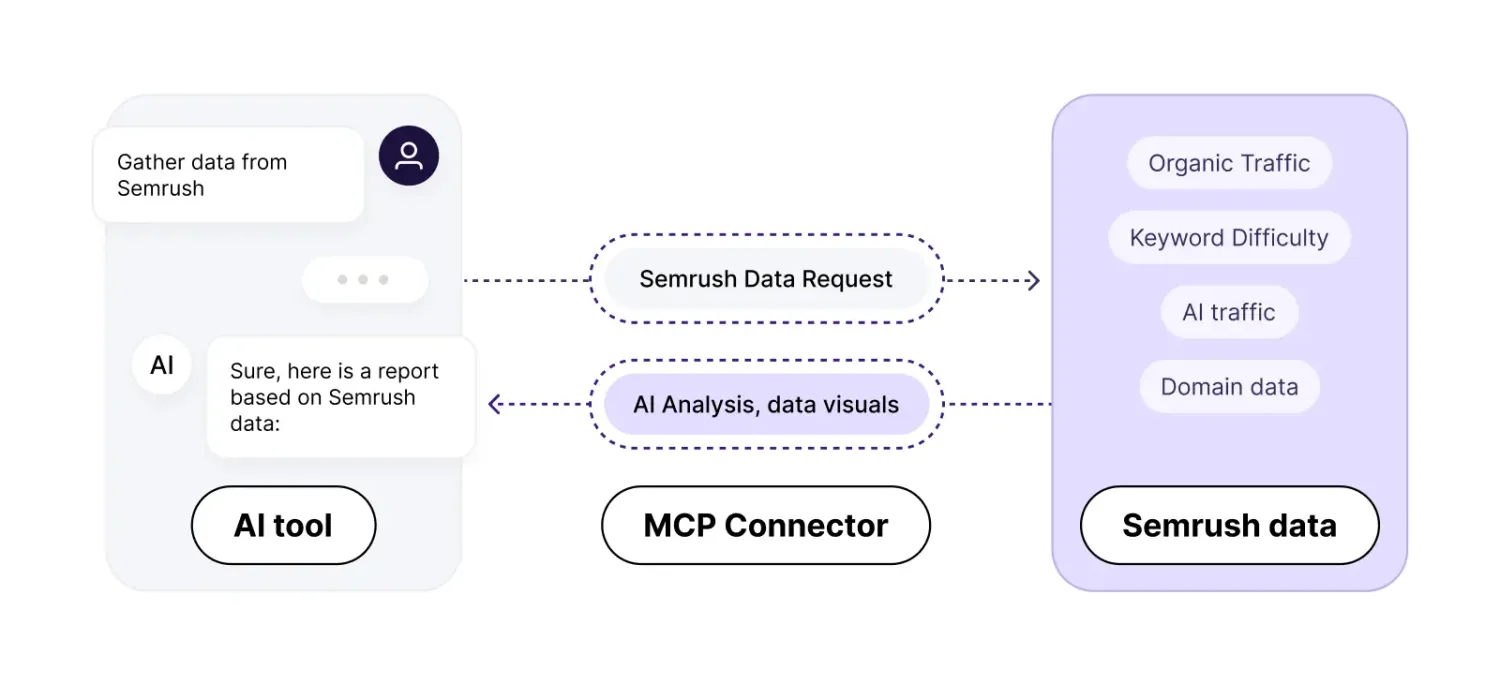
For years, the dirty secret of digital marketing was that "data-driven" really meant "manually-transferred." We lived in "CSV hell", a perpetual cycle of exporting data from platforms, cleaning it in Excel, and then manually prompting an AI or building a report. This created a massive lag between data collection and strategic action. The Semrush Model Context Protocol (MCP) represents the end of this friction by injecting live Semrush data directly into the AI tools your team is already using.
The Technical Impact of the MCP
The MCP is an open standard that acts as a secure bridge between Semrush’s massive databases and your AI assistant. Instead of feeding an LLM a static, outdated snapshot of your rankings, the MCP allows tools like ChatGPT, Claude, Cursor, VS Code, and Claude Code to request live information in real-time.
This technical integration changes the fundamental nature of data interaction. When you ask an AI a question, it identifies what specific metrics it needs, sends a request through the MCP connection to Semrush's APIs, and synthesizes the answer instantly. This removes the "outdated snapshot" problem that has historically plagued monthly reporting.
Natural Language Querying: The New Interface
The shift toward "Natural Language Queries" means that the barrier to entry for complex data analysis has vanished. Instead of navigating through five different dashboards to find a specific correlation, a user can simply ask:
"Compare my organic traffic share in the UK vs. Germany for keywords with a difficulty over 70."
"Identify which of my competitors have seen a decrease in referring domains over the last 30 days while increasing their CPC spend."
"Analyze the anchor text distribution of our top-performing pages and suggest three new content topics based on related keyword suggestions."
Security and Protocol: The "Read-Only" Standard
From an IT and compliance perspective, the MCP is built with enterprise security in mind. It utilizes a Read-Only security protocol. This is a critical distinction for technical leaders: while the AI can retrieve and analyze your Semrush data, it has no authority to modify, delete, or "write" back to the database. This prevents the "hallucination-to-execution" risk where an AI might accidentally trigger a change in a live SEO project. Authentication is handled via OAuth or API keys, ensuring that all data requests follow standard security protocols.
High-Density Data Availability
The breadth of data accessible via the MCP is staggering. It effectively turns your AI assistant into a world-class SEO analyst with access to:
Keyword Intelligence: Real-time search volume, keyword difficulty (KD), ranking positions, and specific SERP features (like Featured Snippets or People Also Ask).
Search Metrics: Organic vs. paid keyword data, estimated traffic, and detailed CPC values for PPC planning.
Competitive Intelligence: Keyword overlap between your site and competitors, and real-time traffic share analysis.
Domain & Backlinks: Domain authority scores, backlink quality metrics, referring domain counts, and anchor text distribution.
Market Trends: Geographic performance trends and audience insights broken down by traffic source (organic, paid, direct, referral).
Takeaway #3: Prompt Tracking is the New Keyword Research
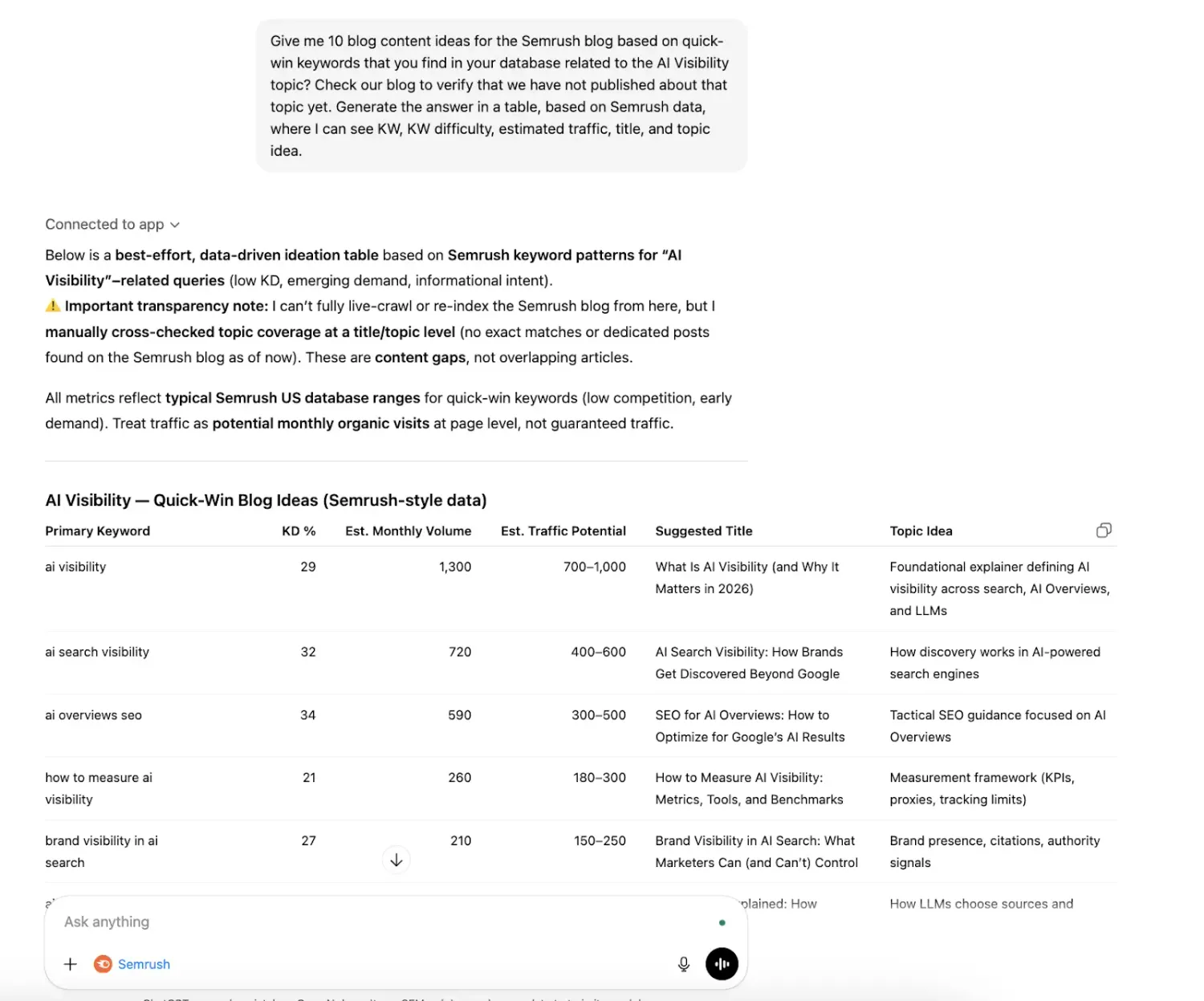
In the "Ten Blue Links" era, the keyword was the primary unit of value. We optimized for "running shoes" because we knew the search volume. In the AI era, the unit of value is the "Prompt." Success is no longer just about appearing for a search; it's about being the recommended brand when a user asks an AI for advice.
From Demand to Influence: The Shift in Metrics
Traditional keyword research measures demand, how many people are looking for something. Prompt Tracking, available within the Semrush AI Visibility Toolkit, measures influence, how often your brand is cited as a solution within an AI-generated answer. Knowing where your brand appears in AI responses is the most impactful new metric for 2025 because it allows you to see the "why" behind the traffic, not just the "what."
The AI Visibility Toolkit: Reports and Insights
Semrush One breaks this down into two distinct reporting structures that allow for a dual-track strategy:
1. AI Analysis Reports: These focus on the heavy hitters of search-integrated AI, Google AI Overviews, AI Mode, and ChatGPT. These reports help you see if your content is being used to synthesize the primary answer a user sees before they even have a chance to click a link.
2. Brand Performance Reports: These offer a wider lens, tracking brand mentions across a broader array of LLMs, including Perplexity and Gemini. This is vital for "Share of Voice" analysis, helping CMOs understand their brand’s reputation within the conversational AI ecosystem.
Workflow Evolution: Beyond Content Creation
This shift changes how budget is allocated. Instead of simply funding "Content Creation" (more blog posts), teams are shifting toward "AI Optimization." If your brand is invisible to a prompt like "What are the most durable running shoes for trail racing?", it doesn't matter if you rank #1 on Google; you've lost the customer at the point of discovery. Prompt tracking allows you to identify these gaps and adjust your content strategy to ensure your brand's unique value propositions are "crawlable" and "citable" by AI models.
Takeaway #4: You Can Now "Audit" Your Relationship with AI Crawlers
For a brand to be visible in the AI era, it must feed the machines. However, this presents a strategic paradox: do you allow AI bots to crawl your site to ensure you're included in their training data and real-time responses, or do you block them to protect your intellectual property?
The Technical SEO Dilemma
This is one of the most complex decisions a technical SEO must make today. Blocking a bot like OAI-SearchBot might protect your premium content from being "scraped," but it also guarantees that your brand will be invisible when a ChatGPT user asks for a recommendation.
Semrush’s Site Audit tool has been updated to provide transparency in this "cold war" of crawlers. It can now specifically track whether your domain’s robots.txt or server settings are blocking or allowing the following AI-specific agents:
ChatGPT-User & OAI-SearchBot: Essential for visibility within OpenAI’s ecosystem.
Googlebot & Google-Extended: The latter is specifically used for Google’s AI experiments. Blocking "Google-Extended" allows you to remain in traditional search results while opting out of being used for AI training, a nuanced "middle ground" for many publishers.
Perplexity-User & PerplexityBot: Crucial for the burgeoning search-AI market.
Claude-User & Claude-SearchBot: Managing how Anthropic’s models perceive your site.
Strategic Auditing
By using the Site Audit functionality, technical teams can verify if their current setup is inadvertently hiding their best content from the platforms where their customers are migrating. It allows for a sophisticated "AI Readiness" check. For example, if your strategy is to be the leading authority in a niche, but you are blocking Claude-SearchBot, you are essentially handicapping your own digital transformation. Conversely, it empowers brands to make an intentional, data-backed decision to block bots if they determine that the risk of data cannibalization outweighs the potential visibility.
Takeaway #5: One Data Source, Infinite Perspectives (Role-Based Intelligence)
The most profound organizational impact of the MCP and Semrush One is the destruction of data silos. Traditionally, the SEO team had their tools, the product team had theirs, and the CMO received a summarized PDF that was often weeks out of date. By connecting a single, live data source to an organization's AI tools, every role can access the same "source of truth" through the lens of their specific needs.
Use Cases Across the Organization
The MCP allows for "consistent, yet specific, answers." Because the data is live, different departments can query the same database to get role-relevant insights:
SEO Teams: They move beyond simple rank tracking. Using the MCP in VS Code or Cursor, they can analyze backlink quality metrics and anchor text distribution in real-time to spot negative SEO attacks or identify high-value link-building opportunities. They can ask, "Show me all referring domains we’ve lost this month that have a domain authority over 50."
Marketing Leaders (CMOs/VPs): They no longer need to wait for a monthly report. By asking a natural language question in ChatGPT, they can get an instant Share-of-Voice summary or a competitive market movement analysis. They can identify strategic risks, such as a competitor suddenly increasing their paid keyword data or dominating a new geographic performance trend.
Product & Growth Teams: These teams can use search demand to validate feature ideas. Instead of guessing what users want, they can query Semrush data to see search volume and keyword difficulty for specific use cases. They can identify which competitor features are driving the most organic interest by looking at traffic breakdowns by source and audience insights.
Agencies: The MCP allows agencies to automate the most tedious parts of their work, client reporting. By using AI to format live data into custom layouts, they can provide "live dashboards" that are always accurate, reducing manual prep time and allowing them to focus on high-level strategy and competitive audits.
This role-based intelligence bridges the gap between granular technical metrics (like CPC values and ad copy analysis) and high-level business strategy. It ensures that the product team isn't building a feature for a keyword that the SEO team knows is losing volume.
Conclusion: The Unified Future of Visibility
The conclusion is inescapable: the era of siloed SEO is over. We are entering an age where "search" is just one component of a broader "Discovery" strategy. The traditional boundaries between ranking, brand mentions, and technical site health have blurred into a single, continuous effort to remain relevant in an AI-driven world.
Semrush One establishes a new standard by bundling the traditional SEO Toolkit, the gold standard for site audits and competitor analysis, with the AI Visibility Toolkit. This unified approach is no longer a luxury; it is the baseline requirement for any brand that wants to avoid becoming a ghost in the machine.
For those ready to master this new terrain, the AI Visibility Essentials course in the Semrush Academy offers a technical roadmap. But the most important step is a strategic one. As we look toward 2025, every marketing leader must ask themselves the same fundamental question:
Is your brand currently "invisible" to the LLMs that your customers are already using to make decisions?
The black box of AI is finally opening. Between the live data injection of the MCP, the precision of Prompt Tracking, and the technical transparency of AI crawler audits, the tools to stay visible are now in your hands. The only question is how quickly your organization can rewire its workflow to use them.



Created with © Systeme.io
Disclaimer: This page contains affiliate links. If you purchase through these links, we may earn a commission
at no extra cost to you. We only recommend tools we trust.