The Future of SEO in the Age of AI Search: Stay Visible & Thrive Online
The Future of SEO in the Age of AI Search: Stay Visible & Thrive Online
Introduction: SEO Isn’t Dead, It’s Evolving (Faster Than Ever)
Remember when “SEO is dead” articles would pop up every year or so, like clockwork? In 2026, those voices have gotten louder. But here’s the reality: SEO isn’t going anywhere. It’s just changing, radically, and at breakneck speed.
Today, search engines are no longer just Google, Bing, or DuckDuckGo. They’re also large language models (LLMs) that answer questions, recommend products, and summarize research (think ChatGPT, Perplexity, and Google’s AI Overviews). These AI-driven searches don’t just rank pages, they generate answers, blending sources, facts, and sometimes even opinions.
If your business, content, or brand isn’t visible to these advanced AI engines, you’re missing a growing share of searches and revenue. This transformative shift isn’t just tech hype, it’s fundamentally altering how people discover, trust, and act.
This article digs deep into:
Why AI search matters for every website owner and marketer
How AI is rewriting the “rules” of SEO
What it actually takes to win in this new era
Timely, actionable strategies to measure and improve your “AI Visibility”
How the smartest brands are already thriving with AI-powered search!
Let’s unpack the new playbook for SEO, built for a world where the best content isn’t just for people, but for thinking machines.
A Brief History of SEO: From Keyword Stuffing to Human Understanding
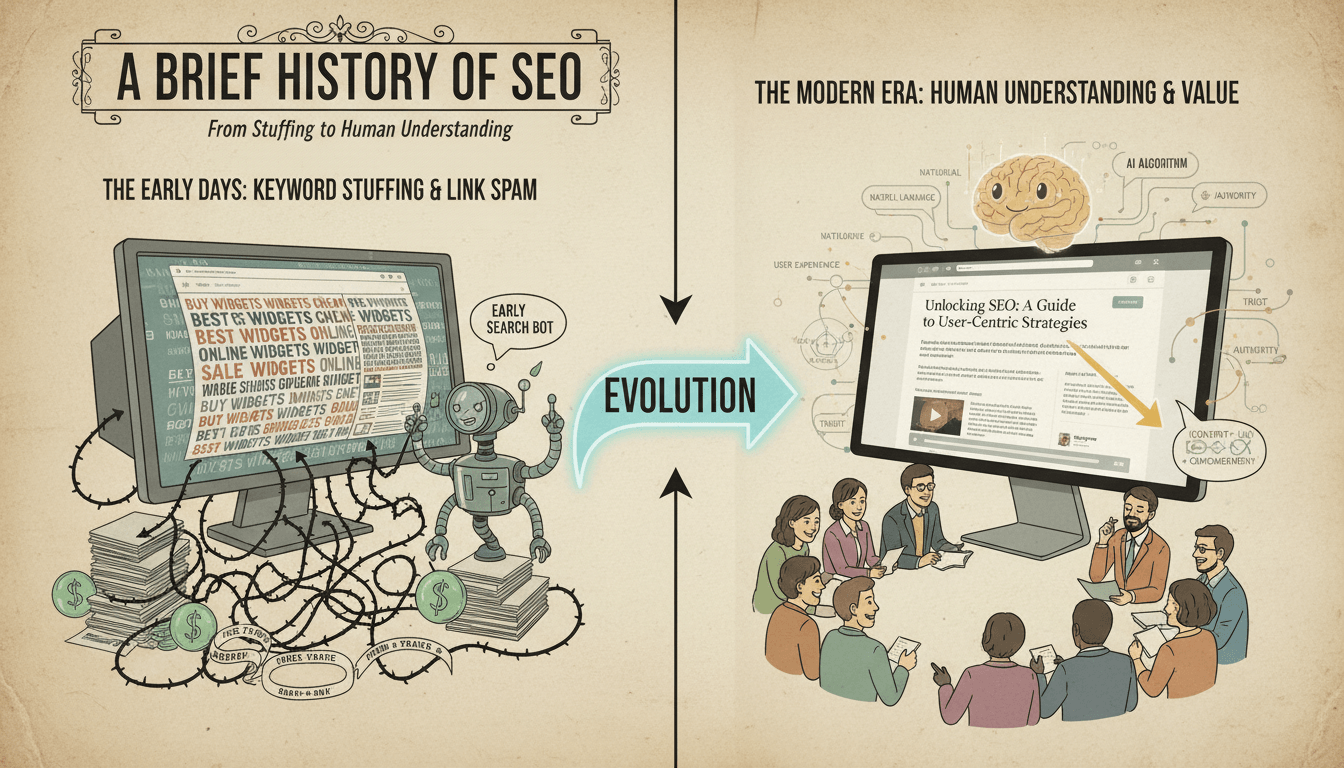
Before we tackle the future, it’s worth taking a quick stroll down memory lane.
The Primitive Days:
SEO used to be almost mechanical. The top sites crammed pages full of obvious keywords, “best vacuum cleaner best vacuum cleaner reviews best vacuum cleaner 2020”, and bought paid links by the truckload. Search engines were simple keyword matchers, and searchers were easy to manipulate.
The Evolution:
Google’s algorithm matured. Updates like Panda, Penguin, and Hummingbird penalized spammy tactics and championed relevance, authority, and user satisfaction. “Content is king” became the rallying cry. SEO transformed into a discipline focused on:
Intent matching (Why did the user search?)
Topical authority (Does this site cover the subject in depth?)
User experience (Is this site fast, secure, and accessible?)
The Personalization Era:
Search got personalized. Results changed based on your location, device, history, and preferences. Rich snippets, knowledge panels, and “People Also Ask” changed how results looked. Still, the process was fundamentally the same: a searcher chose between links on a page.
The Tipping Point:
All of this set the stage for today’s revolution: the rise of searches where the “link” is no longer the primary outcome. Instead, the AI itself gives you the answer, often without a need to click.
AI Search Engines: The Game Changer
The introduction of AI-powered LLMs as search engines is the most seismic shift since Google’s inception.
What Are AI Search Engines?
They’re not just crawling the web, they’re reading, interpreting, and generating answers. Platforms like:
OpenAI’s ChatGPT (now with internet access and plugins)
Google’s Search Generative Experience (AI Overviews)
Microsoft Copilot
Perplexity AI
generate synthesized answers in real time, often citing multiple sources for a single, conversational reply.
Instead of “ten blue links,” users now get:
A direct, often rich summarized answer
Contextual explanations
Follow-up suggestions
Fewer clicks to get what they want
What’s at Stake?
If your website or brand isn’t cited, quoted, or referenced by these AI platforms, you lose visibility, even if you rank well on Google. That means missing out on traffic, leads, and revenue.
It’s the dawn of AI visibility, and its rules are being written right now.
Enter the LLM: How ChatGPT, Gemini, and AI Overviews Are Shaking Up Search
Large Language Models (LLMs) like GPT-4, Gemini, Claude, and their peers have created new behaviors for consumers, and new challenges for marketers.
Why Are LLMs Different?
Contextual Understanding: They don’t just look for keywords; they “understand” questions and nuance.
Synthesis: AI blends content from multiple sources, prioritizing what it deems most trustworthy or relevant.
Memory: With conversational context, they can refine or clarify searches.
Brand Impact: LLMs frequently cite or reference the brands, articles, or experts they trust.
Real-World Impact:
41% month-over-month ChatGPT referrals for leading brands (Semrush data)
286% growth in AI Overview citations on Google
40% of leads now coming through AI search visibility, not traditional search engines
Suddenly, SEO success isn’t just about ranking, it’s about being recognized and referenced by artificial intelligence.
What is AI Visibility and Why Should You Care?

Picture this: Two brands both rank #1 for a valuable keyword. But in ChatGPT’s summary of “best running shoes for flat feet,” only one is mentioned. Which one will the user trust? Which will get more clicks, leads, and trust?
AI Visibility is your brand’s share of mentions and presence in AI-driven search platforms.
It’s a measure of how often LLMs:
Reference your site or brand
Quote your content
Link back or cite sources
Why It Matters:
“Zero Click” Searches: Over 50% of searches now end before a user clicks a traditional link, thanks to direct AI answers.
Authority at Scale: AI references serve as implicit endorsements.
New User Journeys: Users increasingly rely on LLMs for research, recommendations, and even purchasing decisions.
If you’re not part of the AI search answer, you’re functionally invisible to a growing portion of your audience.
Core Shifts in the SEO Landscape
Here’s how the paradigm’s changed:
Old SEO (2010–2020)
Focus on keyword ranking
Traffic = clicks from SERPs
Optimize for user queries
Link-building for authority
On-page and off-page factors
Google as single biggest channel
SEO tools: rankings, SERP features
AI-Powered SEO (2026+)
Focus on AI mention and citation
Traffic = referrals from LLMs
Optimize for AI prompts and topics
Earning AI trust and citations
Entity recognition & topical authority
Google, ChatGPT, Perplexity, etc.
AI tools: visibility, citation tracking
AI isn’t killing SEO—it’s turbocharging it with new complexity, opportunity, and risk.
Winning Tactics for SEO in the Age of AI Search
So how do you win? Here’s what’s working TODAY:
1. Content That’s Clear, Authoritative, and Trustworthy
AI engines prize factual accuracy, expert consensus, and clear explanations.
Fact-check rigorously: LLMs penalize dubious or out-of-date information.
Show, don’t tell: Back claims with data, bring in expert opinions, and add original research.
2. Structured Data and Semantic Markup
Help AI “see” what matters.
Use schema.org markup liberally (FAQ, HowTo, Product, Article, etc.).
Leverage tables, bullet points, and summaries.
3. Topical Authority
Go deep on subjects, don’t just create one great article, build a cluster of world-class resources on your primary topics.
4. Brand Mentions and Citations Across the Web
AI learns not only from your site, but from everywhere your brand is mentioned.
Get quoted by journalists, bloggers, or in “best of” roundups.
Build PR, not just backlinks.
5. Answer Prompts AI Gets Frequently
Study which prompts (questions, problems, needs) AI engines get. Build content directly answering these, using the same language users employ.
6. Monitor and Optimize Your AI Visibility Score
Track how often you appear in:
ChatGPT answers (via AI visibility tools)
Google AI Overviews (and what sources are cited)
Perplexity and other emerging platforms
If you’re absent or misrepresented, adjust content, pitch your expertise, and close gaps with competitors.
Measuring Success: The New KPIs for AI-Driven Search
Classic SEO lived and died by keyword rankings and organic traffic. But AI search demands a new set of metrics:
AI Visibility Score: % of prompts where your brand/site is cited in AI answers (tools: Semrush One, etc.)
AI Referral Traffic: Direct visits originating from AI answers (“As cited by [yourbrand].com...”)
LLM Conversion Rate: % of leads/sales from AI-powered search answers
Sentiment in AI Answers: Is your brand portrayed positively, negatively, or neutrally by AI?Share of Voice (AI): How much “space” you own versus competitors in AI answers for your topicsPrompt Coverage: How many of the top prompts/questions in your niche does your content address?
Regularly monitoring these KPIs will reveal blind spots, and signal when you need to optimize.
Content Creation: What Works (and What Fails) with AI Engines
What Works:
1. Definitive Guides and Explainers:
AI loves citing resources that deeply and clearly answer common (and complex) questions.2. Original Research and Statistics:
LLMs thrive on fresh, unique insights to include in their synthesis.3. Authoritative, Credible Tone:
Include author bios, credentials, and trustworthy sources. “Expertise” counts more than ever.4. FAQ and Comparison Content:
AI engines often answer user prompts by referencing well-structured FAQs, checklists, or comparisons.5. Natural Language Flow:
Write conversationally, LLMs prefer extracting from human-sounding text over stuffy, robotic corporate prose.
What Fails:
Thin, Rehashed Content:
LLMs detect and ignore generic, low-value pages.Over-Optimization:
Keyword stuffing is penalized by both search engines and AIs, which can sense when content “tries too hard.”Lack of Context:
Standalone facts or lists without depth, linking, or explanation are less likely to be seen as trustworthy.Walled Gardens:
Content hidden behind paywalls, logins, or heavy interstitials is inaccessible to AI.
Earning Trust & Authority: Building a Brand That AI Promotes
Being “the answer” in an LLM isn’t just about technical optimization. It’s about trust, credibility, and repeated recognition.
How to Build AI-Friendly Trust:
Be Cited and Quoted Externally:
The more other respected sources link to or quote your site, the higher the chance AI engines will as well.Expert Profiles and Author Pages:
Show credentials, awards, and expertise for every content creator.Transparency and Accuracy:
Clearly cite your own sources, methodologies, and update dates.Engage in Digital PR:
Become a quoted source in roundups, news, and industry discussions.Consistency:
Regularly update and expand your content, signaling authority over time.
The AI-Friendly Website: Technical SEO for the New Search Era
You can’t ignore technical SEO, if anything, it’s become even more critical.
Key Technical Tactics:
Clean, Crawlable Structures:
Ensure your site's critical pages are easily discoverable (no orphaned content!).Structured Data Markup:
Help AIs interpret and classify your content.Fast Loading, Mobile Optimized:
User experience still matters, AI models often learn from engagement signals.API Access and Open Content:
Whenever possible, permit AI bots to access your key resources.Error-Free Sitemaps:
Make sure all your important content is included, categorized, and up-to-date.
Competitive Analysis: Outsmarting Others in the AI Visibility Race
It’s not enough to be good enough, you want to outpace the field.
Here’s how:
1. Benchmark Competitor Mentions in AI
Use tools (like Semrush One’s AI Visibility Score) to see how often your rivals are being cited in popular LLMs.
2. Identify Trending Prompts and Questions
Spot topics that are spiking in AI systems. Build new content around these fast.
3. Close “Prompt Gaps”
Where are your competitors being mentioned but you’re missing? Audit, then fill in the knowledge, authority, or content gaps.
4. Reverse-Engineer Successful Content
Which pages or articles are being cited by AI? Analyze their format, depth, and sources. Improve on them.
5. Monitor Brand Narrative
Use AI visibility tools to check not just if, but how your brand is being talked about by AI, then course-correct negative or unclear portrayal.
Future Outlook: Skills, Tools, and Mindsets for Tomorrow’s Marketers
Skills That Matter:
Prompt Engineering:
Understanding how users frame questions when interacting with AI (and tailoring content accordingly).Entity Building:
Strengthening your brand as a recognized, reliable entity that is “known” by AI models.Full-Funnel Digital Attribution:
Measuring not just “Google traffic,” but all traffic streams from LLMs, voice search, assistant devices, and beyond.Technical Acumen + Creativity:
Integrate SEO, content, data science, and digital PR seamlessly.
The New Toolbelt:
Semrush One (AI visibility, prompt gap analysis, sentiment tracking)
Structured data generators and schema testing tools
Brand monitoring for AI/LLM mentions
Prompt trend discovery platforms
The Mindset Shift:
Don’t chase rankings, chase citations and mentions in AI engines.
Embrace change fast, start measuring AI visibility now, not after it’s too late.
Conclusion: Instead of Outrunning the Bear, Outrun the Other Marketers
The rise of AI search engines isn’t an apocalypse for SEO, it’s a once-in-a-decade opportunity.
Winning in this new world isn’t about gaming the latest algorithm or stuffing more keywords. It’s about producing content that a machine recognizes as the best answer, cited across the web, trusted by millions, and surfaced by AI to answer real human questions.
If you embrace AI-driven SEO, by building authority, answering key prompts, structuring your data, and tracking AI visibility, you won’t just survive. You’ll thrive.
The race isn’t against the AI, it’s against the marketers still playing by the old rules. Get ahead now, and you’ll be the brand LLMs turn to first.
Bookmark this guide, return for updates, and start your journey to AI visibility supremacy today!



Created with © Systeme.io
Disclaimer: This page contains affiliate links. If you purchase through these links, we may earn a commission
at no extra cost to you. We only recommend tools we trust.