AI Visibility Toolkit: Boost Brand Visibility in AI Search
AI Visibility Toolkit: Boost Brand Visibility in AI Search
Introduction: The Evolution of Search and Discovery
The digital landscape is currently navigating its most significant pivot since the advent of the commercial internet. For over two decades, the primary goal of search engine optimization (SEO) was the "blue link", securing a high-ranking position on a traditional Search Engine Results Page (SERP). Success was measured by position, click-through rates (CTR), and organic traffic volume. However, the rise of Large Language Models (LLMs) and the "Search Generative Experience" (SGE) has fundamentally altered this equation. We are moving from a world of "search" to a world of "discovery" and "answer engines."
In this new paradigm, users are increasingly turning to platforms like ChatGPT and Google AI Mode for immediate, synthesized answers. These systems do not just provide links; they provide narratives, recommendations, and direct responses. Consequently, a new metric has emerged as the cornerstone of digital presence: AI Visibility.
As defined by the latest industry standards, AI Visibility represents a new layer of brand presence that exists beyond traditional search ranking. It is the measure of how frequently, accurately, and positively your brand is cited within AI-generated responses. For SEOs, digital marketing strategists, and technical content leads, the stakes have never been higher. If your brand does not appear in the "mental model" of an LLM, it effectively ceases to exist for a growing segment of the market. Adapting to how AI systems position your brand is no longer a forward-thinking luxury, it is a survival requirement for the modern marketing stack.
Strategist’s Note: The "Zero-Click" Reality As AI engines provide more comprehensive answers directly within the interface, the traditional marketing funnel is being compressed. Users may never visit your website, yet they are forming brand impressions based entirely on AI citations. AI Visibility is the only way to influence this "zero-click" journey and ensure your brand remains the preferred recommendation in the LLM’s narrative.
What is the Semrush AI Visibility Toolkit?
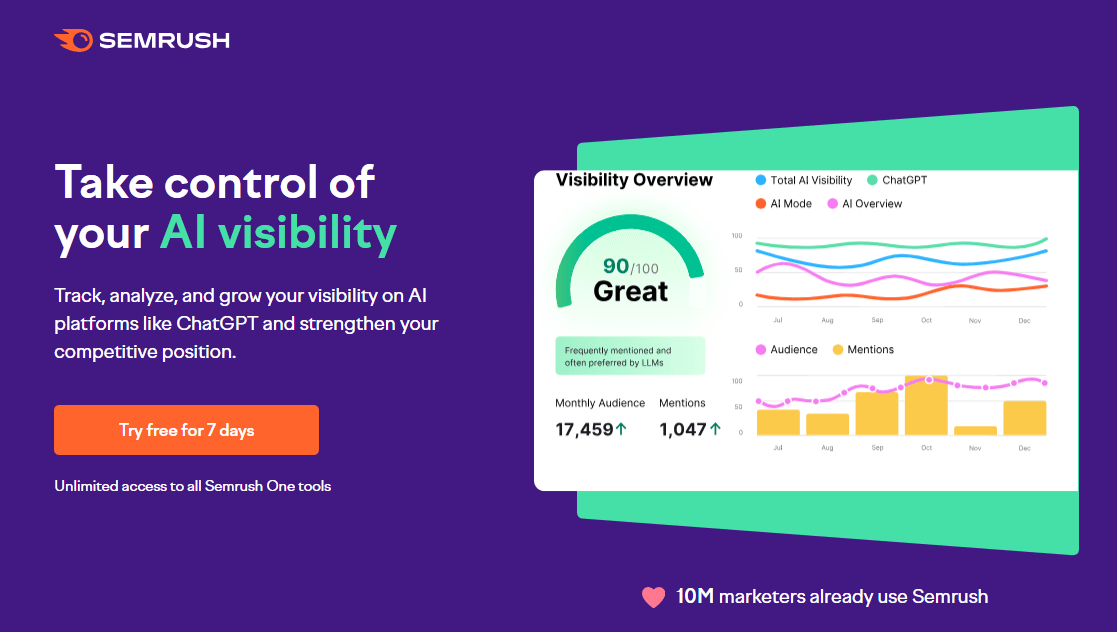
The Semrush AI Visibility Toolkit is a specialized suite of tools designed to help marketing teams monitor, measure, and optimize their brand positioning across the burgeoning ecosystem of AI discovery. While traditional SEO tools focus on keywords and backlinks, this toolkit focuses on prompts and mentions, bridging the gap between historical search data and the new conversational search interface.
Primary Strategic Objectives
The toolkit is engineered to provide actionable data for several high-impact marketing objectives:
Benchmarking Visibility: Establishing a quantitative baseline of how often your brand is mentioned in AI answers relative to industry competitors.
Analyzing Sentiment and Narrative: Moving beyond quantitative mentions to understand the qualitative attributes, positive, negative, or neutral, that AI associates with your products.
Identifying Technical Blockers: Detecting the underlying technical issues, from crawler accessibility to schema errors, that prevent LLMs from accurately "reading" and recommending your content.
Uncovering Visibility Gaps: Pinpointing specific conversational prompts where competitors are dominating the narrative, allowing for targeted content pivots.
Strategic Reporting: Synthesizing complex LLM behavior into presentation-ready reports that align with executive-level KPIs.
Target Audience and Strategic Roles
The toolkit is built for SMBs, agencies, and mid-market companies that need to scale their AI search strategy without increasing headcount. Specific roles within these organizations leverage the toolkit for distinct strategic advantages:
SEOs and Full-Stack Marketers: These professionals use the data to resolve visibility blockers and refine content strategies. They focus on the technical intersection of traditional search and AI crawling.
Agencies and SEO Teams: Agencies use the toolkit as a competitive intelligence engine to benchmark clients against their rivals, identifying "market share" in the AI space and generating growth-oriented pitch decks.
Business and Product Managers: These stakeholders monitor brand perception at scale. They use AI insights to understand how product launches or market shifts are being interpreted and relayed by AI systems to potential customers.
Core Feature Deep-Dive: Navigating the Toolkit
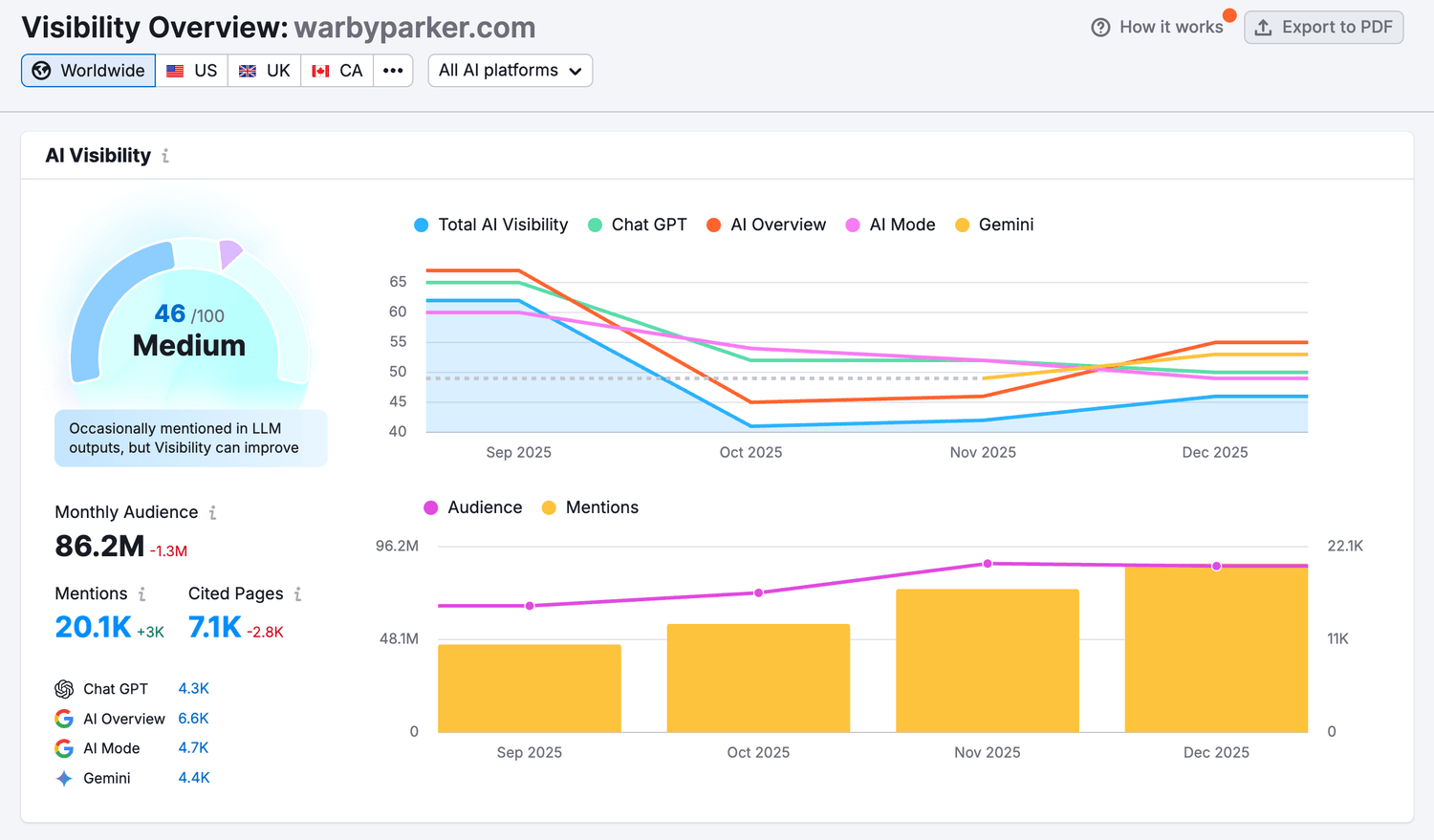
Understanding the toolkit requires a deep dive into its specialized reports, each designed to tackle a specific facet of AI visibility.
Visibility Overview
The Visibility Overview is the starting point for any AI strategy. It provides a macro-level view of a brand’s presence across AI systems. The primary metric here is the AI Visibility Score.
The AI Visibility Score is a normalized benchmark that reflects how frequently your brand appears in AI-generated answers compared to the median number of mentions for your top industry competitors.
Pro Tip: Do not view the AI Visibility Score in isolation. Because it benchmarks against a median of competitors, a declining score might not mean your brand is being mentioned less, it might mean a competitor is scaling their AI-oriented content at a faster rate. Use this score to trigger deep-dives into the Competitor Research report.
Strategic Use Case for Agencies: For an agency, the Visibility Overview is an essential "Health Check" tool. When presenting to a client, the AI Visibility Score provides a tangible way to justify a shift in budget from traditional keyword-heavy content to "Information Gain" content that provides the unique data points LLMs prefer to cite.
Competitor Research
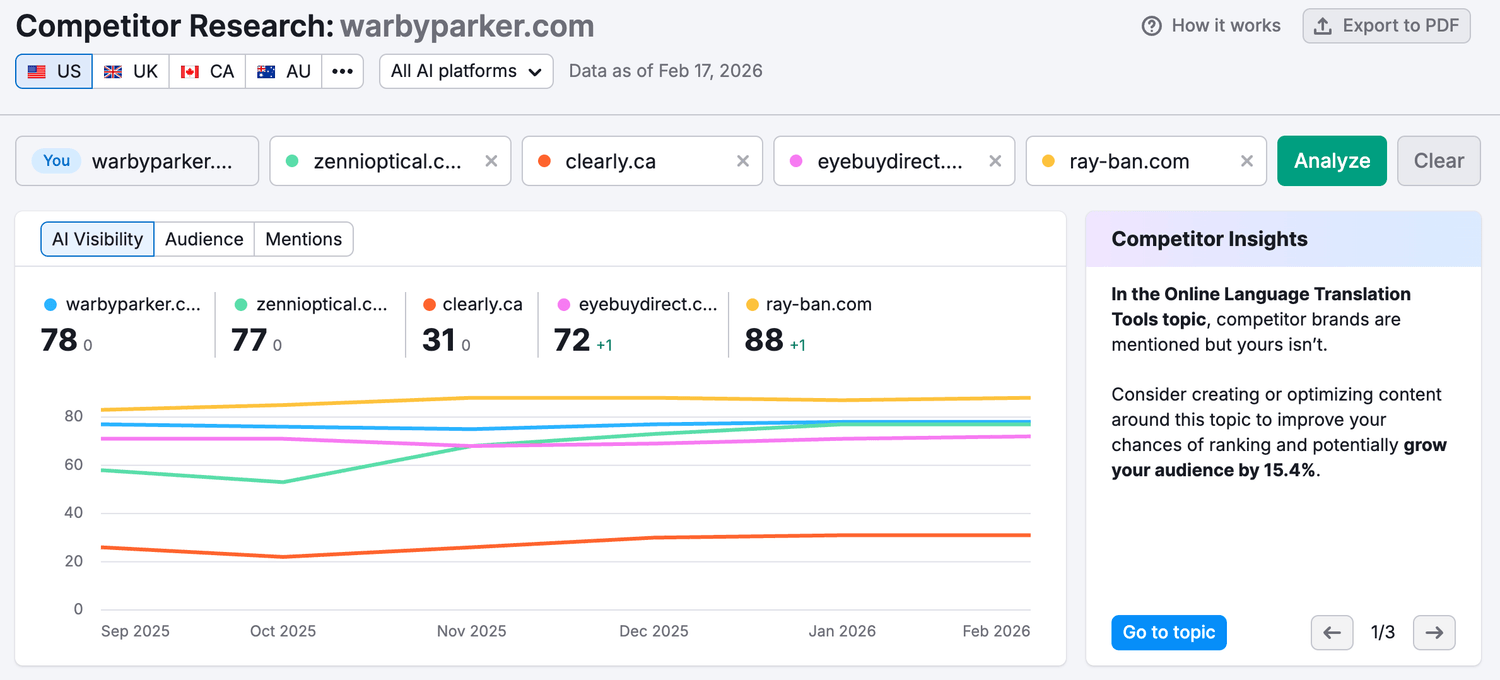
This report is the primary tool for identifying "visibility gaps." It allows you to see exactly how AI platforms position your competitors versus your own brand.
In AI search, the "Gap" is defined as a high-value prompt or topic where a competitor is cited as an authority, but your brand is omitted. The Competitor Research report highlights these omissions, providing a roadmap for content creation. By understanding the "why" behind a competitor's citation, whether it's due to more recent data, better structured data, or a clearer brand narrative, you can adjust your strategy to reclaim that share of voice.
Strategist’s Note: Reverse Engineering Authority Use this report to analyze the types of content competitors are winning with. Are they being cited for technical specifications, or for user reviews? This helps you determine if your "visibility gap" is a content problem or a brand perception problem.
Prompt Research: The New Keyword Research
In the era of AI, the keyword is dead; long live the prompt. Prompt Research helps you discover and prioritize the complex, conversational strings that users are inputting into LLMs.
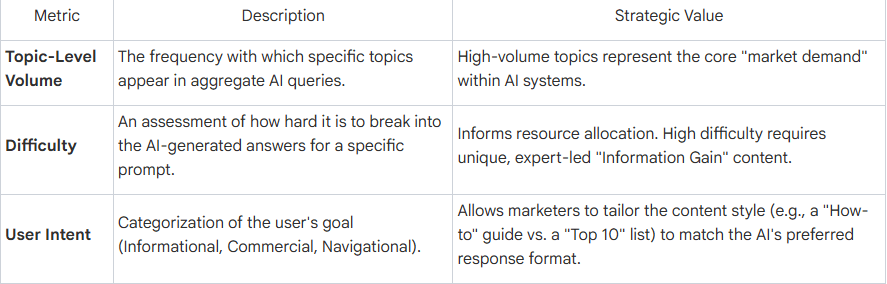
Expert Commentary on Difficulty: When a prompt has high "Difficulty," it usually means the AI has already established a set of "Canonical Sources" for that answer. To disrupt this, your content cannot simply be a rehash of what is already on the web. You must provide proprietary data, unique case studies, or a more current perspective that forces the LLM to update its internal representation of the topic.
Brand Performance & Sentiment
Brand Performance goes beyond mere mentions to analyze the quality of those mentions. This report suite includes:
Share of Voice (SOV): Your brand’s percentage of total citations within a specific industry prompt set.
Brand Sentiment: An AI-powered analysis of the tone (Positive, Neutral, Negative) used when the LLM describes your brand.
Key Narratives: The core themes or "stories" the AI associates with your business (e.g., "The affordable option," "The technical leader").
The toolkit provides AI-generated strategic recommendations based on these narratives. If the AI identifies a negative narrative, for example, that your software is "powerful but difficult to use", the toolkit will suggest specific messaging pivots to address this perception.
Prompt Tracking
Digital landscapes change daily, and LLM "hallucinations" or model updates can cause visibility to fluctuate wildly. Prompt Tracking provides daily monitoring for high-value prompts on ChatGPT and Google AI Mode.
This allows for agile marketing. If your brand suddenly drops from a "Top Recommendations" list for a core product category, you can immediately investigate whether a competitor updated their documentation or if a technical error on your site is blocking the AI's recent crawl.
AI Search Site Audit: Technical Deep Dive
Technical health is the prerequisite for AI visibility. If an AI crawler cannot parse your content, it cannot cite it. The AI Search Health widget in the Site Audit tool is designed specifically for this challenge.
Technical Checklist for AI Accessibility:
1. Robots.txt Directives: Modern SEO requires managing specific AI agents. Ensure your robots.txt does not inadvertently block GPTBot (OpenAI) or Google-Extended (Google’s AI crawler), unless you have a specific strategic reason to withhold data.
2. Schema Markup (JSON-LD): AI systems rely heavily on structured data to build "Entities." Proper implementation of Organization, Product, and Article schema is essential for helping the LLM understand your brand's relationship to specific topics.
3. Content Semantic Density: Avoid over-optimizing for keywords. AI models prioritize semantic clarity. Ensure your headers and introductory paragraphs use clear, entity-based language (e.g., "Our [Product Name] is a [Category] designed for [User Type]").
4. Crawlability and Speed: Just like traditional bots, AI crawlers can time out. A high-performing, fast-loading site is essential for deep indexing by LLM data pipelines.
Strategist’s Note: The Role of Schema in Entity Recognition Think of Schema as the "Metadata of Trust." By providing clear, machine-readable definitions of who you are and what you do, you reduce the "computational cost" for an LLM to verify your authority, making it more likely to cite you as a factual source.
The Methodology: How the AI Visibility Toolkit Works
The toolkit operates by simulating high-scale human interaction with leading LLMs. It gathers a curated collection of common, commercially relevant queries and runs them through platforms like ChatGPT and Google AI Mode.
Simulated Behavior and LLM Analysis
The tool doesn't just "scrape" answers; it uses AI to analyze AI. By processing the raw text generated by LLMs, the toolkit extracts brand mentions, detects the sentiment of the surrounding text, and identifies the underlying narratives. This dual-layered approach allows the toolkit to differentiate between a "passive mention" and an "active recommendation."
Update Frequencies
In the fast-moving world of AI, data freshness is critical. The toolkit maintains a rigorous update schedule:
Visibility Overview, Competitor Research, and Prompt Research: Updated daily on a rolling basis, ensuring you are seeing the most recent "snapshot" of the AI landscape.
Prompt Tracking: Updated daily for real-time monitoring of your most critical prompts.
Brand Performance Reports: Updated weekly, providing a stabilized view of brand sentiment and narratives over time.
AI Search Site Audit: Updated on-demand, allowing technical teams to verify fixes immediately.
Global and Regional Coverage
The toolkit is designed for global brands, offering extensive geographical granularity:
Research Tools (Visibility, Competitor, Prompt): Supports 15 key countries: Australia, Brazil, Canada, France, Germany, India, Italy, Japan, Mexico, Netherlands, Spain, Sweden, United Arab Emirates, United Kingdom, and the United States.
Worldwide Scale: The Visibility Overview also offers a "Worldwide" aggregate view for brands operating across multiple borders.
Brand Performance: Provides over 68,000 localized options, from specific cities and regions to global-level analysis.
Prompt Tracking: Supports over 220 countries and territories, ensuring that even hyper-local AI responses can be monitored.
Pricing, Limits, and Scaling Your AI Strategy
The AI Visibility Toolkit is structured to scale with your business, whether you are an independent consultant or a large agency.
Standard Pricing
The standalone AI Visibility Toolkit is available for $99 per month. This subscription provides the core foundation for AI discovery:
1 Project Folder.
1 Domain for Brand Performance analysis.
300 daily queries in AI Analysis reports.
1,000 daily queries in Prompt Research.
25 prompts for Prompt Tracking.
AI Search checks for up to 100 pages in Site Audit.
10 CSV exports per day (up to 1,000 rows per export).
Semrush One Integration
For those looking for a unified SEO and AI strategy, the Semrush One bundle integrates these tools into tiered plans that automatically increase your prompt-tracking capacity:
Starter: 50 prompts for Prompt Tracking.
Pro+: 100 prompts for Prompt Tracking.
Advanced: 200 prompts for Prompt Tracking.
Add-on Options for Enterprise Needs
If your requirements exceed the standard limits, you can customize your plan:
Additional Domain/Location for Brand Performance: $99/mo per domain. This is essential for agencies managing multiple client brands or for global companies tracking performance in different regions.
Additional Prompts: $60/mo for an additional 50 prompts in your tracking limit.
Corporate Sub-users: Additional licenses can be added for $99 each, providing separate reports and limits for team members.
Frequently Asked Questions (FAQ)
How is the AI Visibility Score calculated?
The score is a benchmarking metric. It compares the number of times your brand is cited in AI answers against the median citation count of your top industry competitors. These competitors are automatically identified by the system to ensure your benchmark is relevant to your specific market.
Which regions does the toolkit support?
For Visibility, Competitor, and Prompt Research, the toolkit supports 15 specific countries (USA, UK, Canada, Australia, France, Germany, etc.). The Visibility Overview also includes a "Worldwide" option. Brand Performance reports offer over 68,000 locations, and Prompt Tracking covers over 220 countries and territories.
Does the toolkit analyze sentiment?
Yes. The Brand Performance report uses AI to analyze the tone and specific attributes used by LLMs when mentioning your brand, providing a qualitative assessment of your digital reputation.
How often is the data refreshed?
Research and tracking data are updated daily. Brand Performance reports are updated weekly. Site Audits are run on-demand.
Are there limits on data exports?
Active subscribers can run 10 CSV exports per day, with each export containing up to 1,000 rows of data.

Conclusion: Future-Proofing Your Brand Visibility
The transition from a search-centric web to an AI-centric web is not a temporary trend, it is a fundamental restructuring of how humanity accesses information. As "Answer Engines" become the primary interface for consumer discovery, the brands that thrive will be those that treat AI Visibility as a core business KPI.
By utilizing the Semrush AI Visibility Toolkit, you gain the technical and strategic insights necessary to navigate this shift. From resolving technical crawler blockers to identifying competitive narrative gaps, the toolkit provides the data you need to ensure your brand is not just seen, but recommended. The competitive landscape of tomorrow is being indexed by AI today. Now is the time to secure your brand's place in the future of search.



Created with © Systeme.io
Disclaimer: This page contains affiliate links. If you purchase through these links, we may earn a commission
at no extra cost to you. We only recommend tools we trust.