Semrush vs. Moz: The SEO Battle of the Giants (2026 Comparison)
Semrush vs. Moz: The SEO Battle of the Giants (2026 Comparison)
In 2026, the search landscape has transitioned from a predictable list of blue links to a fragmented ecosystem of AI Overviews, conversational assistants, and hyper-localized results. For the modern marketing leader, choosing an SEO platform is no longer a matter of brand popularity or legacy loyalty. It has become a strategic decision predicated on "SEO maturity", the ability of your team to translate raw data into a competitive advantage.
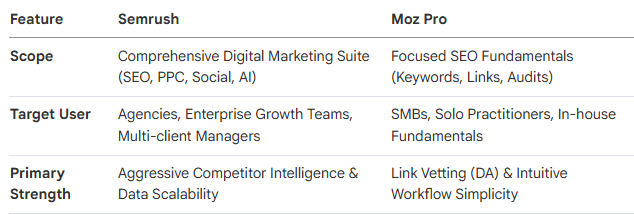
As a Senior SEO Strategist, I see teams struggle not because of a lack of tools, but because of a misalignment between their tool's capacity and their operational requirements. Small and Medium Business (SMB) teams often require operational simplicity to master the fundamentals of search. Conversely, high-velocity agencies and enterprise growth teams require massive data depth, sophisticated competitor reconnaissance, and AI-integrated workflows to maintain market share. The central premise for this comparison is clear: Semrush is a comprehensive growth system designed for aggressive scaling; Moz Pro is a focused, high-integrity toolkit designed for SEO practitioners who value precision and fundamentals.
Key Takeaway Semrush functions as a multi-channel growth engine, integrating SEO, content marketing, PPC, and AI visibility tracking into a single source of truth. It is the platform of choice for teams requiring "cold recon" and massive data exports. Moz Pro remains the industry standard for those who prioritize SEO fundamentals, clean reporting, and the highly-regarded Domain Authority metric, offering a lower barrier to entry for solo practitioners and in-house teams.
Core Philosophies: A 360-Degree View vs. Focused Fundamentals
The divergence between Semrush and Moz begins with their architectural intent. They are not merely competing products; they represent two different philosophies of digital marketing management.
Semrush: The Holistic Growth Suite
Semrush is engineered as a "broader marketing platform" where SEO acts as the anchor for a much wider array of digital activities. As Esther Giménez, Senior SEO & UX Consultant at Annalect, observes, the platform provides a "360-degree view" of projects. This philosophy allows an agency or a large internal team to transition seamlessly from keyword research to content creation, social media scheduling, and even PPC campaign analysis without leaving the ecosystem.
For the Senior Analyst, Semrush is the "Special Ops" tool. It is designed for "cold reconnaissance", situations where you have zero access to a competitor’s internal data but must build a comprehensive map of their traffic, keyword targets, and advertising spend. As Fabrizio Ballarini from Wise notes, Semrush allows a content team to run high-level activities without needing an "army of people specialized in SEO."
Moz Pro: The Precision Specialist
Moz Pro adopts a "focused fundamentals" approach. It does not attempt to be an all-in-one marketing suite. Instead, it doubles down on the classic pillars of SEO: high-quality link research, keyword prioritization, and site health monitoring. By avoiding the feature expansion seen in Semrush, Moz maintains a lower operational complexity. This makes it an ideal choice for teams that do not want to navigate a 50-tool menu just to find their ranking reports.
Brian Dean, founder of Backlinko, has noted that when it comes to pure value, Semrush often wins because it includes Google Ads software for the same price. However, Moz’s value lies in its integrity and the "cleanliness" of its data, particularly for North American teams that rely heavily on its proprietary metrics like Domain Authority (DA).
Platform Philosophy at a Glance
The 2026 Differentiator: AI Visibility and Optimization
The most significant technical gap in 2026 is how these platforms handle the rise of "Answer Engine Optimization" (AEO). In a world where ChatGPT, Perplexity, and Google AI Overviews (AIO) satisfy a significant percentage of user intent directly on the SERP, traditional rank tracking is no longer sufficient.
Semrush: The AI Visibility Toolkit
Semrush has responded to this shift by launching a dedicated AI Visibility Toolkit. This is not just a tracker; it is a brand sentiment and sentiment analysis engine. It allows teams to monitor how often their brand is "cited" by LLMs across ChatGPT, Google, and Perplexity. For a CMO, this data is the new "Share of Voice."
Competitor AI Visibility Benchmarking: Understand if your competitors are being recommended as "the best solution" in conversational prompts while your brand is ignored.
LLM Prompt Tracking: Identify the specific natural language queries that trigger your brand mentions.
Brand Sentiment Analysis: Use AI to analyze if the mentions within LLM responses are positive, neutral, or negative.
AI-Powered Ad and Content Generators: Integrated tools that use the visibility data to generate SEO-friendly articles and ad copy that specifically target the citations needed for AI results.
Moz: Fundamental AI Tracking
Moz’s current AI integration is significantly more conservative. It is primarily limited to tracking Google AI Overviews. While Moz provides visibility into whether your keyword triggers an AI summary, it lacks the cross-platform tracking for third-party LLMs like Perplexity or ChatGPT. For teams focused purely on traditional Google SEO, this may be enough, but for brands in the "Discovery" phase, like FinTech or SaaS, the lack of broader AI footprint monitoring is a strategic disadvantage.
Keyword Research: Database Scale and Discovery Limits
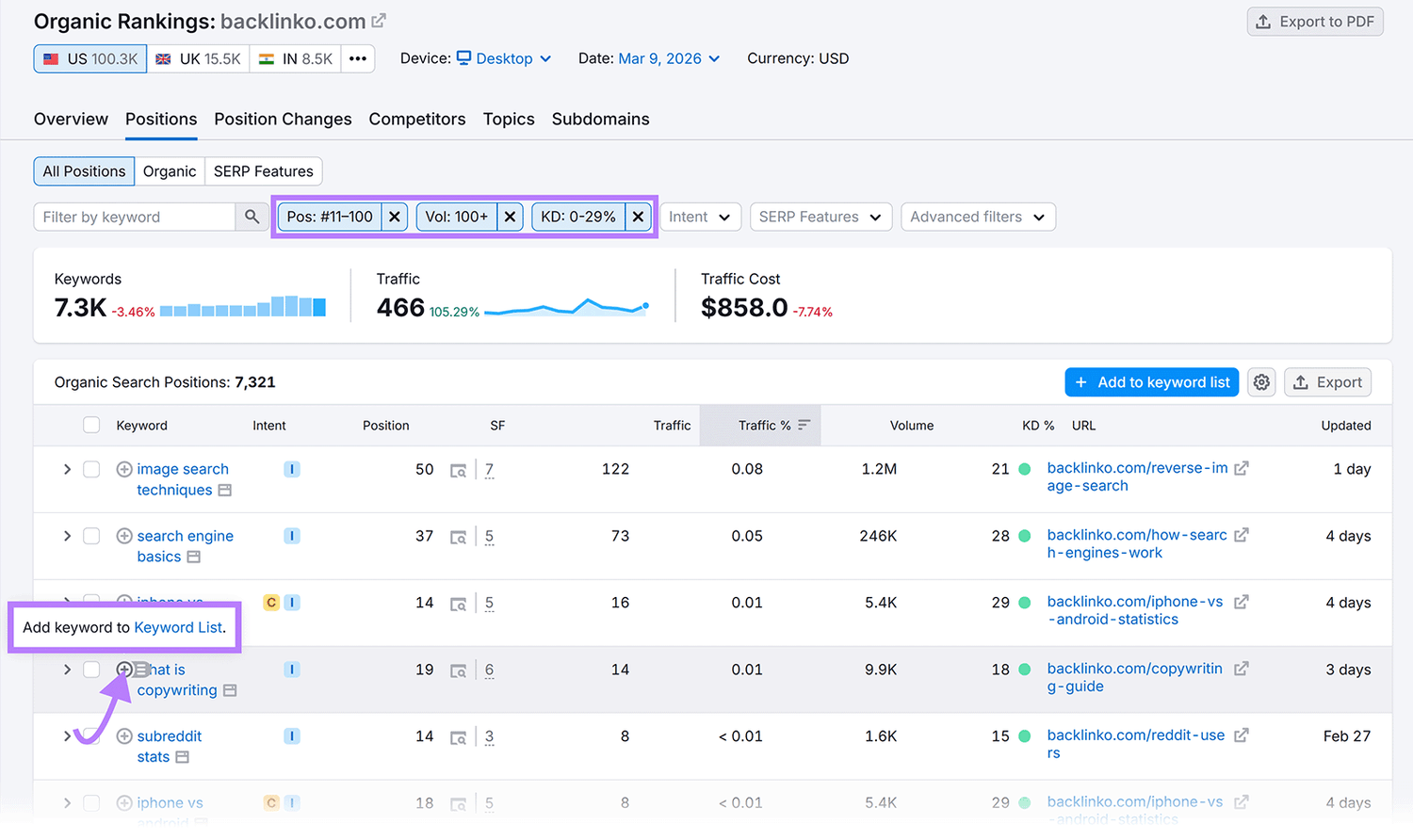
In SEO, data is the raw material. If your tool’s database is too small, your "discovery" phase will be marred by blind spots.
The Scale of Discovery
Semrush Database: 26.7 billion keywords.
Moz Database: 1.25 billion keywords.
The implications of this 20x difference are felt most acutely during the "Expansion" phase of a project. If you are a SaaS company trying to map out a 500-page topical cluster, the Semrush database will surface long-tail variations and niche questions that simply don't exist in the Moz index.
The Friction of Suggestion Limits
Operational friction is the silent killer of agency productivity. Moz keyword workflows are frequently capped at 1,000 suggestions per report. In a professional workflow, this is a major bottleneck. Semrush, by contrast, offers tiered limits that align with the scale of the business:
Pro: 10,000 results per report.
Guru: 30,000 results per report.
Business: 50,000 results per report.
Sector Spotlight: Why Limits Matter
SaaS Content Ops
A high-growth SaaS company building a library of "How-to" and "Alternative to [Competitor]" pages needs to export thousands of keyword variants to build internal linking maps. A 1,000-suggestion cap forces the team to run dozens of individual searches, manually deduplicating data in Excel, a massive waste of high-value analyst time.
E-commerce Expansion
For a large retailer in the US or Canada managing thousands of product facets (size, color, brand + product modifiers), the ability to export 50,000 results at once allows for the creation of comprehensive category clusters that dominate the SERPs.
Multi-location Legal SEO
Law firms targeting multiple cities and provinces require high-volume variations of "Personal Injury Lawyer + [City Name]." Semrush’s database depth ensures that even lower-volume, high-intent local keywords are captured, whereas smaller databases often overlook these as "zero-volume" terms.
Competitor & Market Intelligence: The Visibility Gap
The "biggest separation" identified by industry analysts is how these tools handle competitor recon.
Semrush: The "Cold Recon" Specialist Semrush provides built-in traffic estimates and market views without requiring any backend access. For an agency pitching a new client, this is the "Secret Weapon." You can walk into a meeting with a complete breakdown of the prospect's top pages, their declining keyword trends, and the exact content gaps where their rivals are winning. This is "Cold Recon", the ability to see the invisible.
Moz: The "Owned Data" Workaround As noted in the SEOlogist Inc analysis, Moz typically requires Google Analytics (GA) access to provide the level of traffic detail that Semrush provides natively. This is a dealbreaker for competitive research. You cannot ask your rival for their GA login. This limits Moz to being an "Optimization" tool (improving what you already know) rather than a "Growth" tool (discovering what you don't).
Pro Tip Always treat traffic estimates as directional markers, not ground truth. Use them to identify which competitors are gaining or losing momentum over a 6-month period, then validate those trends using your first-party data.
Technical SEO: Audits, JavaScript, and Crawl Capacity
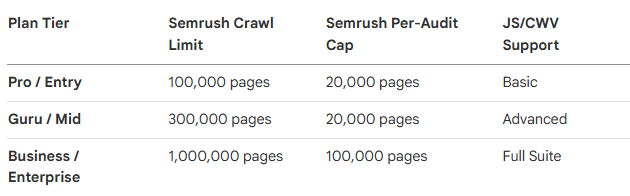
In 2026, technical SEO is about more than just finding broken links; it’s about Core Web Vitals (CWV) and JavaScript (JS) rendering.
Semrush: Deep Diagnostics
The Semrush Site Audit tool includes 140+ checks. Crucially, it provides specialized reporting for JavaScript rendering and Core Web Vitals. Many modern websites (especially in the SaaS and FinTech sectors) are built on frameworks like React or Vue. If your crawler can’t render JS, it isn't "seeing" the content that Google is indexing.
Moz: The Generous Fundamentalist
Moz is often praised for having a "more generous" crawl limit on lower-tier plans. For a smaller site with 5,000 pages of static HTML, Moz's cleaner UI makes it easier for a non-technical founder to identify and fix basic errors without getting lost in the "noise" of 140 different diagnostic checks.
Crawl Limits Comparison (Monthly)
Link Building: Authority Metrics and Operational Workflows
Moz’s legacy is built on the Domain Authority (DA) ecosystem. For many North American brands, DA remains the most trusted third-party metric for link vetting.
Moz DA & Spam Score: Moz's Spam Score is particularly useful for link cleanup, as it measures the percentage of sites with similar features that have been penalized by Google.
Semrush Authority Score: Semrush uses a similar "Authority Score" but focuses more on the operational workflow. It includes a dedicated "Link Building Campaign" tool and "Backlink Audit" workflow that allows you to manage outreach and monitor for "toxic" links that could lead to penalties.
Strategic Insight: For FinTech and Law Firm SEO, industries where E-E-A-T (Experience, Expertise, Authoritativeness, and Trustworthiness) is a matter of survival, using both metrics as a "double-check" is often the best practice.
The "True Cost" Checklist: Pricing and Seat Scalability
The most common mistake CMOs make is comparing the base price of these tools and ignoring the "Seat-Cost-to-Output" ratio.
The Entry Points
Moz Pro: Starts at $49/month.
Semrush SEO Toolkit: Starts at $139.95/month.
The Hidden Costs of Scaling
The "sticker price" is the floor, not the ceiling. For an agency, the biggest expense is user seats.
Semrush Seat Add-ons: Semrush has a clear but expensive pricing model for adding users. If you need 5 SEO specialists, 3 content writers, and 2 account managers to have access, your monthly bill will quickly exceed $1,000.
Moz Seat Tiers: Moz often includes specific seat counts within its tiers, making it more predictable for small teams.
The "Overage" Trap: Buying a lower tier of Semrush but then paying for additional crawl capacity or keyword tracking can result in a higher cost than simply upgrading to the "Guru" or "Business" plan.
Frequently Asked Questions (FAQ)
1. What Are the Key Differences Between Semrush and Moz?
The fundamental difference lies in their scope: Semrush is a broad marketing platform, while Moz Pro is a focused SEO toolkit. Semrush integrates SEO with adjacent workflows like content marketing, competitive intelligence, PPC, and social media management. In contrast, Moz prioritizes classic SEO fundamentals such as keyword research, rank tracking, and link analysis, delivered through a simpler user interface.
Data depth is another major differentiator; for example, Semrush maintains a keyword database of 26.7 billion compared to Moz’s 1.25 billion. Additionally, Semrush offers extensive AI visibility tracking across platforms like ChatGPT and Perplexity, whereas Moz's AI features are currently limited to Google AI Overviews.
2. Why Choose Semrush Over Moz?
Marketers often choose Semrush for its all-in-one capability, providing a "360-degree view" that includes Google Ads software and social media tools for the same price as an SEO-only suite. It is widely considered superior for competitor intelligence because it provides traffic estimates and domain comparisons without requiring access to a competitor's Google Analytics. Furthermore, Semrush wins on technical depth, offering over 140 site audit checks, JavaScript rendering insights, and historical data dating back to 2012.
3. When Should You Use Semrush Instead of Moz?
You should opt for Semrush when your SEO strategy requires scaling and aggressive growth. Specific scenarios include:
Managing large-scale sites: If you are auditing eCommerce platforms with 10,000 to 1,000,000 URLs, Semrush’s higher crawl limits and technical configurations are more suitable.
Cold competitor research: When pitching new clients or entering new markets where you lack internal data, Semrush’s traffic estimation tools are essential.
Building large content clusters: Semrush is better for teams that need to export thousands of keyword variants to build complex content briefs and internal linking maps.
Omnichannel marketing: If you need to manage social media scheduling and PPC keyword research alongside organic search in a single dashboard.
4. How Does Semrush Compare to Moz in SEO Tools?
In head-to-head feature comparisons, the tools diverge in several ways:
Keyword Research: Semrush provides deeper discovery and larger suggestion limits (up to 50,000 per report); Moz is praised for simplicity but often caps visible suggestions at 1,000.
Link Building: Moz is famous for its Domain Authority (DA) and Spam Score metrics, which remain popular for benchmarking. Semrush counters with a vast backlink database (43 trillion links) and dedicated outreach management tools.
SERP Analysis: Semrush tracks over 49 SERP features, significantly more than the 16 features tracked by Moz.
Reporting: Semrush offers plan-based limits on PDF scheduling and integrations, while Moz is noted for a clean reporting experience that is easy for in-house teams to share without extensive training.
5. Who Benefits More from Semrush or Moz?
The choice typically depends on the operating mode of the team.
Semrush Benefits: Agencies, large enterprise teams, and multi-client specialists who need repeatable competitor research, scalable data exports, and multi-user seat configurations. It also benefits businesses in the Canada and US markets that rely on heavy content scaling.
Moz Benefits: Solo entrepreneurs and small-to-medium businesses (SMBs) who are focusing on SEO fundamentals and prefer lower operational complexity. It is ideal for teams that want a "do the basics well" tool without the distraction of advanced competitive intelligence or paid advertising features.
Final Verdict: Which Giant Should You Choose?
Pick Moz if:
You prioritize simplicity and a clean, intuitive user interface.
You are an SMB or solo practitioner focused on SEO fundamentals without the need for PPC or Social tools.
You require a lower entry price to get your SEO efforts off the ground.
Your strategy relies heavily on the Domain Authority ecosystem for link benchmarking.
Pick Semrush if:
You need a "fully-featured suite" that serves as a 360-degree growth engine for SEO, PPC, and Social.
You are an agency requiring aggressive competitor intelligence and the ability to "recon" markets without internal data.
You are scaling content clusters and need massive keyword discovery limits.
You want to be an early adopter of AI Visibility tracking across ChatGPT and Perplexity.



Created with © Systeme.io
Disclaimer: This page contains affiliate links. If you purchase through these links, we may earn a commission
at no extra cost to you. We only recommend tools we trust.