What Is AI Visibility? The Complete Beginner’s Guide for 2026
Introduction: The New Frontier of Search
The digital landscape has reached a definitive, irreversible turning point. As we navigate the complexities of 2026, the traditional search engine results page (SERP) is no longer the sole arbiter of brand success. The era of the "blue link" has been superseded by a more intuitive, conversational, and synthesized experience. AI platforms, including ChatGPT, Google AI Mode, Gemini, and Google AI Overviews, have fundamentally rewritten the rules of discovery. These systems are rapidly becoming the default search interface for billions of users, shifting the paradigm from a list of fragmented options to a cohesive, authoritative answer.
For brands, the stakes are not just high; they are existential. We are currently witnessing a massive migration of user attention. Projections indicate that AI-generated results will overtake traditional organic search traffic by 2028. This isn't merely a change in how people find information; it is a fundamental shift in how they convert. Data reveals a staggering reality for growth marketers: users who search with Large Language Models (LLMs) are 4.4x more likely to convert than those using traditional search engines. This massive increase in intent and trust makes presence within these AI interfaces mandatory for any brand seeking to survive the next decade.
In this new era, AI Visibility has emerged as the North Star metric for CMOs and SEO leads alike. It is defined as the holistic measure of your brand’s presence, narrative, and authority within the conversational search interface. To lead in this space, you must go beyond simple keyword rankings. You must understand how your brand is recommended, how often it is cited, and how it is perceived by the machines that now guide the vast majority of consumer decisions. AI Engine Optimization (AEO) is no longer a niche tactic; it is the core of modern growth marketing.
Why AI Visibility Is the North Star Metric for 2026
The transition from traditional search to LLM-generated answers is a total market transformation. To understand why AI Visibility must be your primary KPI, we have to look at the sheer scale of the shift. ChatGPT alone now receives 2.5 billion prompts every single day from over 190 million active users. When consumers interact with these models, they aren't just looking for a website to browse; they are looking for a definitive answer, a tailored recommendation, or a vetted solution.
Traditional SEO focused on the "middleman" aspect, getting a user to click a link so the brand could then attempt to sell to them. In the AI-driven world of 2026, the AI is the salesperson. If your brand is not appearing in the answers generated by Gemini or Google AI Mode, you are essentially invisible to a segment of the market that is, as previously noted, 4.4x more likely to buy. The "top of the funnel" has moved entirely into the LLM environment.
This shift has created an urgent need for a new layer of digital presence tracking. The Semrush AI Visibility suite has established itself as the industry standard for this task. It allows marketing directors and technical SEOs to look beyond the SERP and measure how often their brand name appears in AI-generated dialogues and which sources are being used to validate those mentions. Without these insights, brands are flying blind in an ecosystem that processes hundreds of millions of intent-rich queries every hour.
The Strategic Shift: From Keywords to Narratives
In 2026, we no longer optimize for a single word; we optimize for a narrative. AI models do not just "rank" you; they describe you. They synthesize information from across the web to tell a story about your brand’s reliability, pricing, and quality. AI Visibility tracks this narrative. If the AI mentions your competitor as the "best value option" and mentions you as the "premium but expensive choice," that is a visibility and sentiment gap that traditional SEO tools simply cannot catch.
The Conversion Multiplier
The reason LLM users convert at a 4.4x higher rate is rooted in the "Zero-Click" nature of the interaction. Users are getting pre-vetted information. By the time they click through to your site from an AI Overview, they have already been "sold" by the AI’s synthesis. Your website's job is no longer to introduce the brand, but to facilitate the final transaction. AI Visibility ensures you are part of that pre-vetting process.
Deep Dive: Mentions vs. Citations
To master AI Visibility, you must distinguish between the two primary pillars of the ecosystem: Mentions and Citations. These metrics are the DNA of your brand performance in the age of AEO.
Brand Mentions: The Measure of Visibility
A Mention is a direct count of how often your brand name appears within an AI-generated answer. It is the purest measure of visibility. Based on Semrush’s benchmark study of over 126 million US AI search prompts, mentions tell you how often the AI perceives your brand as relevant to the user’s intent.
If you have a high number of mentions, you have a dominant Share of Voice (SOV). In an agency workflow, this is the metric you use to prove brand awareness to a client. For example, if a user asks, "What are the most reliable SUVs for 2026?" and the AI lists your brand, that is a mention. It is the machine equivalent of a word-of-mouth recommendation.
Brand Citations: The Measure of Authority
A Citation occurs when an AI platform links to your domain as a primary source to back up its answer. These are typically found in the "Sources" sidebar or listed as footnotes at the bottom of a response in Google AI Mode or ChatGPT.
While mentions are about being "talked about," citations are about being "trusted." A high citation count indicates that AI platforms are relying heavily on your content to form their knowledge base. This is where the technical SEO persona must focus. Citations are the new "backlinks" of 2026. If the AI synthesizes an answer but links to a competitor as the source, you are losing the authority battle.
The Reddit Phenomenon: A Technical Case Study
One of the most fascinating data points from the Semrush AI Visibility Index is the performance of Reddit, which shows a 135% citation rate. This means Reddit appears 1.35 times per prompt on average.
From a technical perspective, this reveals how LLMs synthesize data. The AI isn't just picking one page; it is pulling from multiple threads and viewpoints within a single domain to create a comprehensive answer. For marketers, this means that User-Generated Content (UGC) and community-driven authority are now more valuable than polished, one-way corporate blogs. If your brand isn't being discussed on authoritative community hubs, your citation potential drops significantly.
Strategic Brand Performance Relationships
Understanding the intersection of mentions and citations allows you to diagnose your brand’s health:
High Visibility, Low Authority: Your brand is frequently mentioned by name, but your website is rarely cited as the source. This suggests strong traditional PR or brand recognition, but a failure in Technical AI Readiness. The AI knows who you are but doesn't trust your site's data enough to use it as a reference.
High Authority, Low Visibility: Your domain is a trusted reference source used by AI to build answers, but your brand name isn't dominating the narrative. You are the "expert behind the scenes." This is a massive opportunity to pivot your content strategy to include more brand-centric narratives to turn those citations into mentions.
The Semrush AI Visibility Index 2026: A Benchmark Study
In June 2026, Semrush released the most comprehensive research ever conducted on this landscape: The Semrush AI Visibility Index. This study is the definitive roadmap for navigating the AI-first world.
Study Scale and Methodology
The index is built on a foundation of 126 million real US AI search prompts, though the total global database exceeds 261 million prompts. This scale allows for an unprecedented look into how AI models behave across 22 different industries. The study doesn't just look at what happened; it analyzes the "Why" by looking at co-occurrence patterns and sector-specific trends.
The "Universal 36"
Perhaps the most significant finding of the 2026 study was the identification of the Universal 36. These are the elite group of brands that managed to dominate visibility every single month of the year across all four major AI platforms.
What makes a "Universal 36" brand? Our analysis shows these leaders share three specific traits:
Technical Accessibility: Their sites are perfectly optimized for LLM crawlers like GPTBot.
Omni-Platform Authority: They aren't just strong on Google; they have high Source-Source Overlap across ChatGPT and Gemini.
High Content Density: They produce high-utility, data-rich content that AI models find easy to cite.
Industry-Specific Insights
The study reveals that AI visibility isn't a level playing field. In the Finance sector, AI models lean heavily on established institutional domains for citations. In Retail, however, visibility is driven more by co-occurrence, who is being mentioned alongside the market leaders.
For a Growth Marketing Strategist, this means your strategy must be vertical-specific. You cannot use a retail playbook for a healthcare client. The Semrush AI Visibility Index provides the data-backed steps necessary to build a presence in your specific sector, uncovering exactly which sources the AI pulls from most frequently.
Understanding the Four Major AI Platforms
Your brand does not exist in a vacuum; it exists across a fragmented ecosystem of AI environments. To succeed, you must understand the nuances of the "Big Four": ChatGPT, Google AI Mode, Gemini, and Google AI Overviews.
The Overlap Metrics: A Strategic Framework
Semrush utilizes three sophisticated overlap metrics to help you understand how these models think and where they agree.
Mention-Mention Overlap
This measures the similarity between the top 100 mentioned brands across two platforms. If ChatGPT and Gemini have high Mention-Mention Overlap, it means they share a similar "worldview" of who the industry leaders are. If the overlap is low, you need a bifurcated strategy, one focused on the training data of OpenAI and another on Google’s real-time index.
Source-Source Overlap
This analyzes whether platforms draw on the same 100 cited sources. For example, if Google AI Overviews and Gemini have high overlap, a single technical optimization strategy will serve both. However, if ChatGPT uses a different set of sources for Finance, you may need to focus on specific high-authority industry publications that OpenAI prioritizes.
Source-Mention Overlap
This is the most critical metric for brand managers. It reveals how often a platform treats the same domain as both a trusted source and a prominent brand. A high score here indicates a "Virtuous Cycle", the AI trusts your site so much that it naturally mentions your brand as a top recommendation.
The Need for Multiple Optimization Strategies
The research explicitly proves that there is varying agreement between these models. A "one-size-fits-all" approach to AEO is a recipe for failure.
Strategic Workflow for Agencies:
Audit the Overlap: Use the AI Visibility Index to see which platforms your client is currently winning on.
Identify Platform Gaps: If you have high visibility on ChatGPT but are absent from Google AI Overviews, the issue is likely real-time indexability.
Bifurcate Content: Create deep-dive technical papers for ChatGPT’s knowledge base and high-frequency, structured-data-rich news for Google’s real-time AI modes.
Competitive Intelligence: Brand Co-occurrence and Gaps
In the age of AI Visibility, your true competitors aren't just the people bidding on the same keywords, they are the brands that the AI chooses to name in the same sentence as you.
Brand Co-occurrence
The Brand Co-occurrence metric tracks how often your brand and a competitor are mentioned together in the same response. This is the ultimate tool for Competitive Intelligence.
If you are a luxury watch brand and the AI consistently mentions you alongside budget-friendly brands, you have a narrative problem. The machine perception of your brand is misaligned with your market positioning. Conversely, if you are a startup and you begin to see co-occurrence with the industry leaders, your AEO strategy is working; you are being "mapped" into the same category as the giants.
Identifying and Closing Visibility Gaps
The Semrush AI Visibility Toolkit allows you to perform a "Gap Analysis" that was impossible three years ago. You can identify the exact prompts where your competitors are cited, but you are not.
Workflow for Spotting Gaps:
Step 1: Enter your domain and your top three rivals into the Competitor Research report.
Step 2: Identify "Competitor-Only" prompts, questions users are asking where the AI only recommends your rivals.
Step 3: Analyze the fuel sources. If your competitors are being cited from a specific industry news site or a specific type of comparison guide, that becomes your high-priority target for content creation or PR outreach.
By identifying the sources that fuel competitor answers, you can strategically position your own content to be the "better" source for the AI's next update.
Mastering the AI Visibility Toolkit: Features and Capabilities
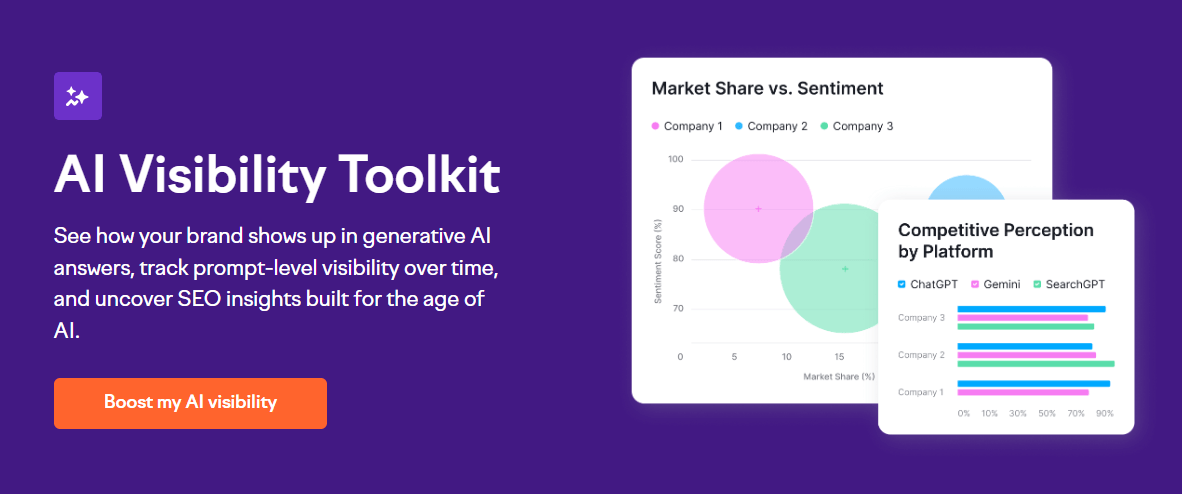
For SMBs and agencies, the AI Visibility Toolkit is the command center for the 2026 marketing landscape. It transforms raw LLM data into actionable growth levers.
Visibility Overview: The AI Visibility Score
The AI Visibility Score is your benchmark. It isn't an arbitrary number; it reflects how often your brand is mentioned compared to the median number of mentions for your top industry competitors.
Agency Use Case: Use the "Worldwide" view to show a multinational client their global share of voice, then drill down into specific regions like the UK or Japan to show where local competitors are outperforming them.
Competitor Research: Uncovering the Blueprints
This report allows you to see how AI platforms position your rivals. You can see the specific prompts where others are getting cited. This is essentially the "blueprint" of their success. If a competitor has a high Share of Prompts for a specific topic, you can analyze their page structure to see why the AI prefers their data.
Prompt Research: Keyword Research for the AI Era
Forget traditional search volume. Prompt Research focuses on topic-level volume, difficulty, and user intent.
Strategic Play: Instead of targeting the keyword "best CRM," you use this tool to find the most common complex prompts, such as "What is the best CRM for a 50-person marketing agency that needs HubSpot integration?" This allows you to create content that answers the exact prompts driving the highest conversion intent.
Brand Performance: Narrative and Sentiment Analysis
This is where the "Growth Marketing Strategist" persona really shines. This suite analyzes your Share of Voice (SOV), brand sentiment, and the key narratives driving your reputation.
It provides AI-generated strategic recommendations to refine your positioning. You can even view snapshots of each mention to see the context. If the AI is mentioning your brand but the sentiment is "neutral," the toolkit will suggest content pivots to move that sentiment toward "positive" or "authoritative."
Prompt Tracking: Daily Sentinel
High-value prompts require daily monitoring. If you are a travel brand, you want to know every single day if you are being recommended for "best summer flights to Italy." Prompt Tracking monitors your presence on Google AI Mode and ChatGPT daily.
Pro Tip: Set up alerts for sudden drops. If your visibility for a core prompt disappears overnight, it’s often a sign of a technical "visibility blocker" or a major update to the AI’s source preference.
AI Search Site Audit: Technical AI Search Health
The AI Search Health widget is a technical necessity. It flags potential blockers that prevent AI bots from crawling your content. You get a clear health score and a prioritized list of fixes. This is the foundation of AEO.
Technical Readiness: Is Your Website AI-Friendly?
Technical SEO in 2026 is no longer just about Googlebot. It’s about GPTBot, Google-InspectionTool, and a host of other LLM crawlers. If these bots can’t parse your site, you don't exist in the AI world.
Identifying Visibility Blockers
A "visibility blocker" isn't always a 404 error. In the context of AI Search Health, a blocker could be:
Javascript Rendering Issues: AI crawlers are often less "patient" than standard search bots. If your content is buried in complex JS, it may be ignored.
Robots.txt Misconfigurations: Many brands accidentally block AI crawlers while trying to prevent data scraping. You must ensure your site is accessible specifically to the tools used by Gemini and ChatGPT.
Unstructured Data: While AI is good at reading natural language, Schema.org and structured data provide the "scaffolding" that helps an AI cite you with 100% confidence.
The Site Audit Workflow
Use the AI Search Health widget within the Semrush Site Audit tool to run an on-demand check. The tool will flag issues that specifically impact AI indexing. For an agency, providing a client with an "AI Readiness Report" that shows a 95% health score is a powerful way to demonstrate technical leadership.
Real-World Impact: Case Studies and Success Metrics
The transition to AI Visibility isn't theoretical; it’s producing massive, measurable ROI for early adopters.
Coalition Technologies: The Power of the Score
Coalition Technologies integrated the Semrush AI Visibility Score into their core client reporting. The result? A 429% boost in AI referral traffic and a 547% increase in conversions from LLMs.
President Jordan Brannon notes that the question has shifted from "Are we ranking?" to "Are we ranking inside the LLM?" By using the score to guide their content strategy, they ensured their clients were not just "there," but were the primary recommendation.
Sure Oak: Dominating AI Overviews
Sure Oak focused on being listed as a source in Google AI Overviews. By identifying visibility gaps and optimizing their content for citation potential, they achieved:
A 286% increase in Google AI Overview appearances.
A 41% month-over-month increase in ChatGPT referrals.
40% of all new leads now come directly through AI visibility.
SEO Director Andrea Schultz highlights that being featured in an AI answer is the new "Position Zero." These wins prove that the 4.4x conversion rate isn't just a statistic, it’s a reality for brands that take AEO seriously.
Pricing, Plans, and Scaling Your AI Strategy
The AI Visibility Toolkit is designed to scale with your brand, whether you are a solopreneur or a global agency.
Standalone Pricing
For $99 per month, you get a powerful entry point into the world of AI analytics:
1 Folder and 1 Domain for Brand Performance analysis.
300 daily queries in AI Analysis reports.
1,000 daily queries in Prompt Research.
25 prompts for daily Prompt Tracking.
AI Search Checks for up to 100 pages in Site Audit.
10 CSV exports daily (up to 1,000 rows per export).
Semrush One Bundles
For teams that need a unified view of traditional SEO and AI Visibility, the Semrush One plans are the most cost-effective option:
Starter: Monitor up to 5 websites and 50 prompts.
Pro+: Monitor up to 15 websites and 100 prompts.
Advanced: Monitor up to 40 websites and 200 prompts.
Business Intelligence for Agencies
Agencies can scale their operations by purchasing additional limits.
Additional Domains for Brand Performance: $99 per domain per month.
Additional Prompts: 50 more prompts for $60 per month.
Annual Billing: If you add the toolkit to an annual subscription, you pay a one-time prorated amount for the remainder of your term. This is a critical feature for agency owners managing annual budgets.
For corporate accounts, access can be shared by adding licenses ($99 each) for subusers, ensuring your entire team, from content creators to tech leads, has access to real-time AI data.
Global Reach and Methodology
Semrush’s data is unmatched in its geographical and technical scale. While the benchmark study focused on 126 million US prompts, the toolkit supports a truly global strategy.
Geographical Coverage
Visibility Overview and Research: Supports 40+ countries, including major markets like the US, UK, Japan, Germany, Brazil, and India.
Prompt Tracking: Offers the broadest reach, supporting 220+ countries and territories.
Brand Performance: Offers more than 68,000 options worldwide, allowing you to track visibility at the country, state, or even city level.
Data Freshness
In the fast-moving world of AI, yesterday's data is ancient history. Semrush ensures your insights are current:
Daily Updates: Visibility Overview, Competitor Research, Prompt Research, and Prompt Tracking are updated daily on a rolling basis.
Weekly Updates: Brand Performance reports.
On-Demand: AI Search Site Audits can be run as often as you need to verify technical fixes.
Conclusion: Preparing for the Future of Discovery
In 2026, the definition of "being found" has changed forever. Traditional SEO is now the foundational layer, but AI Visibility is the ceiling. You can no longer afford to ignore how ChatGPT describes your brand or which sources Gemini uses to validate its recommendations.
The projection is clear: by 2028, AI will be the primary gateway to the internet. The brands that win will be those that master the balance of Mentions (Visibility) and Citations (Authority). They will be the ones who audit their AI Search Health today and take control of their brand narrative within the LLM ecosystem.
Take control of your AI Visibility Score. Benchmark your brand against the competition, identify your visibility gaps, and ensure your website is ready for the bots that are shaping the future of commerce. The future of discovery is conversational, make sure your brand is the one the machines are talking about.



Created with © Systeme.io
Disclaimer: This page contains affiliate links. If you purchase through these links, we may earn a commission
at no extra cost to you. We only recommend tools we trust.