Semrush AI Visibility Toolkit Review: Boost Your AI Search Rank
Semrush AI Visibility Toolkit Review: Boost Your AI Search Rank
Introduction: The New Era of "AI Discovery"
For nearly two decades, the SEO industry has been built on the "ten blue links" model. We optimized for positions, tracked SERP volatility, and aimed for page one. But the landscape has shifted. Search is no longer just a retrieval exercise; it’s a conversation. With the explosion of Large Language Models (LLMs) like ChatGPT, Gemini, and Google’s AI Overviews, users are shifting toward "AI Discovery", where answers are synthesized and brands are recommended directly within the chat interface.
If you feel like you’re "flying blind" in this new environment, you aren’t alone. Traditional tracking doesn't capture mentions inside a generated response. To survive the potential "traffic cliff" as AI takes over top-of-funnel real estate, you need a Generative Engine Optimization (GEO) strategy. The Semrush AI Visibility Toolkit is the first comprehensive GEO dashboard designed to help you measure, optimize, and protect your brand’s presence where it matters most. This is your unfair advantage to move from guessing to leading.
What is the Semrush AI Visibility Toolkit?
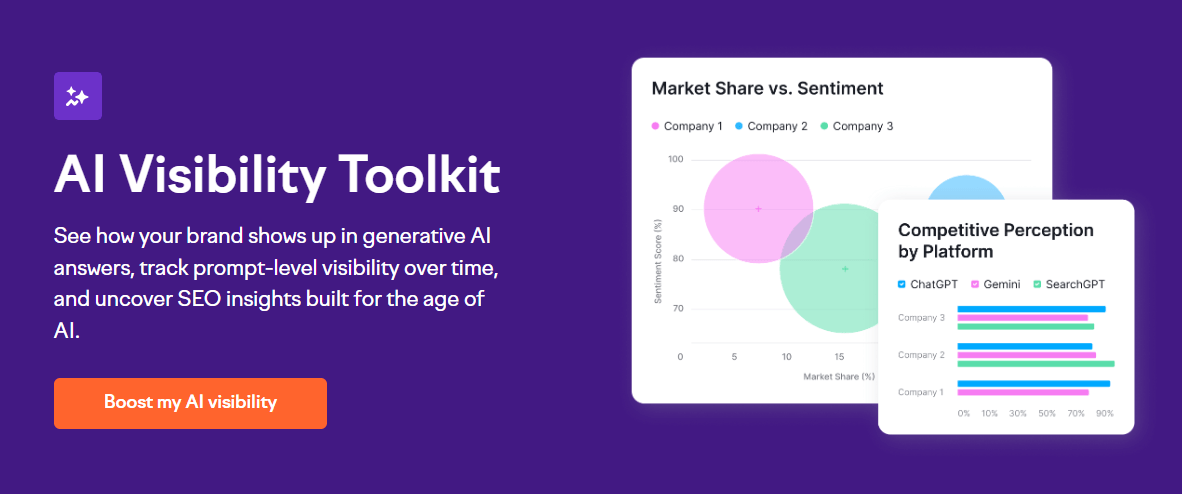
The Semrush AI Visibility Toolkit is a specialized suite built to measure brand presence within AI-generated answers. It moves beyond traditional rankings to monitor mentions and citations across the AI ecosystem, providing the data needed to understand how LLMs perceive and recommend your brand.
Primary Users & Use Cases:
SMBs and Marketing Teams: Benchmarking current AI presence to prevent brand cannibalization by rivals.
SEOs and Full-Stack Marketers: Identifying technical "AI blockers" and adapting semantic density to improve citation rates.
Agencies: Providing clients with clear, ROI-focused reports on AI search authority and competitive share of voice.
Product Managers: Monitoring real-time brand sentiment and perception across global conversations.
The mission is simple: provide a scalable way to monitor your brand’s narrative across AI systems so you can claim your share of the AI search landscape.
The Engine Under the Hood: Data Sources and Reliability
This toolkit is powered by a massive, proprietary 239M+ prompt database. Unlike tools that rely on generic LLM APIs, Semrush captures real requests and responses from ChatGPT, Gemini, and Google’s AI ecosystems. This provides a "directional signal" that is far more accurate for high-level strategy.
To maintain this edge, the toolkit uses specific refresh cycles:
Data Refresh Cycles
Report Type Refresh Frequency
Visibility Overview Daily (Rolling basis)
Brand Performance Weekly
Prompt Tracking Daily
Site Audit On-demand
The system also features a sophisticated AI Brand Extraction System. This technology uses contextual semantic analysis to distinguish between brands with similar names. For example, it can accurately separate Tesla the EV manufacturer from Nikola Tesla the scientist or the Nikola Tesla Airport, ensuring your visibility metrics are never diluted by irrelevant data.
Deep Dive: The Visibility Overview Report
The cornerstone of the toolkit is the AI Visibility Score (0-100). This is a normalized benchmark that reflects how often and prominently your brand appears in AI-generated answers. Crucially, this score is calculated by benchmarking your mentions against the median number of mentions for your top industry competitors, giving you a realistic view of your market standing.
The report breaks down visibility into five key pillars:
AI Visibility Score: Your overall share of presence in the AI landscape.
AI Visibility Trends: Historical data to track your GEO growth over time.
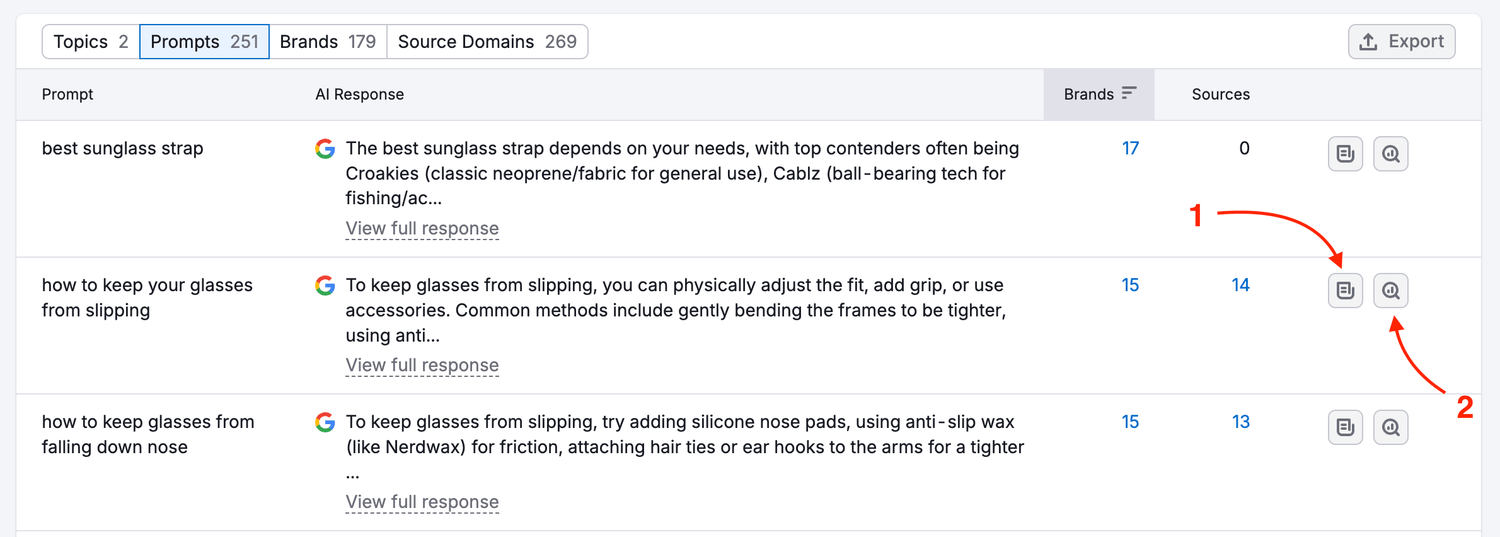
AI Mention Audit: A granular list of prompts where you are mentioned, and exactly where you are missing.
Direct Breakdowns: Analysis by LLM and geography (covering 15 regional databases including the US, UK, Germany, and Japan).
Topic & Source Opportunities: A roadmap of gaps where you can improve visibility.
The Distribution by LLM feature is a standout for strategists. You can toggle between Mentions and Cited Pages specifically for ChatGPT, Gemini, and Google AI Overviews to see which specific engine is driving (or hindering) your brand’s reach.
Benchmarking Against the Competition: Competitor Research
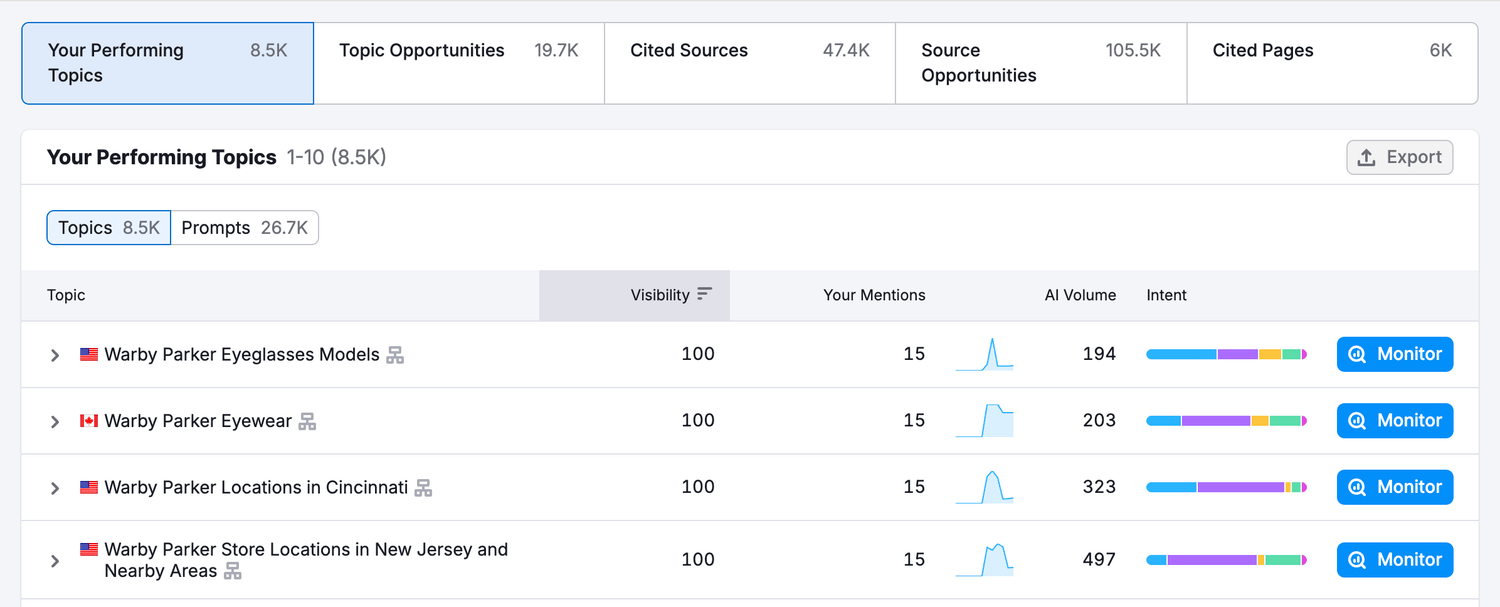
In the world of AI search, visibility is zero-sum. You can add up to four competitors to identify Topic & Prompt Gaps, specific queries where the AI cites your rivals but ignores you.
Use the Topic Opportunities and Source Opportunities tabs to see a direct comparison of the external domains the AI references.
Tactical Tip: High-Consensus Gaps. Sort your opportunities by "Competitors Mentioned." If three of your competitors are being cited for a specific prompt and you are not, the AI "consensus" has already formed against you. These high-consensus gaps should be your #1 priority for content seeding and outreach.
Keyword Research for the AI Era: Prompt Research
Think of Prompt Research as the next evolution of keyword research. Instead of looking at isolated strings, you are analyzing "semantic directions" or topics.
Two core metrics drive this analysis:
AI Topic Volume: An estimate of demand based on how often users engage with related semantic prompts.
Topic Difficulty: A calculation of how hard it is to break into the AI response. This is determined by competitor authority (how established the current mentioned brands are) and opportunity size (the number of available citation spots for that topic).
By analyzing user Intent, you can align your content strategy with the actual conversational needs of your audience.
Mastering the Narrative: Brand Performance & Sentiment Analysis
Mentions alone aren't enough; you need to own the narrative. The Brand Performance suite focuses on Share of Voice vs. Sentiment, ensuring your brand is not just mentioned, but recommended positively. This report covers over 68,000 locations worldwide for hyper-local tracking.
The suite includes four critical sub-reports:
Perception: Tracking sentiment trends over time.
Strategic Value: Monitor whether AI responses are shifting from neutral to positive after a campaign.
Narrative Drivers: Identifying top-cited domains and questions shaping the story.
Strategic Value: Pinpoint which third-party sites are most influential in how AI describes your brand.
Questions: The specific queries driving the conversation.
Strategic Value: Understand the exact prompts causing mentions of your brand across models like Gemini and SearchGPT.
AI-Generated Insights: Actionable strategic recommendations.
Strategic Value: The tool uses LLMs (including ChatGPT both with and without search mode/SearchGPT) to provide specific optimization steps based on your current data.
Monitoring and Technical Health: Prompt Tracking & Site Audit
Optimization requires constant vigilance. Prompt Tracking integrates with Position Tracking to provide daily monitoring across 220+ countries. You can track your visibility on ChatGPT Search and Google’s AI Mode, comparing AI performance side-by-side with traditional SERP rankings.
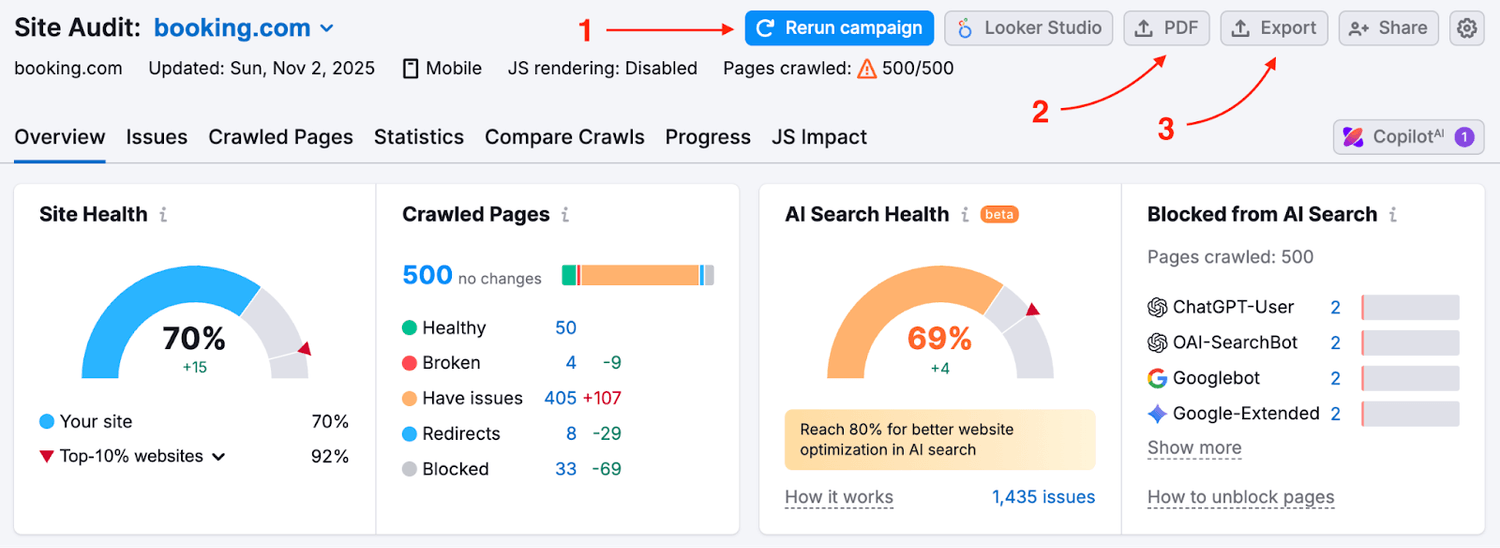
On the technical side, the AI Search Health widget in the Site Audit tool is mandatory for any technical SEO. It identifies technical blockers that prevent LLM crawlers from accessing your content.
Key flags include:
OAI-SearchBot Blocks: Ensuring your robots.txt isn't accidentally barring the very bots that build AI search indices.
Missing llms.txt: Ensuring your site provides the structured summary files LLMs prefer.
Stale "Last-Modified" Headers: Updating these is critical to show LLMs that your content is fresh and relevant.
From Insights to Action: A 5-Step Optimization Strategy
To win in the GEO landscape, apply this Source-Based Optimization workflow:
Benchmark (Visibility Overview): Establish your baseline AI Visibility Score relative to the industry median.
Analyze Gaps (Competitor Research): Identify the high-consensus gaps where rivals are dominating the conversation.
Target Topics (Prompt Research): Select topics with high volume and manageable difficulty.
Optimize & Seed: Use the following Source-Based Optimization Tactics:
UGC Gaps: If AI cites Reddit or Quora, engage in those communities to seed your brand naturally.
Competitor Media: If the AI cites a competitor's blog, create superior, more authoritative content to win the citation spot.
Non-Competitor Media: If the AI cites a third-party publication, use the AI PR Toolkit for outreach to secure a mention on that influential domain.
Track & Audit (Prompt Tracking and Site Audit): Monitor daily changes and ensure no technical blockers like OAI-SearchBot are hindering your progress.
Pricing, Plans, and Limits
The toolkit is flexible, offering both a standalone option for specialists and integrated bundles for power users.
Plan Type Features & Limits
Standalone Toolkit ($99/mo) 1 Folder; 1 Domain for Brand Performance; 300 daily AI analysis queries; 1,000 daily Prompt Research queries; 25 tracked prompts.
Semrush One Starter 5 Websites; 50 Tracked Prompts.
Semrush One Pro+ 15 Websites; 100 Tracked Prompts.
Semrush One Advanced 40 Websites; 200 Tracked Prompts.
Important Note on Limits: The standalone $99 plan includes 10 CSV exports per day (1,000 rows each), which is a per-user limit, perfect for individual consultants or small teams. If you need more tracking power, you can purchase an add-on of 50 additional prompts for $60/month.
FAQs
1. What Is the Semrush AI Visibility Toolkit?
The Semrush AI Visibility Toolkit is a specialized set of tools designed to help marketers and SEOs measure and improve their brand's presence within AI-generated answers. It provides a layer of visibility data beyond traditional search engines, tracking how brands are positioned across platforms like ChatGPT, Gemini, and Google AI Overviews. The toolkit is powered by a massive database of over 239 million prompts and offers daily updates on brand mentions, citations, and overall market share.
2. Why Choose Semrush AI Visibility Toolkit for Your SEO Needs?
Choosing this toolkit allows you to navigate the shifting landscape of AI-driven search with data-backed strategies. Key reasons to use it include:
Benchmarking: You can establish an AI Visibility Score (0–100) to see how your brand ranks against the industry median.
Sentiment Analysis: Unlike traditional SEO, this toolkit analyzes brand perception and narratives, helping you understand if AI platforms are discussing your brand positively or negatively.
Technical Readiness: It includes an AI Search Health widget in the Site Audit tool to identify technical issues, such as robots.txt blocks or missing llms.txt files, that prevent AI bots from crawling your content.
Competitive Intelligence: It identifies "Topic Opportunities", specific prompts where your competitors are mentioned but you are missing.
3. When Should You Use the Semrush AI Visibility Toolkit?
You should integrate this toolkit into your workflow when you need to adapt your marketing strategy for generative AI. Specifically, use it when:
Launching Optimizations: Use Prompt Tracking to monitor daily changes in visibility after updating your content for AI search.
Content Planning: Use Prompt Research when you need to discover what your audience is asking AI platforms to guide your new content creation.
Reporting: Use it to generate presentation-ready reports for stakeholders to prove the ROI of your AI visibility efforts.
Auditing: Run it during regular site maintenance to ensure your technical setup is AI-friendly.
4. How Does Semrush AI Visibility Toolkit Improve Your Visibility?
The toolkit improves visibility by turning raw data into actionable strategic recommendations. It helps you:
Close Gaps: By identifying "Source Opportunities," you can find external publications or UGC platforms (like Reddit or Quora) that AI systems cite, allowing you to target those sources for mentions.
Target High-Volume Topics: It provides topic-level volume and intent data, similar to keyword research, so you can prioritize prompts that will drive the most reach.
Refine Brand Narratives: By analyzing Narrative Drivers, you can see which specific questions are shaping your brand's story and adjust your PR and content strategy to influence those narratives.
Ensure Accessibility: It flags technical barriers, such as content that is too long for AI models or outdated headers, ensuring your site is cited as a trusted source.
5. Where to Find Tutorials for Semrush AI Visibility Toolkit?
Tutorials and educational resources can be found in several locations within the Semrush ecosystem:
Knowledge Base: Contains detailed "How-To" articles, report-specific documentation (e.g., Visibility Overview Report), and "Getting Started" guides.
Semrush Academy: Offers courses and learning paths to help you master the toolkit's features.
Semrush Blog: Features articles and deep dives into AI search optimization tactics and industry trends.
Help Center & Webinars: Provides ongoing support through live sessions and updated documentation on new features.
Conclusion: Why You Can’t Afford to Wait
The transition from traditional SEO to AI Discovery is the biggest shift in digital marketing since the mobile revolution. AI responses are fast-changing and highly personalized, making reliable "directional signals" from a massive database like Semrush’s non-negotiable.
You cannot manage what you do not measure. By tracking your AI Visibility Score, closing competitor gaps, and securing your technical readiness, you move from being a passive observer to an active leader in the AI search landscape. Don't wait for the traffic cliff to hit, secure your brand's future today.



Created with © Systeme.io
Disclaimer: This page contains affiliate links. If you purchase through these links, we may earn a commission
at no extra cost to you. We only recommend tools we trust.