AI Visibility: How to Track & Grow Your Brand Presence in LLMs
AI Visibility: How to Track & Grow Your Brand Presence in LLMs
Welcome to the era where search is no longer limited to a Google box. The rise of powerful language models, like ChatGPT, Bard, and others, has flipped the script for digital visibility, fundamentally changing how users discover, evaluate, and choose brands. Businesses that want to lead the conversation must master a new discipline: AI Visibility.
If you’ve ever wondered why your brand shows up (or doesn’t) in AI-generated responses, or how LLMs (large language models) are influencing buying decisions, you’re in the right place. In this definitive guide, we’ll dive deep into tracking and growing your brand presence in LLMs, blending technical know-how with actionable strategies. Whether you’re an SEO professional, marketer, or business owner, get ready to transform your approach to search for the AI age.
What Is AI Visibility?
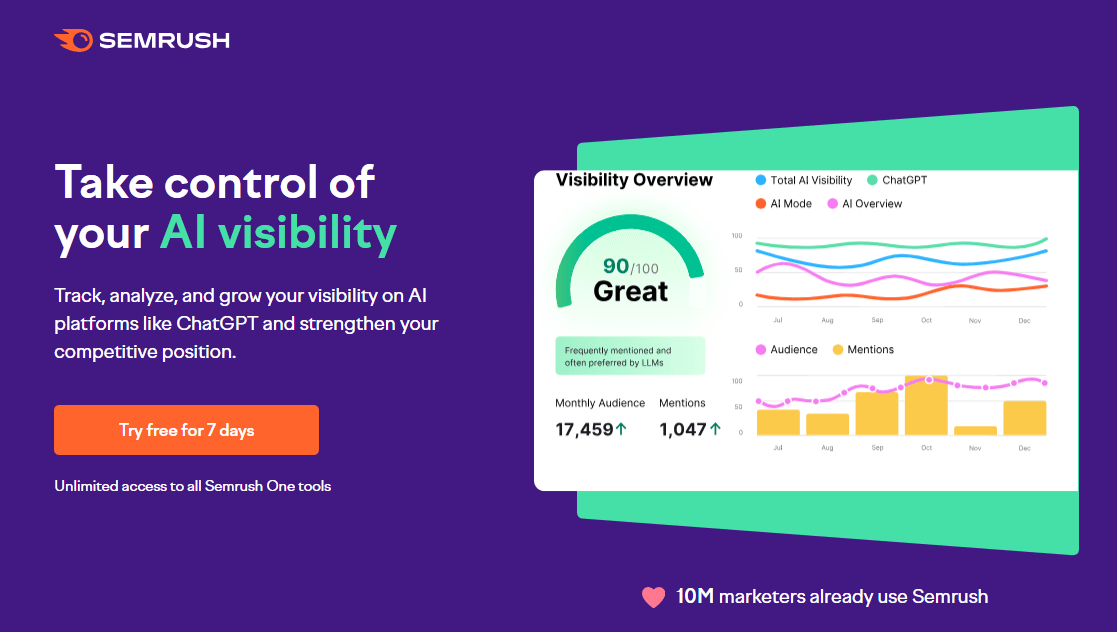
Let’s kick things off with the basics. AI Visibility is all about understanding, measuring, and improving the presence and perception of your brand within the responses and citations generated by AI-powered tools, primarily LLMs like ChatGPT, Google Bard/Gemini, Microsoft Copilot, and their many integrations.
While traditional SEO focuses on getting your website to rank higher in search engine results, AI Visibility zooms in on how (and how often) your brand, products, or content get referenced, cited, or recommended in the answers created by AI tools.
Why does it matter? Because these AI responses are increasingly what prospective customers see first. When a potential buyer asks an LLM for the “best project management software,” or a recommendation for eco-friendly skincare brands, which names appear, and which are omitted, can make or break your opportunity to win that customer.
Why LLMs Are the New Discovery Frontier
Remember the early days of “Googling” everything? Today, millions turn to AI assistants for quick answers, advice, or product recommendations, often bypassing traditional web search entirely.
What’s changed?
LLMs are everywhere: From search engines to smartphones and customer service chatbots, LLMs like ChatGPT, Gemini, and Bing Copilot power the answers people trust.
Conversational recommendations: Instead of a list of URLs, users often get concise, confident-sounding answers with the top brands, sources, or explanations directly embedded.
Authority matters: LLMs prioritize trustworthy, authoritative sources when compiling responses, making brand credibility more crucial than ever.
Why brands can’t ignore LLMs:
Discovery happens in the answer: If your brand isn’t cited or referenced in these responses, you lose awareness and sales opportunities.
Competitor leapfrogging: Rivals optimizing for LLM visibility can win share of voice (and wallet) even if they’re not ranking #1 on Google.
Sentiment and narrative: LLMs aren’t just parroting facts; they relay sentiment, reviews, and opinions. Getting mentioned positively can amplify your brand’s reputation, while negative mentions can quietly erode it.
How LLMs Find and Cite Information
To show up in AI-generated answers, you have to understand how these models decide what to say, and where brands fit in.
LLMs Use Three Key Inputs:
1. The Model’s Training Data:
LLMs ingest vast swaths of public internet content, reputable databases, and sometimes even proprietary subscription sources. Content that’s widely referenced, well-structured, and authoritative is more likely to influence LLM outputs.
2. Real-Time Web Index (for some models):
Some LLMs access live web data, crawling trusted sources to supplement or verify their knowledge base. This means your most up-to-date, optimized content can shape LLM responses if it’s easily accessible and understandable.
3. Prompt Context and User Intent:
How people phrase their questions matters. LLMs parse a prompt’s nuance to decide what type of answer (and which sources/brands) are most relevant, so semantic optimization and understanding intent are critical.
How LLMs Choose What to Mention:
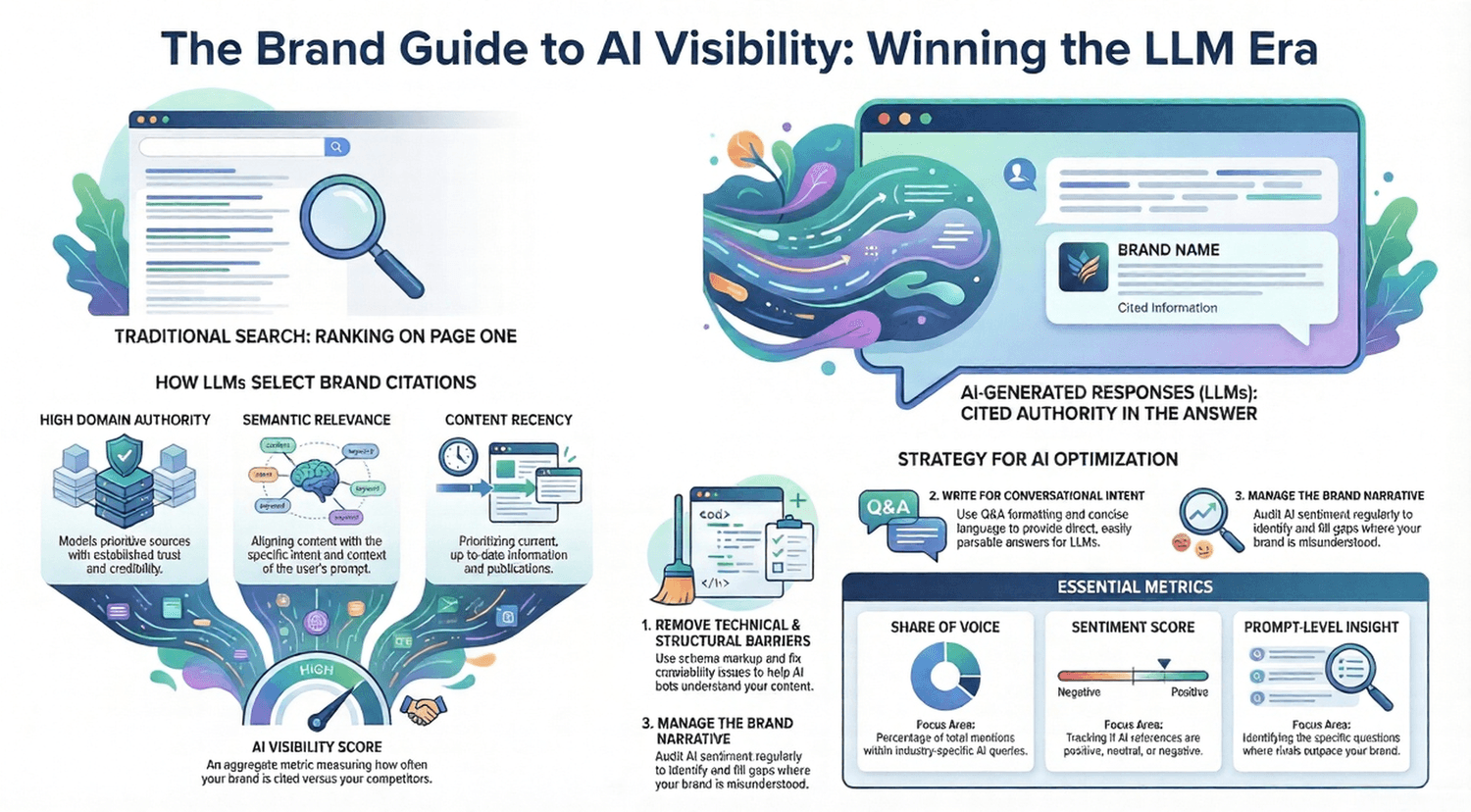
Authority & Trust Signals: Brands with high domain authority, frequent editorial citations, and positive sentiment are favored.
Relevance: Content that closely matches the specifics of the question has a better chance.
Recency (in some cases): Fresh, frequently updated sources are surfaced more, especially by LLMs that check the web in real time.
Bottom line: To be mentioned, your brand and content must be both visible to LLMs and compelling enough to be referenced over competitors.
Tracking Your Brand’s AI Visibility
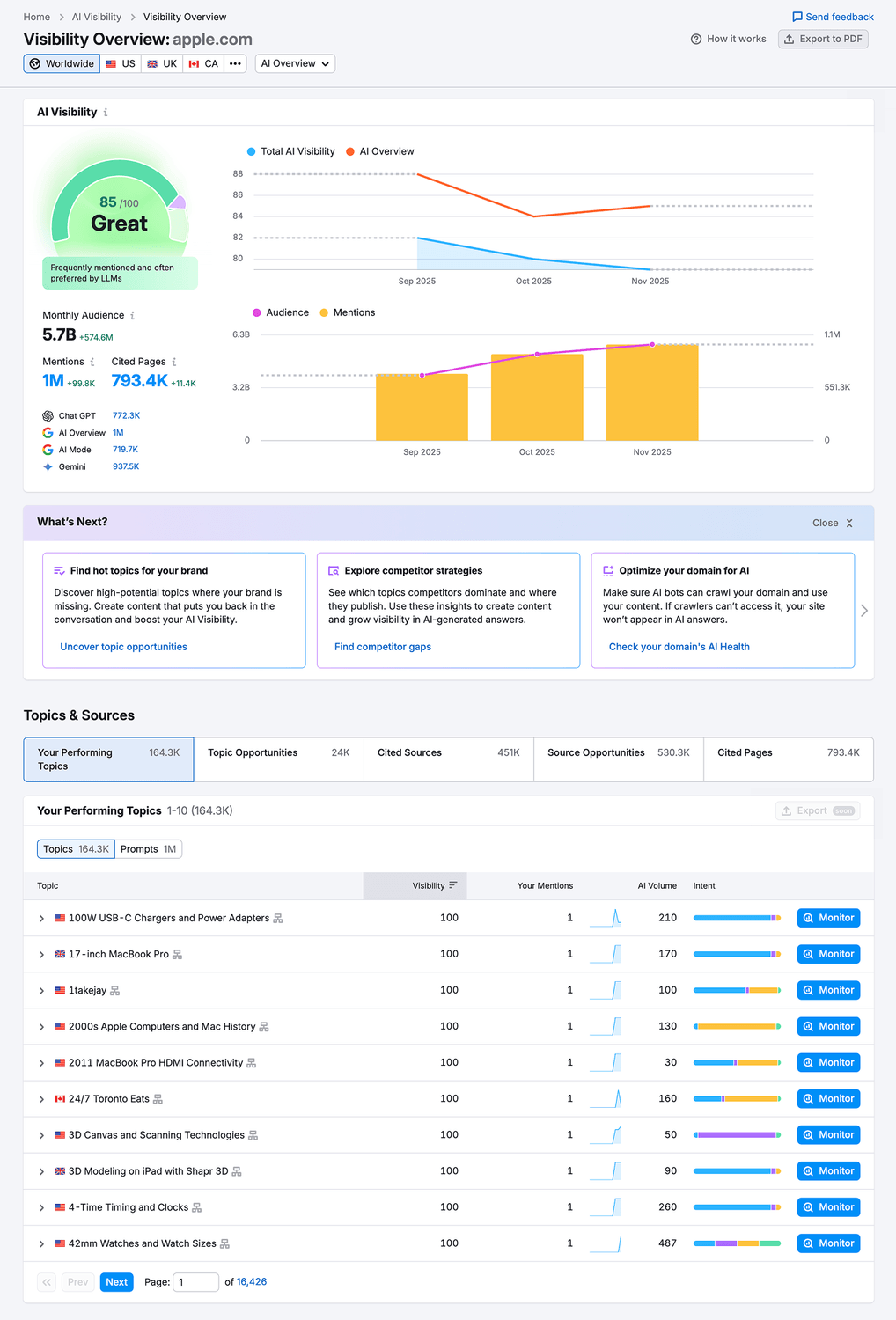
Now for the million-dollar question: How do you actually track your brand’s presence and share of voice in LLMs?
Essential Metrics to Monitor
AI Visibility Score: An aggregate measure showing how often your brand is cited in AI-powered responses versus your competitors.
Share of Voice in AI Platforms: The percentage of total mentions your brand achieves within your industry’s common AI queries.
Top Prompts & Mentions: The most relevant, high-traffic prompts where your brand appears (or doesn’t!).
Authority & Sentiment Metrics: Not just if you’re mentioned, but how, is the AI referencing you positively, neutrally, or negatively?
Platform-Specific Performance: Analysis tailored to ChatGPT, Bard, Bing Copilot, and others, since each has unique data sources and bias.
How to Start Tracking
Today, you can leverage all-in-one AI Visibility toolkits (like those offered by Semrush), which allow you to:
Monitor relevant mentions and citations in LLM responses.
Filter by AI platform, source, or intent to see where you’re strongest, and weakest.
See daily visibility changes for crucial prompts, letting you quickly spot trends or issues.
Access prompt-level insights: Uncover the real questions your audience is asking, fueling both content ideation and optimization.
Benchmark against competitors: Instantly identify prompts, sources, and contexts where rivals outpace you.
Pro tip: Don’t just set and forget. Schedule regular audits, so you’re always up-to-date on your brand’s standing in the fast-evolving AI landscape.
Identifying Competitor Gaps
Tracking your own brand is only half the battle. To dominate AI visibility, you need to know where competitors are winning, and why.
What to Watch for
Prompts and sources where competitors are cited but you’re not.
Analysis of rival mentions: Is their content more authoritative, more recent, or better structured for AI parsing?
Sentiment comparison: Are competitors getting more favorable sentiment in AI responses?
Source breakdown: What kinds of sources (media, blogs, reviews) are fueling their mentions?
How to Close the Gap
Benchmark regularly: Use AI visibility tools to keep a running scorecard of your share of mentions versus top competitors.
Investigate missing mentions: Analyze prompts where rivals appear but you don’t. What are they doing right? Is it content depth, reviews, partnerships, or technical SEO?
Spot missed opportunities: Identify high-value, trending topics or questions in your niche that aren’t yet saturated, then move quickly to fill the void with great content.
Competitive analysis in the AI age isn’t just about “keywords”, it’s about understanding and intercepting the conversation before your rivals do.
Optimizing Content for AI and LLM Citation
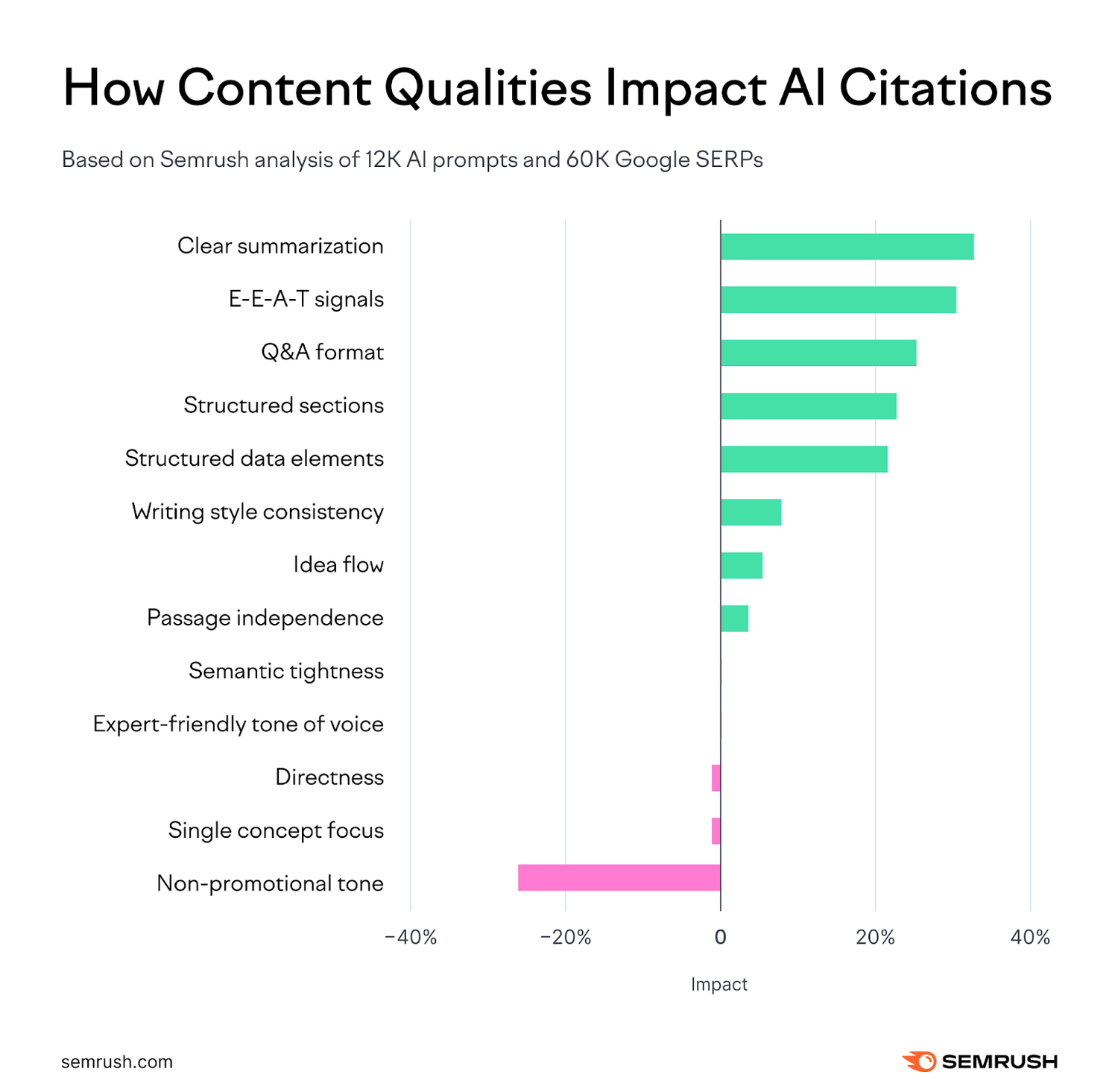
If you want LLMs to cite you, your content must not only be discoverable, but also seen as the best possible answer.
Steps to Optimize for AI Search
1. Remove Barriers to Visibility
Ensure crawlability: Fix robots.txt or meta tag issues that might block AI bots.
Use schema markup: Structured data helps LLMs understand content context and relationships.
Prioritize mobile and speed: Many AI assistants pull data from mobile web experiences.
2. Write With AI Audiences in Mind
Anticipate key prompts/questions: Build robust, FAQ-rich content around common industry queries.
Use clear and concise language: Complex jargon can trip up language models.
Provide direct answers: LLMs love concise, high-authority summaries, but don’t neglect depth for supporting queries.
3. Build Authority and Trust
Earn high-quality backlinks and citations from respected brands and publishers.
Highlight expert credentials and up-to-date research.
Encourage authentic, positive user reviews and testimonials.
4. Keep It Fresh and Relevant
Regularly update and expand pillar content.
Monitor emerging topics in your field and respond quickly with new content.
5. Strengthen Source Signals
Clearly attribute data or claims with reputable sources.
Use original insights, statistics, or case studies, uniqueness sets you apart in the “training data” arms race.
6. Optimize for Featured Snippets and Summaries
Use question-and-answer formatting.
Format with lists, bullet points, and concise explanation blocks, these are easily parsed and cited by LLMs.
Remember: LLMs reward clarity, authority, and user intent alignment. The better your content answers real user needs, the more likely you’ll earn those coveted citations.
Owning Your Brand Narrative in AI
It’s not enough just to appear in AI answers, you want to be presented in the best possible light. That means actively managing your brand sentiment and narrative in LLMs.
How to Benchmark and Influence Brand Sentiment
Monitor AI-generated mentions: Use tools to track positive vs. negative mentions in LLM responses.
Identify narrative gaps: Where is your brand misunderstood, under-represented, or mischaracterized?
Proactively address weaknesses: Publish content that clarifies your brand story, debunks myths, or highlights strengths overlooked by current AI coverage.
Collect and amplify testimonials: Positive reviews, awards, and media features can help train LLMs, and the editors who curate their sources, to favor your brand.
Steps to Own Your Narrative
Regular sentiment auditing: Mark monthly/quarterly to spot trends, early detection of negative sentiment is critical.
Strategic content creation: If AI sources are missing your new features or unique value, build content that highlights these differences.
Brand messaging consistency: Ensure your value prop, mission, and differentiators are universal across your owned and earned content.
PR for the AI era: Amplify positive coverage, respond to negative incidents transparently, and build connections with journalists or thought leaders whose work impacts LLM inputs.
The brands that shape their narrative today will be tomorrow’s trusted citations.
Integrating AI Visibility with SEO
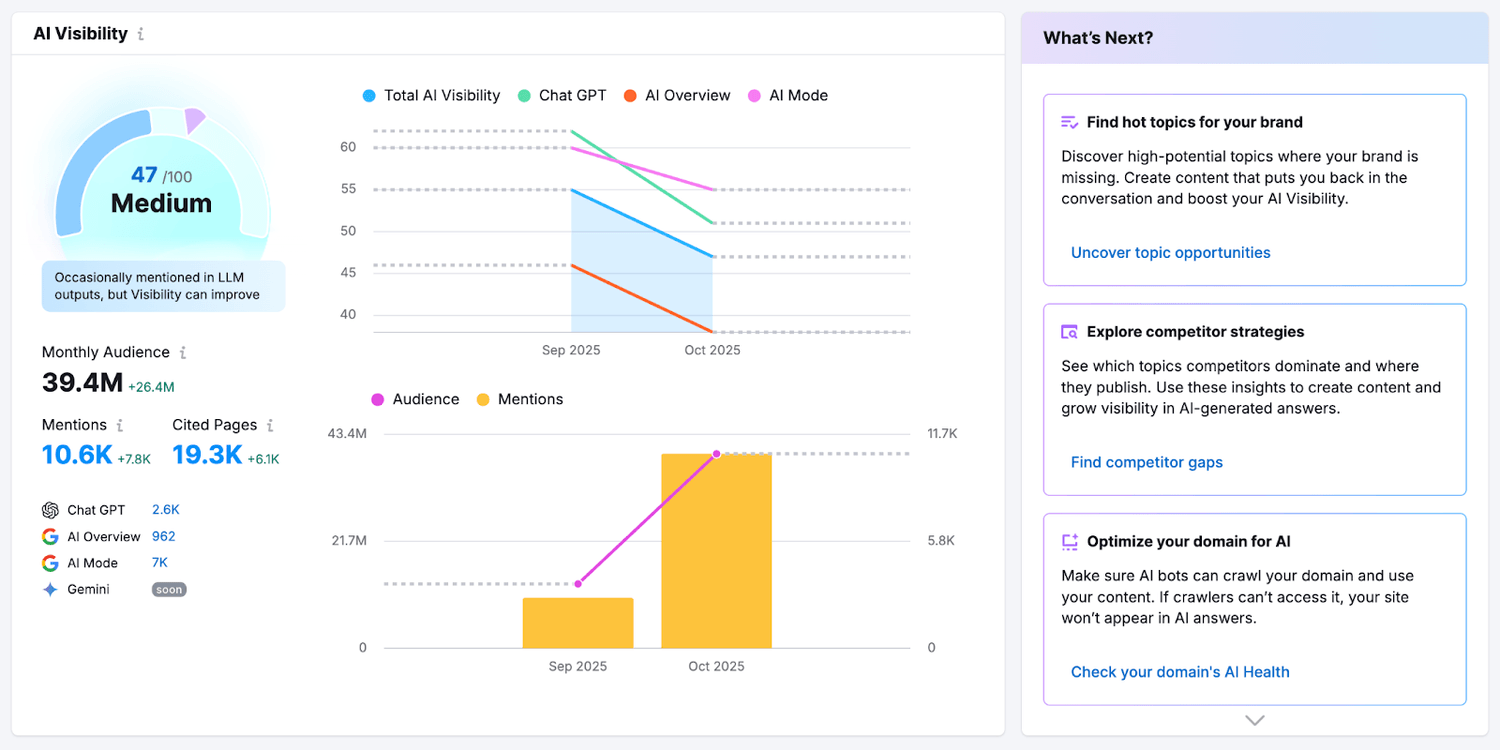
AI Visibility isn’t here to replace SEO, it makes it more important than ever. The two disciplines work best together, as part of an integrated digital strategy.
How AI Visibility Complements SEO
Extends reach beyond SERPs: Even if you don’t top Google rankings, optimized content may still surface in AI answers.
Reinforces authority signals: Technical SEO improvements (site structure, schema, E-E-A-T) are valued by both search engines and LLMs.
Uncovers new keyword and topic opportunities: AI prompt analysis reveals how real users phrase questions (often missing from keyword tools).
Accelerates content ideation: By analyzing trending prompts in your category, you can continuously produce relevant, timely content.
Practical Steps for Integration
Sync reporting: Combine your SEO and AI visibility metrics for a full picture of digital authority.
Optimize for both: Apply best practices that benefit both Google (SEO) and LLMs (clarity, authority, Q&A, structured data).
Continuous improvement loop: Use insights from AI prompt monitoring to refine both your content strategy and technical optimization.
The takeaway: The more you synchronize your SEO and AI visibility strategies, the stronger your digital brand moat becomes.
Proving the ROI of AI Visibility
As marketing budgets face more scrutiny, being able to prove and quantify the impact of your AI visibility efforts is crucial.
Key ROI Metrics
Increase in AI platform mentions/citations (before vs. after optimization).
Growth in AI-derived traffic and conversions (as platforms begin surfacing your brand more).
Positive change in share of voice relative to competitors.
Improved AI sentiment scores and user trust signals.
Connecting the Dots: Tracking Traffic from AI
Analytics integration: Modern toolkits allow you to connect AI visibility dashboards with Google Analytics, revealing how AI-driven mentions correlate with spikes in website visitors, leads, or sales.
Custom reporting: Generate branded dashboards that show AI visibility trends alongside traditional SEO and web analytics.
Attribution modeling: As AI assistants start driving more direct web or commerce referrals, expect attribution tools to evolve, track early signals now to inform long-term strategy.
Future-Proofing Your Efforts
Stay agile: As LLMs become more transparent (and trackable), keep updating your approach.
Educate stakeholders: Internal champions are critical, demonstrate the bottom-line impact of leading in AI-driven discovery and reputation.
The Future of Brand Discovery: Trends to Watch
Staying ahead means anticipating where the AI landscape is headed. Here’s what smart brands are watching:
Increasing Transparency in LLM Sourcing
Leading models are beginning to clarify which sources inform their responses, giving marketers more actionable data to optimize for.
Integration of Real-Time Data
LLMs powered by real-time information (including the latest news, reviews, and social signals) will reward brands that prioritize current events and agile content strategy.
Conversational Commerce
As users get comfortable buying directly through AI assistants, brands with strong AI visibility will capture more direct sales, potentially bypassing traditional web “funnels” entirely.
Platform Fragmentation
Each LLM (ChatGPT, Bard/Gemini, Bing, etc.) has its own quirks, data pipelines, and bias, savvy brands will tailor their AI visibility efforts by platform type for maximum impact.
Regulatory and Ethical Considerations
Expect more scrutiny into how LLMs select sources, handle bias, and manage “hallucinations.” Brands will need to be transparent, accurate, and proactive as the ecosystem matures.
Takeaways & Next Steps
AI Visibility isn’t a fleeting trend. It’s the new table stakes for brand discovery, reputation, and growth. Here’s how to get started today:
Five-Step AI Visibility Action Plan
Audit Your Current AI Presence:
Use visibility tools to benchmark your brand’s mentions, sentiment, and gaps in leading LLMs.
Analyze and Learn from Competitors:
Identify where and how they’re cited, and why users trust them.
Invest in AI-Optimized Content:
Update old assets and build new, authoritative resources targeting the prompts your audience asks AI assistants.
Monitor, Adapt, Repeat:
The AI landscape evolves fast, commit to continual improvement, sentiment monitoring, and agile content updates.
Champion AI Visibility Internally:
Educate your teams and stakeholders on its importance, building alignment ensures a sustained, leadership-first approach.

Final Thoughts: Becoming the Brand AI Recommends
The next wave of digital leaders will not simply win on Google, they’ll dominate the conversational landscape that shapes daily decisions. With the right blend of SEO, content strategy, and AI visibility know-how, you can make your brand the one that LLMs, and the people who trust them, recommend first.
Ready to take your AI visibility to the next level? Start tracking, optimizing, and shaping the conversation, because in the AI-powered future, visibility is everything.
Stay tuned for more guides, insights, and strategies on leading in the age of AI discovery. The future of search, and your brand’s role in it, starts now.



Created with © Systeme.io
Disclaimer: This page contains affiliate links. If you purchase through these links, we may earn a commission
at no extra cost to you. We only recommend tools we trust.