AI Visibility Strategy for B2B Brands: Master LLM Citations Now
AI Visibility Strategy for B2B Brands: Master LLM Citations Now
The search landscape is no longer a battle for "blue links." It has evolved into a war for synthesis. We are witnessing a fundamental pivot in how information is discovered, processed, and consumed. Traditional Search Engine Optimization (SEO), once focused solely on ranking high enough to earn a click, is being superseded by AI Visibility. In this new era, Large Language Models (LLMs) like ChatGPT, Perplexity, Claude, and Google’s AI Overviews act as the ultimate intermediaries, filtering, evaluating, and synthesizing the entire web into singular, direct answers.
If your brand is not part of that synthesis, you are invisible.
The objective is no longer just capturing search volume; it is what strategist Andrew Holland calls "Fame Engineering." This is the strategic process of increasing your brand’s relative fame and authority within a specific market to the point where AI systems view your brand as a foundational entity. This is not about vanity metrics; it is about driving organic revenue growth. When an LLM cites your content, it provides a level of third-party validation that traditional search results never could. AI Visibility is the bridge between being a "result" and being the "answer."
The B2B Case for AI Visibility: Why Citations are the New Currency
For B2B organizations, the shift toward AI discovery is a massive opportunity for those who act while the competitive window remains open. Current research into user behavior reveals a startling trend: AI search visitors convert 4.4 times better than traditional organic visitors.
This disparity exists because the "discovery-to-decision" loop is significantly shorter in AI environments. By the time a user clicks a citation link in Perplexity or ChatGPT, the AI has already educated them, compared your solution against competitors, and validated your expertise. You aren't receiving a cold lead; you are receiving a pre-qualified prospect who has already been sold by the AI’s synthesis.
To capture this value, B2B brands must master the "AI Funnel," a framework pioneered by David Schneider at Earned Media Australia. This model replaces the traditional linear funnel with a three-tiered approach to AI-driven discovery:
Top (Visibility, Mentions, and Citations): This is where Fame Engineering lives. The goal here is establishing your brand within the "consideration set." If an LLM is asked about your industry and fails to mention your brand or cite your data, you have failed at the most foundational level.
Middle (Visual Proof and Recommendations): At this stage, the AI doesn't just know you exist; it recommends you. This involves appearing in highly targeted prompts, such as "best enterprise CRM for mid-market manufacturing", where your brand is presented with visual proof (such as a bulleted list or a table) as a top-tier option.
Bottom (Referral Traffic and Conversions): This is the final conversion point. Platforms like ChatGPT Search and Perplexity provide direct citations and source links. Turning these citations into clicks requires high-density, authoritative content that makes the user want to "see more" of the source data.
While traditional SERPs are saturated and difficult to disrupt, AI platforms are currently "citation-hungry." They are looking for authoritative data to fuel their responses. If you provide the most parseable, accurate, and expert data, you win the citation.
The AI Visibility Audit: Establishing Your Baseline
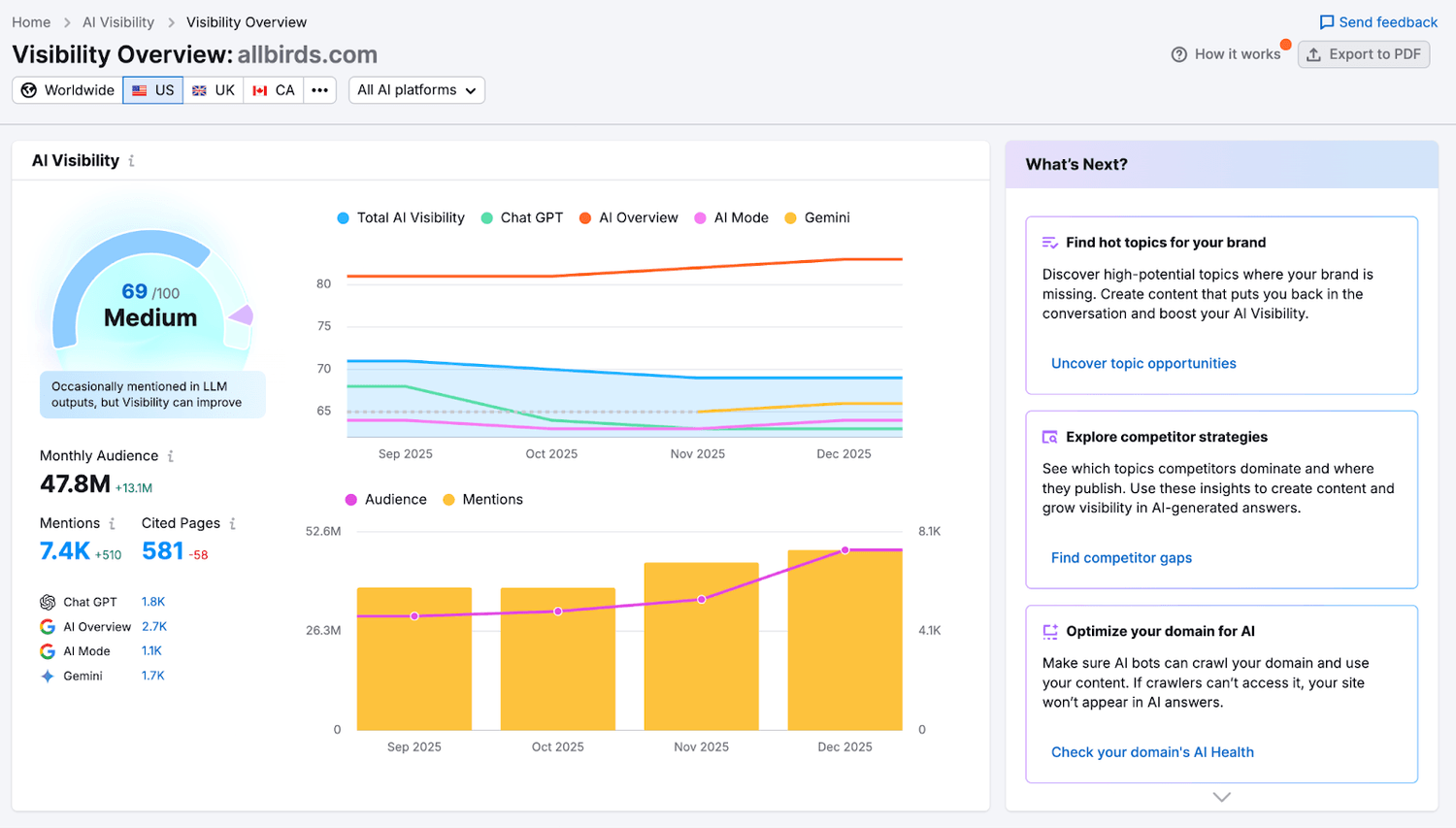
A non-negotiable first step for any brand is the AI Visibility Audit. You cannot optimize what you haven't measured. Using the methodologies of the Semrush AI Visibility Toolkit, you must move beyond anecdotal evidence (searching your brand name once) and into data-driven benchmarking.
Step 1: Benchmark Your AI Visibility Score
The AI Visibility Score is your primary metric. It measures how frequently your brand is mentioned in AI-generated answers relative to the median number of mentions for your top industry competitors. A daily monitoring cadence is essential here; AI responses are inherently inconsistent. SparkToro research has shown that asking the same question 100 times can produce nearly 100 different brand lists. You need an automated baseline that accounts for these fluctuations across ChatGPT, Google AI Overviews, Gemini, and Perplexity.
Step 2: Identify "Citation-Worthy Content"
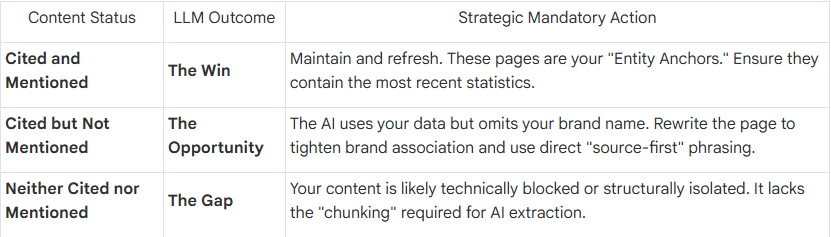
Using the Visibility Overview report, you must categorize your current content performance. The audit should focus on the "Missed" vs. "Mentioned" toggle within the UI to identify high-value opportunities.
Step 3: Identify Topical and Sentiment Gaps
The Topic Opportunities section of your audit reveals where AI recommends your competitors but ignores you. For example, if you are a B2B SaaS provider in the HR space and competitors are consistently cited for "remote team retention strategies" while you are missing, you have a topical gap.
Furthermore, you must analyze the Key Sentiment Drivers. AI doesn't just rank URLs; it assigns attributes. If the AI perceives a competitor as "innovative" while your brand is described as "legacy," you have a narrative gap that requires immediate content intervention.
Step 4: Assess Off-Site Influential Sources
LLMs do not look at your website in a vacuum. They are trained on massive datasets that include Reddit, YouTube, Quora, LinkedIn, and Medium. Your audit must include a check of "Cited Sources." If you find that for your core topics, AI frequently cites Reddit threads or YouTube transcripts, you must establish a presence on those platforms. AI systems use these UGC platforms to "socially proof" their recommendations.
Technical Foundations: Ensuring AI Systems Can "See" You
Technical SEO in the GEO era is about accessibility and interpretability. If an AI crawler cannot "read" your site or understand the relationship between your pages, it will never cite you.
The AI Access Checklist
Verify that your robots.txt file is explicitly allowing access to the "Big Three" crawlers that power the majority of generative search:
GPTBot: The primary crawler for OpenAI and ChatGPT.
CCBot: Used by Common Crawl, a foundational dataset for many LLMs.
Claude-Web: The crawler for Anthropic’s Claude.
The llms.txt Standard: One of the most important emerging technical signals is the llms.txt file. Located in your root directory, this file provides a clear, markdown-based map of your site’s most important content specifically for LLM interpretation. It acts as a "cheat sheet" for AI crawlers, helping them bypass fluff and get straight to your most authoritative data.
Identifying and Removing Technical Blockers
The AI Search Health widget in the Semrush Site Audit tool is your diagnostic engine for these issues. You must hunt down and resolve:
1. Weak Internal Context: Links that lack descriptive anchor text (e.g., "click here" vs. "our 2024 B2B email marketing report") fail to provide the "entity" signals AI needs to categorize your content.
2. Structurally Isolated Pages: Pages with only one incoming internal link are effectively invisible to many AI systems. Every high-value page should be part of a robust topic cluster.
3. JavaScript-Only Navigation: While crawlers are getting better, content that requires complex client-side rendering is a significant risk. If an AI crawler can't see the text without executing JS, it likely won't cite it.
4. Paywalls and Login Walls: If your "expert" data is gated, it does not exist to an LLM. Consider providing a "public summary" of gated reports that contains the key statistics and conclusions to earn the citation.
Five Pillars of Content Optimization for AI Search (GEO)
Generative Engine Optimization (GEO) requires a shift from "writing for humans with SEO in mind" to "writing for synthesis." This means creating content that is modular, authoritative, and data-dense.
Pillar 1: Statistics and Data (The "Source-First" Model)
AI systems are designed to summarize, but they crave evidence. Content containing specific, sourced statistics is cited significantly more often than qualitative claims.
Before: "Email marketing remains a highly profitable channel for most B2B companies." (Too vague, no citation value).
After: "Email marketing generates $42 for every $1 spent, according to Litmus 2024 research." (Highly citeable. The AI can "chunk" the 42/1 stat and attribute it to your page).
Implement a "Source-first" writing model: every major claim must be backed by a quantitative data point.
Pillar 2: Direct Answer Structure
LLMs extract "chunks" of information. To facilitate this, use question-based headings followed immediately by a standalone answer.
Header: "How do I reduce enterprise website loading time?"
Immediate Answer: "To reduce enterprise website loading time, you must optimize image compression, implement a global Content Delivery Network (CDN), and minimize server response times to under 200ms."
Avoid "building suspense" in your writing. Provide the most critical information in the first paragraph so the AI can easily extract it as a direct answer.
Pillar 3: Expert Quotability and Results
AI systems look for specific, concrete results to support their summaries. They also look for authority signals in author bios.
Expert Directives: Instead of "We improved our speed," use "By reducing page load time from 4.2 to 1.8 seconds, we achieved a 43% increase in organic traffic within 60 days."
Credentialing: Ensure every piece of content is attributed to an expert with a detailed bio that includes their credentials and industry experience. AI systems look for these E-E-A-T signals when choosing between two similar sources.
Pillar 4: Recency and Updates (Recent over Perfect)
As Metehan Yeşilyurt, Co-Founder of AEO Vision, notes: "ChatGPT prioritizes RECENT over PERFECT." A world-class guide from 2022 is effectively dead to an LLM if a mediocre piece of content was published on the same topic yesterday.
Maintain a rolling update strategy. You do not always need to write new content; you need to refresh your existing authoritative pages with the latest statistics and insights (e.g., updating a 2024 survey to a 2025 survey) to maintain your "freshness" signal.
Pillar 5: Off-Site Narrative Influence
Your brand is an "entity" represented across the entire web. To steer the AI’s narrative, you must influence the sources it trusts most.
Reddit & Quora: If your brand is consistently mentioned as a solution in these communities, LLMs are more likely to synthesize those mentions into their "recommendations."
YouTube: AI systems frequently crawl YouTube transcripts. High-quality video content where you explain complex topics provides a rich secondary source for LLMs to cite.
Third-Party Publishers: Use the Prompt Research report to find which external domains are most cited for your industry’s keywords. Targeting those specific domains for PR or guest content is a strategic mandate for GEO.
Brand Narrative and Sentiment Protection: Fighting AI Hallucinations
One of the greatest risks to B2B brands is the AI hallucination, where an LLM presents outdated, incorrect, or negatively biased information as fact. Because AI responses are synthesized, a single outdated press release or a cluster of negative reviews can "poison" the AI’s perception of your brand.
Case Study: Correcting the Narrative
Consider the case of Army Surplus World. They discovered through a Competitive Perception chart that ChatGPT was hallucinating that they sold "outdated technology." In reality, they sell high-quality, unused military equipment. This misrepresentation was costing them customers who were using AI to research "modern tactical gear."
How to Steer the AI Narrative
To correct a hallucination or shift sentiment, you must engage in a messaging overhaul across all digital touchpoints:
1. Direct Phrasing: Use very clearly worded, directly phrased content on your About page and Homepage. (e.g., "We provide unused, high-performance tactical equipment," rather than "A legacy of surplus gear.")
2. Social Profile Alignment: Ensure LinkedIn and other social profiles use the exact same modern positioning statements. LLMs cross-reference these to build their entity model.
3. Entity Association: Connect your brand to accurate "entities" (keywords/concepts) by creating content that links your brand name to your current features and pricing.
Agency Insights: Real-World AI Visibility Success Stories
Agencies are already using the AI Visibility Toolkit to deliver massive ROI for B2B and franchise clients. These case studies provide the roadmap for what is possible.
Sure Oak: Authority through Proof of Concept
Sure Oak didn't just sell GEO; they became their own proof of concept. They targeted the high-competition search term "winning saas seo." By restructuring their content with AI-friendly headings and topic clusters, they appeared as a top source in Google AI Overviews.
Results: A 286% boost in AI Overview appearances. Using the AI Share of Voice line graph, they demonstrated to prospects that 40% of their new leads were now coming directly from AI visibility. They proved that AI search is an integrated addition to SEO, not a separate silo.
Activate Digital Media: Closing the Error-Code Gap
Working with the franchise Dryer Vent Wizard, Activate Digital Media used the toolkit to identify a specific topical gap. Competitors were being cited for dryer error codes, but their client was missing.
Results: They created a comprehensive guide to these error codes and localized it across 100+ locations. This allowed the client to rank "locally" for specific error codes in AI responses. Today, 10% of all franchise leads for Dryer Vent Wizard originate from AI visibility.
Coalition Technologies: Rescuing Brand Reputation
As mentioned earlier, Coalition Technologies rescued Army Surplus World from the "outdated technology" hallucination.
Results: By moving toward "very clearly worded, very directly phrased content" and refreshing messaging across the About page and social profiles, they increased AI referral traffic by 429%. More importantly, they saw a 547% lift in conversions as the AI began accurately describing the brand's value proposition.
The AI Visibility Toolkit: A Roadmap for Scaling
Scaling AI Visibility across a large B2B organization requires more than manual testing. You need a centralized system of intelligence that can handle the massive volume of data generated by LLMs.
The Semrush AI Visibility Toolkit is built on a foundation of massive scale:
27 Billion Keywords: Providing the context needed to understand traditional search demand.
239 Million LLM Prompts: The largest database of AI-specific queries to monitor how your brand appears across millions of potential conversations.
Key Toolkit Functions for B2B Marketers:
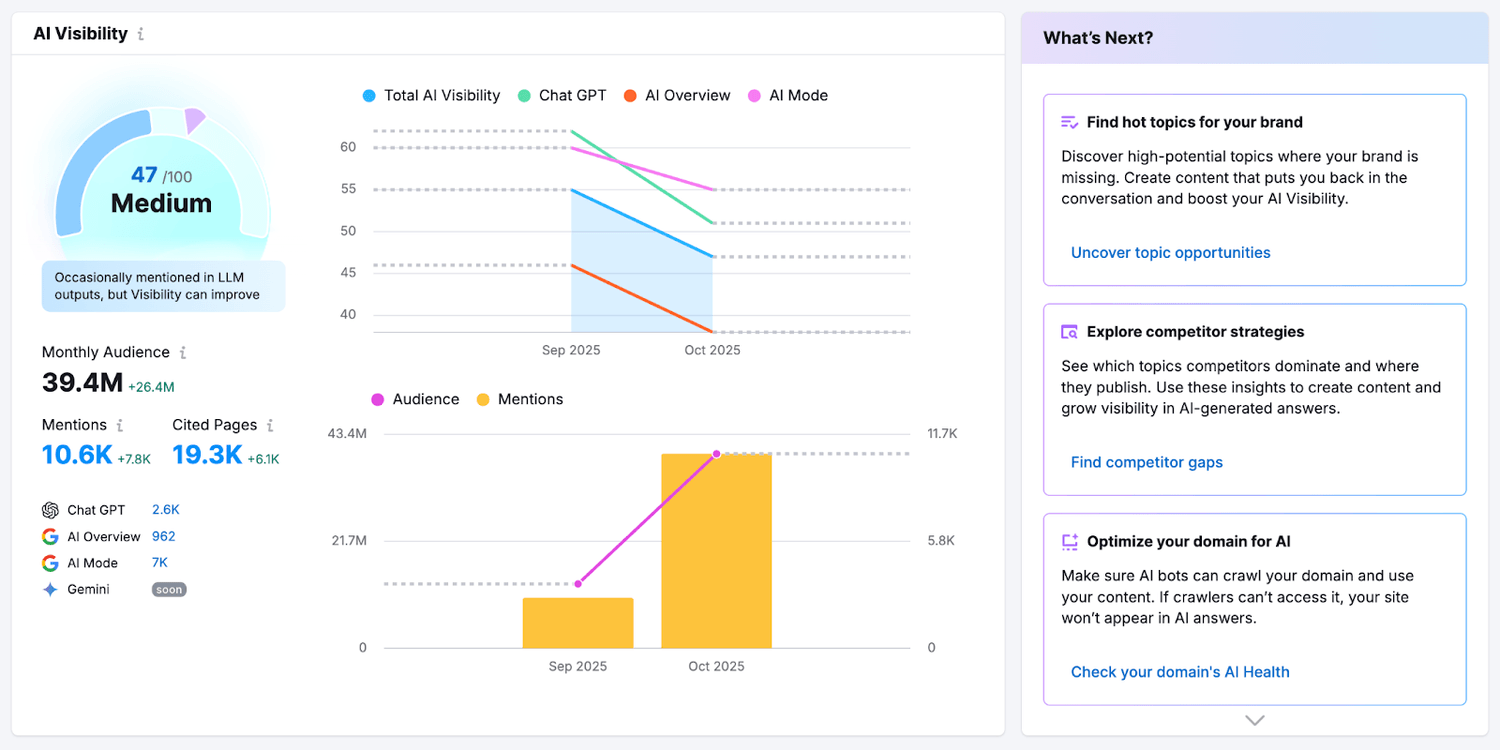
Visibility Overview: The central dashboard for benchmarking mentions, citations, and your overall AI Visibility Score.
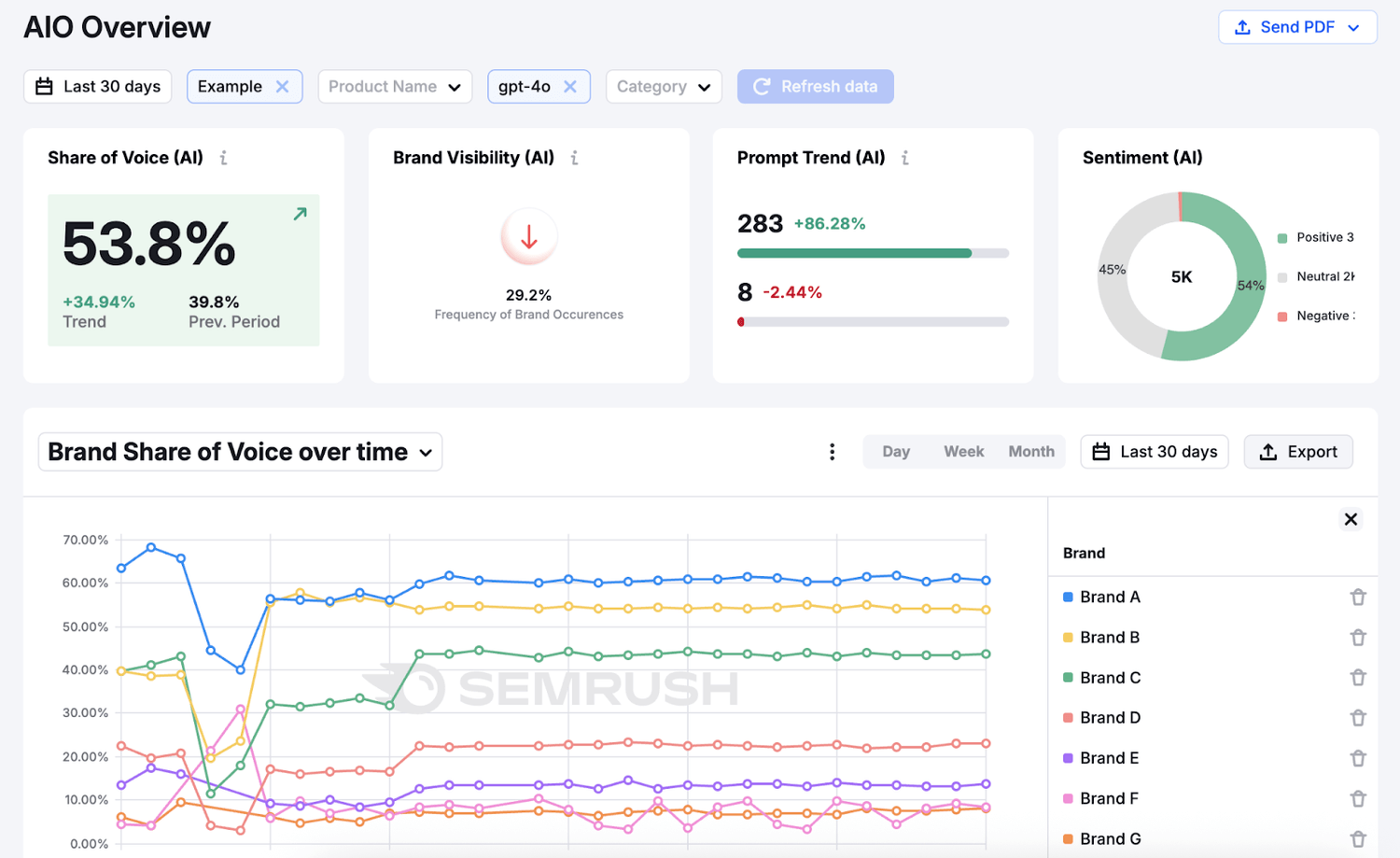
Brand Performance: This is where you analyze Share of Voice and sentiment. It breaks down how the AI perceives your brand versus competitors, providing strategic recommendations to improve your positioning.
Prompt Research: This is keyword research for the AI age. It allows you to find topic-level volume and difficulty for the specific questions people ask LLMs.
Prompt Tracking: A daily monitoring system for your most valuable prompts on Google AI Overviews and ChatGPT. This allows you to act immediately if a competitor displaces you from a top citation spot.
Conclusion: The Competitive Window is Open
The shift from "blue links" to "synthesis" is the most significant change in discovery since the dawn of the internet. We are currently in a unique historical window. While traditional SERPs are saturated and entrenched, the AI search landscape is currently "citation-hungry" and ready to be claimed by those who provide the best data.
By prioritizing AI Visibility now, you aren't just getting a few extra clicks; you are engineering your brand's fame and ensuring you are the authority that AI systems recommend for years to come.
Your "Week 1" Action Plan:
1. Technical Remediation: Use the AI Search Health widget to identify structurally isolated pages and refresh anchor text to provide clearer "entity" signals. Ensure GPTBot and CCBot are not blocked in your robots.txt.
2. Implement the "Source-First" Model: Identify your top three revenue-generating pages. Replace three qualitative claims with quantitative data points (e.g., the Litmus 42−to−1 example) and ensure they are clearly cited.
3. Perform an Off-Site Influence Check: Review the "Cited Sources" in your Visibility Overview. If Reddit or YouTube are dominating your category, dedicate four hours this week to engaging in those communities or planning video content.
4. Baseline Audit: Use the AI Visibility Toolkit to identify one "Topic Opportunity" where your competitors are currently being recommended but you are missing. Create one piece of "chunkable," direct-answer content to fill that gap.
The competitive advantage goes to the brand that becomes the AI’s favorite source. Start engineering that fame today.



Created with © Systeme.io
Disclaimer: This page contains affiliate links. If you purchase through these links, we may earn a commission
at no extra cost to you. We only recommend tools we trust.