Why Your Traffic Is Dropping Even Though You Rank #1 (AI Overviews Explained)
The Great Traffic Paradox: Why #1 is the New #10
For the last two decades, the chief marketing officer’s playbook has been written in a single, unwavering ink: organic search dominance. We lived in a linear world. You identified a high-value keyword, you built superior content, you earned the backlinks, and you claimed Position #1. In that world, Position #1 was the "Holy Grail," a guaranteed faucet of high-intent traffic that fueled your lead gen and brand awareness.
But lately, something has gone fundamentally wrong. You open your rank-tracking dashboards and see a sea of green. Your primary keywords are holding steady at the top of the SERP. Your technical SEO health is impeccable. Yet, when you pivot to Google Analytics or your CRM, the organic traffic line is trending aggressively downward, often by 30% to 60% year-over-year.
Welcome to the "Invisible Traffic Thief."
Search is currently undergoing a massive "rewiring." According to investigative data from Optivara, nearly 50% of current search traffic is now at risk as AI “front doors” like Gemini, ChatGPT, and Perplexity move answers "upstream" in the buyer journey. Traditional rankings are becoming a vanity metric because a #1 position no longer guarantees a click. In the age of Google’s AI Overviews (AIO), a #1 rank is functionally the new #10, pushed so far below the fold by a massive, generative "mini-article" that it might as well not exist for the majority of users. We are witnessing the disconnect between "Ranking" and "Clicks," a paradox that is turning traditional SEO dashboards into red-ink nightmares for CMOs across the globe.
Deciphering the "Mini-Article": What are Google AI Overviews (AIO)?
To fight the traffic drop, you must understand the architecture of the engine that is intercepting it. Google AI Overviews are not merely "Featured Snippets 2.0." They represent a fundamental shift in how information is retrieved and presented to the user.
Powered by Google’s Gemini models, AIOs use a system called Retrieval-Augmented Generation (RAG). Instead of simply identifying the "best" page and extracting a snippet of text, Google now "authors" a custom response by synthesizing facts and perspectives from across the entire web. It is a "mini-article" generated in real-time, specifically tailored to the user's prompt.
The Mechanics and Positioning of AIOs
The "Position #0" Dominance: AI Overviews sit directly below the search bar. They appear before organic results, before traditional featured snippets, and often even before the paid ads that Google usually protects at all costs. On mobile devices, an AIO can occupy up to 70% of the first screen, effectively burying your organic content under a wall of synthesized prose.
Gemini-Powered Synthesis: Using Gemini, Google analyzes multiple sources, often competing ones, and drafts a unified answer. This synthesis removes the user's need to "pogo-stick" between different search results to find a consensus.
The Citation Matrix: AIOs include citations, but they are often reduced to small, secondary icons or links within the text. They provide a "read-only" experience where the user consumes your information without ever visiting your domain.
AIOs vs. Featured Snippets: A Comparison
Source of Text: A Featured Snippet extracts a short, static paragraph or list from a single webpage. An AI Overview generates an original, long-form response synthesized from multiple sources across the web.
Link Visibility: Featured Snippets offer a clear, prominent, clickable link to the source domain. AIOs use small icons and "Show More" toggles that are frequently overlooked by users, making the link secondary to the answer.
Generation Method: Featured Snippets are extracted directly from a page's HTML using ranking algorithms. AIOs are generated by a Large Language Model (Gemini) using a RAG architecture that reconstructs the content.
Traffic Impact: Featured Snippets often drive more traffic to the source because they act as a "teaser." AIOs strongly reduce clicks by providing a complete answer that satisfies the searcher's intent on the SERP itself.
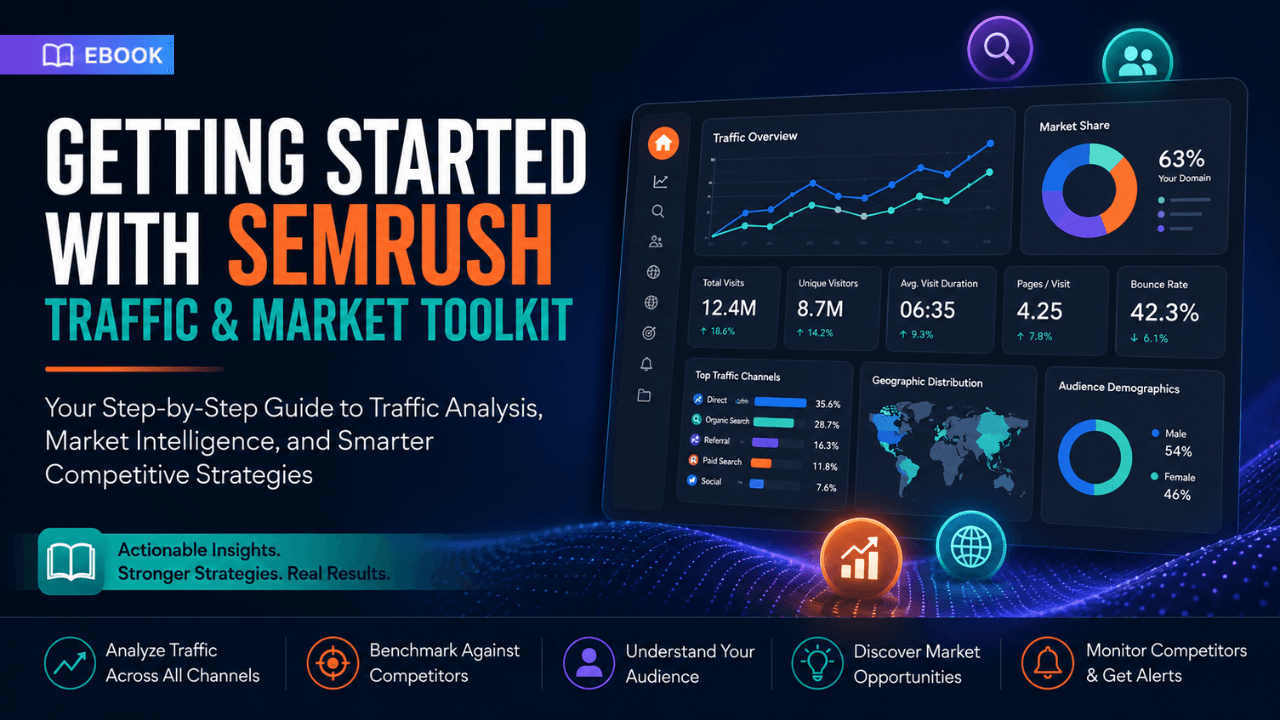
Getting Started with Semrush Traffic & Market eBook Download Your Copy 👇
The Brutal Reality of CTR Compression (The Data Deep-Dive)
The "Invisible Traffic Thief" isn't a theoretical threat, it is a measurable economic force. To understand the scale of the crisis, we must look at the hard data from the industry's largest studies.
The Seer Interactive Findings: A 61% Collapse In an analysis of 5.47 million queries and 2.43 billion impressions, Seer Interactive uncovered the staggering "CTR Drop Spectrum." When an AI Overview is present, the average organic CTR for a query collapses by 61%, dropping from 1.76% to a mere 0.61%. Even for pages lucky enough to be cited within the AIO, the CTR sits at 2.1%, compared to the 3.3% they would receive on a standard page.
The Ahrefs Impact Study: The King is Dead Ahrefs’ data confirms that no rank is safe. Their study of 300,000 keywords found that even the #1 organic result, the historical king of the SERP, loses 34.5% of its CTR the moment an AIO appears. Across a broader set of 863,000 keywords, the average CTR for top-ranking pages fell by a total of 58% in the presence of AI.
The "CTR Drop Spectrum" by Intent (Digital Applied Research) The severity of the impact depends on what the user is trying to accomplish.
Informational Intent (The Danger Zone): For queries like "how to calculate ROI" or "what is a bridge loan," the CTR drop can reach as high as 89%. Because the AI can fully synthesize the answer, the user has zero residual reason to click through.
Transactional Intent (The Resilient Zone): AIOs currently appear on only about 5% of transactional queries. Because these users want to do something (buy a CRM, book a flight), the click loss is lower, typically around 15%.
Hypothetical Case Study: The Lost Lead Value Imagine a B2B SaaS company ranking #1 for "best CRM for manufacturing." Historically, this query might generate 10,000 impressions per month with a 25% CTR for Position #1, yielding 2,500 highly qualified visitors. If a lead converts at 2% and the average contract value is $50,000, that #1 rank is worth $2.5M in monthly pipeline.
With an AIO present, that 25% CTR drops by 61%, leaving you with a 9.75% CTR and only 975 visitors. Your pipeline value has just vanished by over $1.5M, even though you are still "Position #1."
The Rise of the Zero-Click Search (60% and Counting)
We have officially entered the era of the "Zero-Click Search." Data from SparkToro and Datos shows that 60% of all Google searches now end without a single click to an external website. This is an acceleration of a trend that began with featured snippets but has reached a fever pitch with AIOs. Between May 2024 and May 2025 alone, the zero-click rate jumped from 56% to 69%.
The User Journey of a Zero-Click Search Consider a user searching for a medical symptom, a category where AIOs have an 88% activation rate. A mother searches for "early signs of Lyme disease." Traditionally, she would click the top result, the Mayo Clinic, to read the symptoms.
In the AIO era, Gemini instantly presents a bulleted list of symptoms, a timeline of the rash, and immediate care steps at the top of her mobile screen. She reads the information, feels satisfied, and closes the tab. The Mayo Clinic provided the expertise, Google provided the answer, and the Mayo Clinic received zero traffic. This satisfies "curiosity clicks" instantly, effectively severing the relationship between the expert publisher and the reader. In "AI Mode," a more aggressive conversational interface, research from Digital Applied indicates that 93% of searches now end without a click.
The Citation Myth: Why Ranking Higher Doesn't Guarantee an AI Mention
One of the most dangerous myths among SEO managers is that their existing #1 rankings will automatically turn into AI citations. The data suggests that AI Overviews are using a source selection mechanism distinct from Google’s traditional ranking algorithm.
Ahrefs conducted a study of 1.9 million citation links to find the correlation between traditional rankings and AI mentions using the Spearman Correlation (where 1.0 is a perfect link).
The 0.347 Correlation: Ahrefs found a moderate positive correlation of 0.347 between ranking in the top 10 and being cited in the top 3 AI results. While ranking helps, it is not a guarantee.
The "Coin Flip" Reality: Even if you rank #1 in traditional results, you only have about a 50% chance of being cited in an AI Overview.
The Source Pool Disconnect: Shockingly, only 38% of cited pages rank in the top 10 of traditional results (down from 76% in previous months). Furthermore, the arXiv study found that 29.8% of AIO-cited domains do not appear in the first-page results at all for that query.
However, if you are cited, your traditional rank matters for prominence. Ahrefs found a stronger correlation of 0.445 for the position of the cited URL versus its organic ranking. In short: ranking helps you get a "better" citation, but it doesn't guarantee you'll get one at all.
Vulnerability Assessment: Is Your Content Type at Risk?
Not all content is equally vulnerable to the "Traffic Thief." Based on findings from Webperts and theStacc, we can categorize content by its "Topic Compressibility", how easily an AI can replicate your value.
High-Risk Content (Summarizable)
"What Is" and Definitions: If your traffic relies on defining concepts, you are at extreme risk. These are low-uniqueness queries.
Simple How-To Guides: Processes that can be explained in 3–5 simple steps (e.g., "how to reset a router") are easily captured.
Question-Form Queries: These trigger AIOs at a rate of 64.7%, compared to just 9.5% for non-question queries. This 6.8x difference makes "FAQ" style content highly vulnerable.
Low-Risk Content (High Information Gain)
In-Depth Research & Proprietary Data: AI cannot synthesize data that hasn't been published yet. Original surveys and experimental results are "AIO-proof."
First-Hand Experience: Content that says "I tested this for six months" is highly defensible.
Interactive Tools: AI cannot replace a complex mortgage calculator or a custom SaaS tool.
Industry Heatmaps: Healthcare, Education, and B2B Tech
The impact of AIOs is not evenly distributed. Certain sectors are the "front lines" of the AIO transition.
Activation Rates by Industry:
Healthcare: 88%. Google has high confidence in medical summaries, meaning almost every health lookup triggers an AIO.
Education: 83%. This sector is seeing a 70–90% decline in organic clicks for top-ranking university pages. Prospective students are getting tuition and program data directly from the AIO rather than the university’s dot-edu site.
B2B Technology: 82%. SaaS and tech companies are seeing massive AIO presence for educational and "top-of-funnel" content.
Insurance: 63%. Moderate exposure as AI synthesizes policy types.
Entertainment: 37%. The least affected, as these queries are often navigational (searching for a specific movie or site).
Advanced Tracking: Mastering Google Search Console's "AI Mode"
If your dashboard is turning red, you need to use the new "Search Type" segments in Google Search Console (GSC) to isolate the damage.
Step-by-Step Guide to Filtering for AI
Open Performance Reports: Navigate to "Search Results" in GSC.
Apply Search Type Filter: Click the "Search Type: Web" filter and select AI Overviews or AI Mode.
Identify "Click Interception": Compare your "Web" impressions vs. your "AI Overviews" clicks. If you see 100,000 AI impressions but only 100 clicks, your content is being used to train the user without paying you in traffic. This "Click Interception" delta is your primary KPI for lost opportunity.
Analyze AI Mode: Look for queries in the "AI Mode" segment. These are typically 2.3x longer and more conversational. This represents the high-intent research you are either winning or losing in the conversational interface.
The New Playbook: Generative Engine Optimization (GEO)
Traditional SEO is dead. We are now in the era of Generative Engine Optimization (GEO), the practice of optimizing for citations and visibility within LLMs like ChatGPT, Gemini, and Perplexity.
Key Components of GEO
Generative Placement Score (GPS): A new metric from Optivara that tracks how frequently your brand is mentioned across AI agents, adjusted by your industry's specific usage weight.
Entity SEO: It’s no longer about keywords; it’s about becoming a "trusted entity." You must build brand associations within the training data.
Semrush One: Use this tool to audit your site visibility and identify "traffic-stealing" competitors who are winning the AI citation slots you used to own. It is essential for identifying untapped keyword opportunities with low AIO activation rates.
Fighting Back: 5 Strategies to Reclaim Your Clicks
The Freshness Factor: Content not updated quarterly is 3x more likely to lose AI citations. Update your high-performing pages every 90 days.
High "Information Gain": Prioritize original research. Google’s algorithms are beginning to reward content that adds something new to the web that isn't already in the LLM’s training set.
Semantic Boundaries: Use structured lists and explicit definition blocks. Making it easy for the AI to "slice" your content for a citation increases your "citation halo effect," which can lead to a 35% increase in organic clicks compared to being uncited.
E-E-A-T and Author Authority: Link your content to verified author bylines. Citation probability is significantly higher for authors with proven credentials.
Direct Traffic Channels: Invest in newsletters and podcasts. When a user searches for your brand name directly, AIOs are much less likely to trigger.
The Economic Fallout: Publisher Revenue and Ad Exposure
The arXiv research paper highlights a phenomenon called "Asymmetric Capture." This is the brutal economic reality of the AIO era.
The study found that well over 50% of AIO-cited pages belong to publishers who rely on display advertising. When the AIO suppresses the organic click, the publisher loses 100% of their ad revenue. However, the study observed that Google’s own sponsored ads continue to appear on those same pages, often positioned above the AI summary.
Failure Mode Data (The Brand Risk) The arXiv paper also analyzed 98,020 atomic claims in AIOs and found a alarming lack of "Epistemic Security":
11.0% of claims are unsupported by the cited pages.
4.1% of claims are directly contradicted by the cited content. This means that in over 1 out of 10 cases, Google is citing your brand to support a claim you didn't make, or one that is flatly wrong. This is a massive brand reputation risk for any C-suite executive.
Conclusion: Adapting to the Post-Click Era
The transition from "Ranking" to "Being Cited" is the most significant change in search since its inception. While the initial data was bleak, there are signs of stabilization. After bottoming out at 1.3% in December 2025, the CTR on Google AI Overviews climbed to 2.4% in February 2026. Users are beginning to realize that the AI summary is just the starting point, not the destination.
The future of search belongs to those who move from a traditional SEO mindset to a multi-platform GEO strategy. Stop obsessing over Position #1 and start obsessing over your Generative Placement Score. The clicks may be harder to earn, but the value of being the "trusted answer" in an era of AI-generated noise has never been higher. Adapt your strategy, secure your brand, and reclaim your voice in the post-click era.



Created with © Systeme.io
Disclaimer: This page contains affiliate links. If you purchase through these links, we may earn a commission
at no extra cost to you. We only recommend tools we trust.