Unlocking the Power of Semrush for AI Search Visibility
Unlocking the Power of Semrush for AI Search Visibility
Introduction: The New Frontier of Search
The digital marketing landscape is currently undergoing a structural realignment more profound than the initial rise of the mobile web. We have officially transitioned from the "Top 10" era, where the primary goal was to rank a blue link on the first page of Google, to the era of the "Chosen Citation." In this new "Zero-Click" reality, traditional search engine results pages (SERPs) are being superseded by synthesized, generative answers. Search engines are no longer just massive indexes; they have become sophisticated, real-time editors that digest, summarize, and deliver information without requiring the user to ever leave the platform.
For the modern digital strategist, the metric for success has fundamentally shifted. It is no longer enough to be "ranked" in an index; your brand must be "referenced" by the Large Language Models (LLMs) that power tools like ChatGPT, Perplexity, and Google’s AI Overviews. AI SEO, or Generative Engine Optimization (GEO), is the strategic discipline of ensuring your content is the authoritative source that these models extract to build their answers. This is about establishing a presence within the very fabric of the AI's response.
Navigating this transition requires a unified architecture. You cannot treat traditional SEO and AI visibility as separate silos. Semrush has recognized this evolution with the introduction of Semrush One, a platform designed to bridge the gap between legacy authority and modern visibility. In the following guide, we will explore how to leverage this unified suite to ensure your brand isn't just a result, but the primary reference in the generative era.
The State of AI Search in 2026: Data and Trends
To lead in the AI search era, one must first understand the tectonic shifts in user behavior. By 2026, the way information is processed and delivered has moved from a fragmented, multi-click process to a seamless, conversational flow.
Traditional Search vs. AI Search: A Strategic Comparison
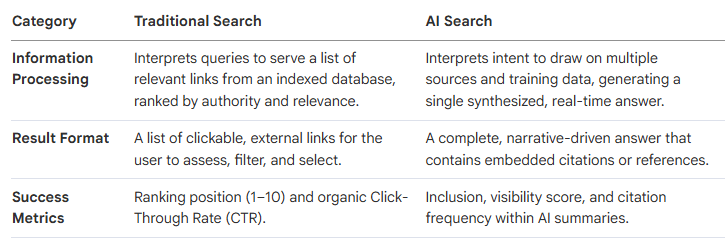
The Data Behind the Disruption
The shift is backed by staggering adoption rates across all demographics. According to a poll from the Associated Press-NORC Center for Public Affairs Research, 60% of Americans now use AI to find information at least some of the time. Among younger cohorts, the disruption is even more pronounced: 31% of Gen Z users start their searches directly on AI platforms or chatbots, compared to 20% of the general population.
Visual search has also become a cornerstone of the multimodal experience. Google Lens now processes over 12 billion visual searches every month, with "Circle to Search" queries tripling in frequency over the last year. Perhaps most importantly for SEO professionals, the saturation of AI Overviews is accelerating. In January 2025, AI Overviews appeared for 6.49% of U.S. desktop searches; by March 2025, that number jumped to 13.14%.
The Narrative Shift: From Fragments to Complex Queries
The nature of the query itself has evolved. Users are abandoning keyword fragments in favor of complex, long-tail questions. In the past, a user might search for "CRM software." Today, they ask: "What's the best CRM for a 50-person marketing agency with Salesforce integration that costs under $150 per user monthly?"
AI systems handle this complexity by blending text, data, and visual context into a single, structured response. For marketers, this means keyword targeting is dead; contextual relevance is the new gold standard. If your content cannot be segmented and extracted to answer specific, scenario-based prompts, you will be invisible to the LLMs.
The Click-Through Reality: Why Visibility Matters More Than Ever
We must address the elephant in the room: the decline of the traditional click. When an AI Overview satisfies a user’s intent immediately, the incentive to click through to a source website diminishes. Studies indicate a 15.5% drop in CTR for queries that trigger AI Overviews. Pew Research data is even more sobering, showing that clicks are nearly twice as high when no AI summary appears (15% vs. 8%), and a mere 1% of users actually click the links provided inside an AI summary.
Presence is the New CTR
While these numbers might seem catastrophic to the old-school SEO, the digital strategist sees a massive opportunity for efficiency. We are moving from a volume-based game to a value-based game. Presence is the new CTR. Being the cited source in a generative answer grants your brand immediate authority and psychological "prime real estate" in the user’s mind.
The 4.4x Conversion Value Factor
The strategic justification for focusing on AI visibility is found in the quality of the traffic that does click through. Semrush research indicates that the average AI search visitor is worth 4.4x more in conversion value than a traditional search visitor. Why? Because the AI has already done the heavy lifting of informing the user. By the time a user clicks a citation inside a ChatGPT response or a Google AI Overview, they are deep in the consideration or decision phase. This significantly lowers your Customer Acquisition Cost (CAC) and increases long-term Customer Lifetime Value (LTV) because you are capturing high-intent users who have already been "pre-sold" by the AI’s synthesis.
Semrush One: The Unified Architecture for Modern SEO
To succeed in this environment, you need a platform that treats the SERP and the LLM as a single ecosystem. Semrush One is the unified architecture that integrates traditional SEO authority with the AI Visibility Toolkit. It allows you to see how search engines and AI models talk about your brand simultaneously, providing a "360-degree" view of your digital footprint.
The 8 Core Benefits of the Semrush One Strategy
Utilizing the Semrush One suite offers eight critical strategic advantages:
Analyze LLM Narrative: Gain a deep understanding of exactly how ChatGPT, Google AI, and Gemini describe your brand. This isn't just about presence; it's about perception. If the AI frames your product incorrectly, your conversion rates will suffer regardless of your rank.
Track Prompt Rankings: Move beyond keywords. Monitor where your brand ranks for specific natural language prompts (e.g., "Compare X to Y") to understand your share of voice in conversational search.
Spot Visibility Gaps: Identify the "Missed Mentions", prompts where your competitors are featured in AI Mode or ChatGPT but your brand is absent. This is your roadmap for content creation.
Personalized Performance Metrics: Access AI Visibility Scores (0-100) and share-of-voice data that are normalized against your industry peers, providing a true benchmark for your AI authority.
Streamline SEO and AI Audits: Conduct unified audits that look at technical crawlability and "AI Search Health" simultaneously, ensuring you aren't fixing one at the expense of the other.
Uncover Audience Questions: Use the 239M+ query database to find the long-tail, scenario-based questions your audience is actually asking AI assistants, rather than relying on outdated keyword volume.
AI-Powered Recommendations: Receive actionable, prompt-level recommendations on how to adjust your content structure to increase the likelihood of becoming a "Chosen Citation."
Find Brand Mention Opportunities: Identify high-authority third-party sources (like Reddit, Quora, or industry-specific news sites) that AI models frequently cite. Getting mentioned there is often the fastest path to being cited in an LLM.
Building the Foundation: Technical and UX Trust Signals
AI models are fundamentally risk-averse. They prioritize citing sources that are secure, fast, and structured in a way that is easy to interpret. Technical health is no longer just about Google’s crawlers; it’s about making your site "machine-consumable."
Core Web Vitals and the Trust Equation
Google’s Core Web Vitals (CWV) are primary signals of high-quality content. AI systems like Perplexity and Google AI Overviews often draw from the same results Google favors in traditional search.
LCP (Largest Contentful Paint): Measures loading performance. Fast sites signal reliability.
INP (Interaction to Next Paint): The new standard for responsiveness. Sites that feel "laggy" are less likely to be viewed as authoritative sources.
CLS (Cumulative Layout Shift): Visual stability. AI crawlers favor stable, well-structured layouts.
Actionable Step-by-Step: The Semrush "AI Search Health" Audit
To ensure your site is technically prepared for AI discovery, follow this workflow:
Run a Site Audit: Open the Semrush Site Audit tool and configure your project.
Identify AI Search Health: In the overview dashboard, locate the "AI Search Health" widget. This specifically flags issues that hinder AI crawlers.
Consult the Thematic Reports: Use the "Site Performance" thematic report to prioritize fixes for slow-loading resources that might be impacting your LCP.
Accessibility Scan: Use the Accessibility Scan & Monitor app. AI "reads" content in a similar way to accessibility tools. Descriptive alt text, clear heading hierarchies, and logical navigation are signals that allow AI to segment and repurpose your visuals and text.
Implement llms.txt: While not a "blocker," adding an llms.txt file to your root directory is a cutting-edge signal. It provides a clear, machine-readable summary of your site's content, specifically designed for LLM interpretation.
Establishing Entity Identity: Organization Schema and "sameAs"
In a generative world, your brand is an "entity," not just a website. AI systems look for consistent patterns across the web to verify that you are who you say you are. If your brand signals are inconsistent, the AI will default to a more "verifiable" competitor.
The Strategic Value of "sameAs"
The "sameAs" property in your Organization schema is the most powerful tool for entity mapping. It creates a digital "web of trust" by linking your website to other authoritative proof points like LinkedIn, Wikipedia, or Crunchbase.
Expert Template: JSON-LD Organization Schema
<script type="application/ld+json">
{
"@context": "https://schema.org",
"@type": "Organization",
"name": "[Brand Name]",
"url": "https://www.yourbrand.com",
"logo": "https://www.yourbrand.com/logo.png",

"sameAs": [
"https://www.linkedin.com/company/yourbrand",
"https://twitter.com/yourbrand",
"https://www.crunchbase.com/organization/yourbrand",
"https://www.facebook.com/yourbrand",
"https://en.wikipedia.org/wiki/Your_Brand"
]
}
</script>
Brand Consistency as a Ranking Factor
As SEO expert Charles Floate notes, strong brand signals can allow you to rank for competitive terms even without targeting those specific keywords in your content. This is because the AI recognizes your brand's authority within a specific niche.
Action: Ensure your brand name, logo, and core service descriptions are identical across your Google Business Profile, LinkedIn, and official site. Naming inconsistency (e.g., using "ABC Corp" in one place and "ABC Solutions" in another) confuses the AI's entity mapping and weakens your visibility.
Content Optimization: The Practical Framework for AI Citations
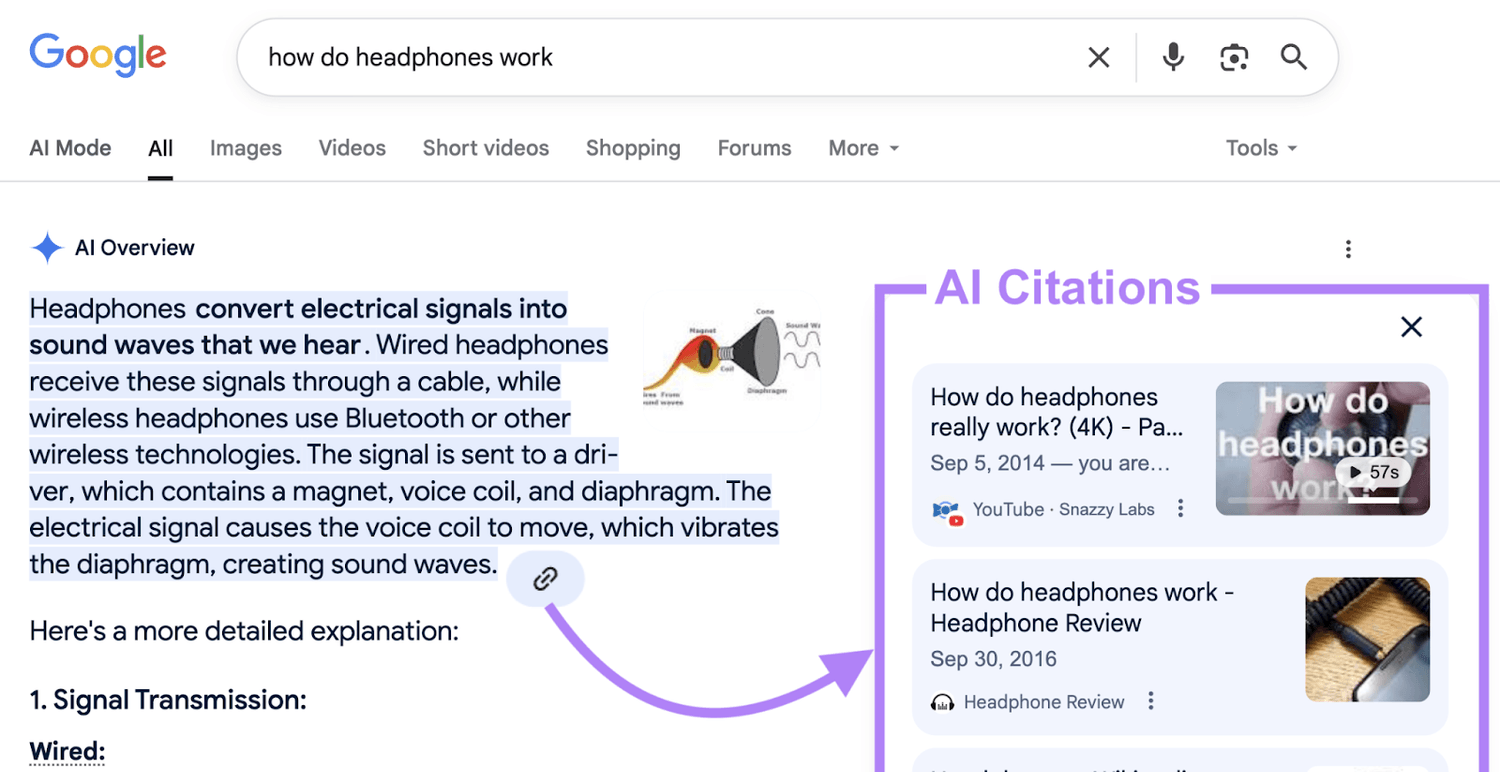
Generative Engine Optimization (GEO) is the process of structuring your information so it is "summary-ready." Use these seven principles to transform your content into a citation magnet.
1. Front-Loading: The Summary-First Structure
AI systems parse content in segments. To be cited, your core answer must be the first sentence of every section.
Tactical Rule: Open every section with a direct definition or answer. Use the exact terminology from your H2 heading in the first sentence. Keep this initial answer to a maximum of two sentences before expanding with context.
2. Scannable Hierarchy
AI cannot synthesize what it cannot segment. Use descriptive H2 and H3 headings that mirror natural language queries. Paragraphs should be limited to a maximum of three sentences. Each section should be a "self-contained chunk" of information that can be understood without reading the rest of the page.
3. Entity Consistency and Structure
AI analyzes sentence structure by identifying subject-verb relationships.
Pro-Tip: Keep subjects and verbs close together. Avoid complex, flowery prose.
Noun Consistency: If you call a feature "AI Content Generator," do not switch to "Automated Writing Tool" in the next paragraph. Consistency helps the AI map the entity's capabilities.
4. Keep Content Fresh (dateModified)
AI search favors the current. A page last updated in 2022 is less likely to be cited than a 2025 page, even if the older page has more backlinks.
Action: Use dateModified schema to signal when content was last revised. Regularly replace outdated quotes, statistics, and examples to maintain "freshness" signals.
5. Build Brand Signals and Expert Commentary
LLMs look for third-party validation.
Tactical Move: Use services like Qwoted or HARO to contribute expert commentary to journalists. When a high-authority publication cites your CEO, it reinforces your brand’s authority signal in the eyes of an AI model.
6. Differentiating with Original Information
AI systems are programmed to avoid "echo chambers." If five sites say the same thing, the AI will cite the one with the most authority. If your site provides a unique data point, the AI must cite you.
Action: Publish proprietary research, original survey data, or first-hand case studies. Being the only source for a specific statistic is the fastest way to earn a citation.
7. Topic Clusters and "Query Fan Out"
Use the Semrush Keyword Strategy Builder to create topic clusters. By interlinking a pillar page with detailed subpages, you assist the AI in "query fan out", the process where the AI gathers all relevant sub-queries to provide a comprehensive answer.
The AI Visibility Audit: A Step-by-Step Walkthrough
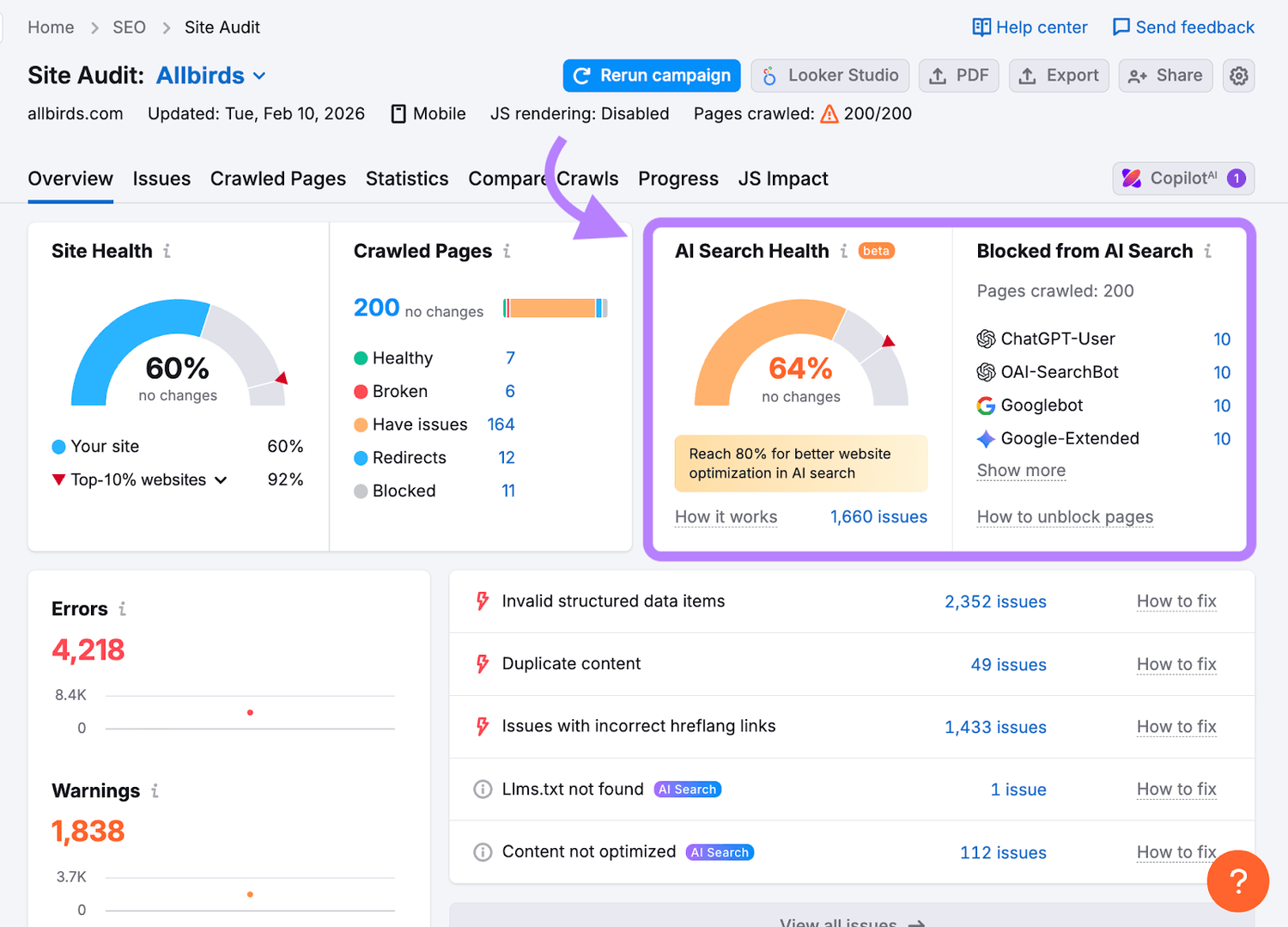
An AI visibility audit is the process of seeing your brand through the "eyes" of the machine. This walkthrough utilizes the methodology applied in the Allbirds case study.
Step 1: Establish Your Baseline
Open the Visibility Overview in the AI Visibility Toolkit. Enter your domain to generate your AI Visibility Score (0-100). This provides a normalized benchmark of your share of voice across ChatGPT, Google AI Overviews, and Gemini.
Step 2: Identify Citation-Worthy Content
Filter your report by "Cited Pages." This reveals which URLs the AI already trusts.
Case Example: In the Allbirds audit, their homepage was cited for 90 prompts. However, their highest-value citations came from specific guides, such as "travel shoe guides" and "walking vs. running" common questions. This tells you which content formats are actually performing.
Step 3: Conduct a Gap Analysis
Navigate to "Topic Opportunities." Look for high-volume prompts where 3+ competitors are mentioned, but you are marked as "Missed."
Case Example: Allbirds identified "Diabetic and Neuropathy Shoes" as a missed opportunity. Despite having relevant products, they lacked the "summary-ready" content needed for the AI to cite them.
Step 4: Source Influence
Check the "Cited Sources" table. This identifies the off-site platforms shaping the narrative in your niche. If Reddit or YouTube appear repeatedly for your core topics, you must prioritize reputation management and engagement on those specific surfaces.
Analyzing the AI Narrative: Sentiment and Perception
AI doesn't just mention your brand; it frames your brand. You must ensure the "Brand Narrative" being formed is positive.
Narrative Drivers and Questions
Use the Brand Performance and Perception reports to dive into the specifics:
Narrative Drivers: This report shows the specific factors (e.g., "sustainability," "durability," "pricing") that AI systems associate with your brand.
Questions Sub-Report: This identifies the exact questions users are asking AI about your brand. Are they asking "Why is [Brand] so expensive?" or "How does [Brand] help with X?"
Correcting Negative Perceptions
If your brand is described in neutral or negative terms, use it as a signal to update your "social proof" content. AI systems are editors; give them better material to reference by adding case studies, third-party reviews, and expert analysis to your site.
Advanced Prompt Research and Tracking
The most successful digital strategists track natural language questions, not just keywords. This requires using the Prompt Research tool, which draws from a database of over 239 million real-world AI queries.
High-Value Prompts to Track
Monitor your share of voice for these prompt types:
The Recommendation: "Best [category] for [specific use case]"
The Comparison: "Compare [Your Brand] to [Competitor]"
The Problem-Solver: "How to solve [Problem] using [Product Category]"
The Leader Search: "Who are the leading providers of [Service]?"
The "Contains" Logic Pro-Tip
When using the Topics and Sources table in Semrush, use the search bar with case-insensitive "contains" logic. This allows you to find every variation of a prompt or topic name regardless of capitalization, ensuring you don't miss nuanced opportunities in the massive prompt database.
Case Study: The 40% Growth Blueprint
The power of these strategies is illustrated by the Rank Secure case study led by Baruch Labunski. By shifting from a link-based strategy to an AI-visibility strategy, the agency achieved a 40% growth in AI citations within 90 days.
The 6-8 Week Implementation Process
Volume Creation: The team added roughly 120 new pages specifically targeting "how-to" and "comparison" prompts discovered in the Gap Analysis.
Strategic Revision: They revised 15 high-value existing pages to include front-loaded, direct answers that the AI could easily extract.
The Result: A 40% increase in brand mentions within AI-generated outcomes, capturing a significantly larger share of voice for branded and "how-to" queries.
FAQs: Addressing Common AI SEO Concerns
1. What Is Semrush AI Search Visibility and Why Does It Matter?
Semrush AI Search Visibility is a metric that tracks how often your brand is "referenced" or "cited" by Large Language Models (LLMs) like ChatGPT, Perplexity, and Google’s AI Overviews. In the modern "Zero-Click" reality, search engines act as real-time editors that synthesize answers rather than just providing lists of links.
This visibility matters because:
Declining Traditional CTR: Queries triggering AI Overviews have seen a 15.5% drop in click-through rates, as users often find the information they need within the AI's summary.
High Conversion Value: AI search visitors are worth 4.4x more in conversion value than traditional search visitors. These users arrive at your site "pre-sold" by the AI’s synthesis, typically placing them deeper in the decision-making phase.
The "Chosen Citation": Success is no longer about being in the "Top 10" blue links; it is about being the primary reference the AI extracts to build its narrative,.
2. Why Should You Monitor Your AI Search Visibility with Semrush?
Monitoring is essential to ensure your brand isn't invisible in the conversational search flow. Semrush allows you to:
Analyze the AI Narrative: Understand exactly how AI models describe your brand, focusing on perception rather than just presence.
Benchmarking: Obtain an AI Visibility Score (0-100) that is normalized against your industry peers to see your true share of voice,.
Spot Visibility Gaps: Identify "Missed Mentions", prompts where your competitors are featured but your brand is absent, to create a roadmap for new content,.
Track Perception: Use reports to see the "Narrative Drivers" (e.g., sustainability or pricing) that AI associates with your brand.
3. How Does Semrush Enhance Your AI Search Visibility?
Semrush enhances visibility through its Semrush One unified architecture, which treats traditional SEO and AI as a single ecosystem. Key enhancements include:
AI Search Health Audits: Tools that flag technical issues specifically hindering AI crawlers, such as slow Largest Contentful Paint (LCP) or poor heading hierarchies.
Generative Engine Optimization (GEO): Providing prompt-level recommendations to help you become a "Chosen Citation".
Prompt Research: Access to a database of 239 million+ real-world AI queries to find the complex, long-tail questions users actually ask AI assistants,.
Entity Mapping: Helping establish your brand as a verifiable "entity" through Organization schema and consistency tracking,.
4. When to Use Semrush for Optimizing AI Search Visibility?
You should utilize Semrush for AI optimization during several critical stages:
During Strategic Audits: When you need to conduct a unified audit of technical crawlability and AI Search Health simultaneously.
Content Creation: Before writing, use the Keyword Strategy Builder to create topic clusters that assist AI in "query fan out".
When Competitors Gain Ground: Specifically when you identify high-volume prompts where three or more competitors are mentioned, but you are not.
Reputation Management: When you need to identify Source Influence, such as when third-party sites like Reddit or Quora are shaping the AI narrative about your brand.
5. Where Can You Find AI Search Visibility Metrics in Semrush?
Visibility metrics are integrated across the Semrush One suite, specifically in these locations:
AI Visibility Toolkit: The central hub for your Visibility Overview and the 0-100 Visibility Score.
Site Audit Tool: Features the "AI Search Health" widget in the overview dashboard.
Topic Opportunities Report: Found within the toolkit to identify "Missed Mentions" and gap analysis.
Brand Performance & Perception Reports: These provide data on Narrative Drivers and the specific questions users ask AI about your brand.
Cited Pages/Sources Tables: These tables reveal which of your specific URLs or which third-party platforms are being trusted and cited by AI models,.
Conclusion: Leading in the AI Search Era
We are no longer in the business of just building traffic; we are in the business of building trust and authority that a machine can recognize. Succeeding in the AI search era requires an iterative, unified approach: building a secure technical foundation, establishing a verifiable entity identity, and structuring your content for extraction.
The brands that act now to claim their "missed mentions" will define their category for the next decade. Do not let your competitors define your brand’s narrative in the minds of AI assistants.
Your Immediate Roadmap:
Run your domain through the free AI Search Visibility Checker.
Identify your top three "Missed Mentions" in the Semrush One suite.
Re-structure those three pages using the "Summary-First" GEO framework today.



Created with © Systeme.io
Disclaimer: This page contains affiliate links. If you purchase through these links, we may earn a commission
at no extra cost to you. We only recommend tools we trust.