How to Find Low-Competition Keywords That Actually Drive Traffic in 2026
How to Find Low-Competition Keywords That Actually Drive Traffic in 2026
Introduction: The Evolving Landscape of Search in 2026
In the digital growth ecosystem of 2026, the fundamental laws of visibility have undergone a radical transformation. As a Senior SEO Growth Strategist, I have witnessed the transition from a Google-centric world to a multi-platform search environment where traditional search engines and Large Language Models (LLMs) coexist. However, despite the rise of generative AI and conversational search, one pillar remains unshakable: the keyword.
Keyword research in 2026 is no longer about "tricking" an algorithm; it is about architecting a bridge. This bridge serves three distinct masters: the human user, the traditional search engine (Google), and the AI search platform (such as ChatGPT or Perplexity). Keywords are the data points that allow these AI agents to parse your authority and connect your solutions to a user’s specific problem. When your content, from the H1 headers to the deep body copy, is built upon a foundation of precision-targeted keywords, you are not just ranking; you are becoming part of the "knowledge graph" that AI systems use to generate their answers.
To achieve sustainable growth today, you must abandon the "spray and pray" content models of the past. The 2026 landscape demands that we isolate high-yield opportunities where competition is low but the intent is high. This requires a sophisticated understanding of how data flows between different discovery platforms.
The New Rules of 2026 Traffic Generation:
Platform-Agnostic Visibility: Your keyword strategy must ensure discoverability across Google’s SERPs and the response windows of AI engines. If an AI doesn't see your keyword-optimized data, you don't exist in the conversational search layer.
Precision Data Integration: Relying on gut feeling is a recipe for budget depletion. We utilize real-time, accurate search data to uncover the exact syntax used by your target demographic.
Intent-First Architecture: Traffic is a vanity metric unless it is tied to purpose. Every keyword must be mapped to a specific stage of the customer journey, research, comparison, or purchase.
Personalized Authority Targeting: In 2026, "generic" difficulty scores are obsolete. We leverage Personal Keyword Difficulty (PKD) to identify terms that your specific domain has the unique authority to dominate.
The Fundamentals: Understanding Modern Keyword Metrics
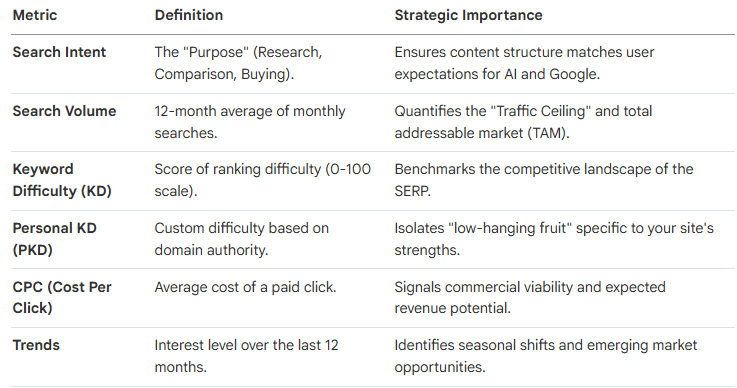
To navigate this competitive landscape, a strategist must look beyond simple search volume. We must conduct a multi-dimensional analysis of every potential query to ensure it aligns with our growth objectives. Below is a deep-dive breakdown of the metrics that define success in the current era.
Search Intent
In 2026, Search Intent is the "North Star" of content strategy. It is the underlying "why" behind a user’s query. AI platforms have become incredibly adept at sensing intent, which means if your content doesn't perfectly align with the user's purpose, you will be filtered out of the results.
Intent is generally segmented into three critical tiers:
Research (Informational): The user is in discovery mode. They are asking "how," "why," or "what." These queries are the bedrock of top-of-funnel (TOFU) traffic and are essential for building the AI Visibility Index of your brand.
Comparison (Commercial): The user has identified a need and is now vetting solutions. They use terms like "best," "top-rated," or "vs." This is where you establish your edge over competitors.
Buying (Transactional): This is high-velocity traffic. The user is ready to execute a purchase. Keywords here involve "buy," "price," "discount," or specific product names.
Search Volume
While many claim volume is secondary, as a growth strategist, I view Search Volume as the primary indicator of market demand. It is the 12-month average of monthly searches. However, in 2026, we look for "Stable Volume" rather than "Spike Volume." We analyze the full year of data to ensure that we aren't chasing a fleeting trend that will leave our content obsolete in three months. A keyword with 500 searches a month consistently is often more valuable than one that hit 10,000 in December and zero in January.
Keyword Difficulty (KD) & Personal KD
Traditional Keyword Difficulty (KD) provides a general baseline of how hard it is to crack the top 10 on Google. It factors in backlink profiles and content quality of the incumbents. But the real breakthrough for 2026 is Personal Keyword Difficulty (PKD).
PKD is an AI-powered metric that correlates the ranking difficulty of a keyword specifically with your website’s current authority and topical relevance. If you are a powerhouse in "SaaS security," your PKD for "cloud firewall reviews" might be 20 (Easy), while a general tech blog might see a KD of 80 (Very Hard). Understanding PKD allows us to ignore "impossible" keywords and focus resources on "attainable" wins that drive immediate ROI.
CPC (Cost Per Click)
For an SEO strategist, CPC is the most reliable "Commercial Value Signal" available. If advertisers are willing to pay $15.00 for a single click on a keyword, it is an objective proof of that keyword’s profitability. High CPCs indicate that the traffic converts at a rate high enough to justify the spend. We use this data to prioritize "money pages", content designed to drive revenue rather than just brand awareness.
Trends
The "Trends" metric is our predictive engine. It tracks the level of interest in a query over a rolling 12-month window. In a market that moves at the speed of AI, being able to spot a rising trend before it becomes high-competition is the ultimate competitive advantage. We look for "Upward Trajectory" keywords, terms that may have low volume now but show consistent growth month-over-month.
Summary of Strategic Keyword Metrics
The Toolset: Leveraging Semrush for Low-Competition Discovery
To execute a 2026 growth strategy, you need more than just "data", you need an industrial-grade intelligence platform. We rely on two specific tiers of keyword discovery to build our roadmaps.
The Free Keyword Tool: The Strategic Entry Point
The Free Keyword Tool is the ideal starting point for rapid-fire discovery and initial market vetting. It is powered by the same high-fidelity engine as the premium tools but is streamlined for speed. This is where we go to validate a "hunch" or find immediate content ideas for a new niche.
The 3-Step Tactical Process:
Enter a Seed Phrase: Input a broad industry term or a specific pain point your business solves.
Click "Find Keywords": The tool parses the landscape to return a list of related syntax and variations.
Review the Data Triad: Immediately analyze Search Volume, Difficulty, and CPC to identify the first layer of opportunities.
Keyword Magic Tool: The Market-Dominance Engine
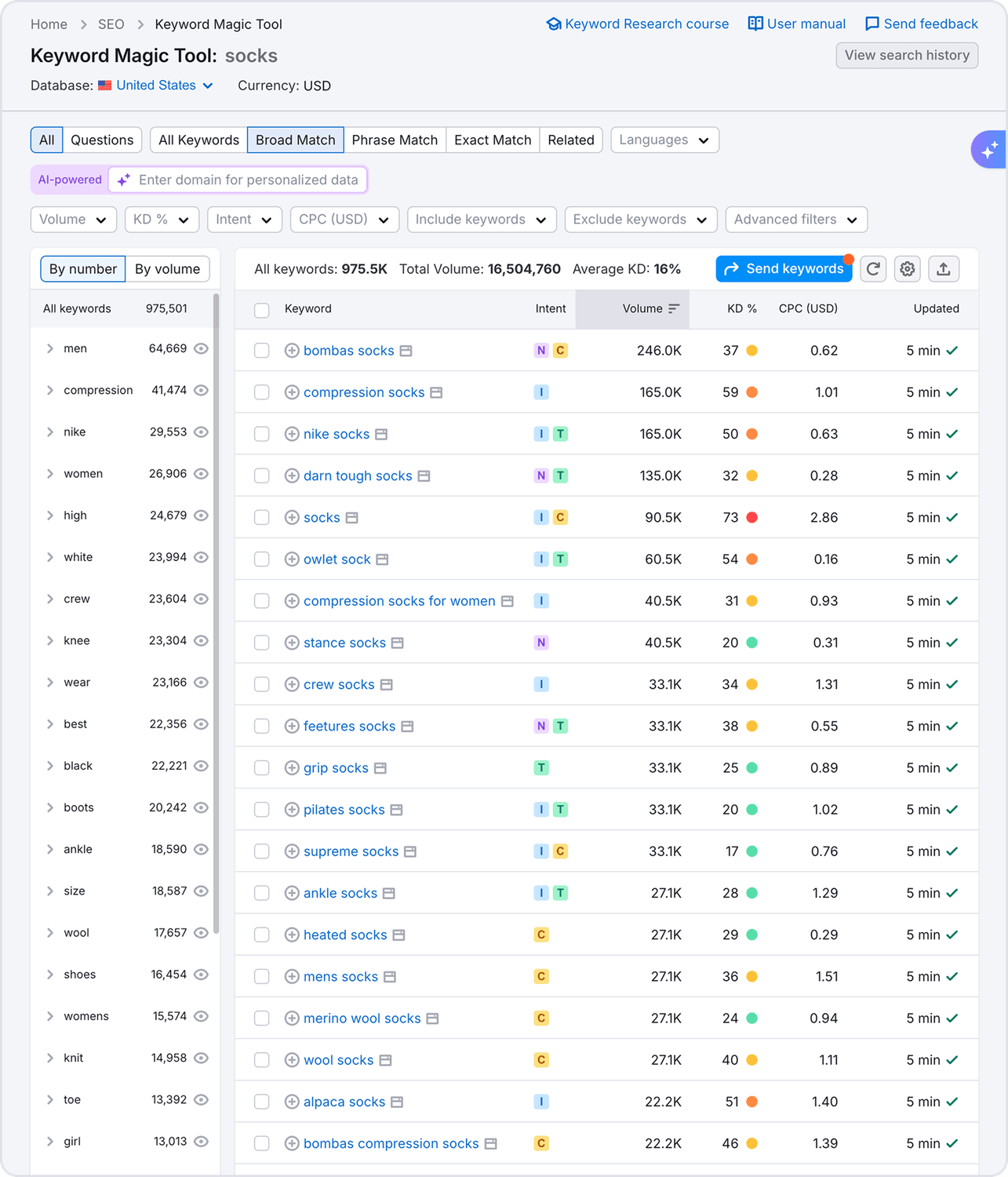
For the serious strategist, the Keyword Magic Tool is non-negotiable. It is the largest keyword database in the industry, boasting over 27.8 billion keywords and 142 geo-databases. When you are looking for that "one in a million" opportunity, this is where you find it. It doesn't just give you a list; it can generate up to 20 million ideas for a single seed keyword.
Strategic "Magic" Features Explored:
Advanced Precision Filtering: Beyond simple phrase matches, we use these filters to isolate keywords with specific intent (e.g., only "Transactional") or specific volume-to-difficulty ratios. This allows us to cut through the noise of 20 million ideas and find the top 50 that will actually move the needle.
Automated Topic Clustering: This feature does the heavy lifting of grouping keywords by subtopic. In 2026, Google and AI engines reward "Topical Authority." Topic clustering allows us to plan 10 interlinked articles simultaneously, ensuring we own the entire conversation around a subject.
SERP Feature Analysis: We use this to identify "Rich Result" opportunities. If a low-competition keyword triggers a "Featured Snippet" or a "Local Pack," that is prime digital real-estate. This analysis tells us exactly how to format our content (e.g., using a list or a table) to capture the snippet.
AI-Powered Personalized Metrics: This is where we access the PKD mentioned earlier. By integrating your own domain data, the tool recalibrates the entire 27.8B keyword database to show you your specific path to ranking.
Step-by-Step Guide: Identifying "Hidden Gem" Keywords
Finding "hidden gems", keywords with high volume but low competition, is an art form backed by data.
Here is the exact workflow I use for my clients to architect a topical authority roadmap.
Check Relevance & SERP Alignment: Never trust a metric blindly. Before committing to a keyword, analyze the current SERP. If you are selling "luxury ergonomic chairs" and the top results for your keyword are all "cheap DIY chair repairs," there is a relevance mismatch. Your content must align with what the search engine already deems helpful. For instance, if you are in the footwear space, "trail running shoes for flat feet" is a targeted gem; "shoe store history" is a distraction.
Prioritize Volume with a "Traffic Floor": We ignore keywords with zero volume unless they are ultra-niche B2B terms. We look for keywords that have enough "meat" to justify the cost of content production. Our goal is to find the "Efficiency Frontier", the point where search volume is as high as possible while the difficulty remains below our site’s PKD threshold.
Isolate the "Low-Difficulty" Sweet Spot: We filter for keywords with a KD or PKD in the "Easy" or "Very Easy" range. These are terms that can often be ranked for with superior content alone, without the immediate need for a massive backlink campaign.
Validate via CPC Value Signals: Once we have a list of low-difficulty, high-volume terms, we look at the CPC. If a keyword has a high CPC, it moves to the top of our priority list. This is a "Hidden Gem" because most competitors are likely fighting over broad, high-volume terms while ignoring these specific, high-value, low-competition phrases.
Group, Map, and Architect: We do not publish isolated pages. We group synonyms and related long-tail phrases. A single authoritative page on "how to choose trail running shoes for flat feet" can rank for 50+ related keywords if the architecture is correct. We then map informational keywords to our blog/resource center and transactional keywords to our product/landing pages.
Strategies for Long-Tail Dominance and AI Visibility
In 2026, the real battle is won in the "long-tail." These are the highly specific, multi-word queries that searchers use when they are close to a decision.
The Long-Tail Strategy
Long-tail keywords are the backbone of high-conversion traffic. While a broad term like "coffee" is impossible to rank for and tells us nothing about intent, a phrase like "organic fair-trade dark roast coffee beans for cold brew" tells us exactly what the user wants. These phrases have lower individual volume but much higher cumulative traffic and conversion rates. Our strategy involves saturating these long-tail queries to build a "moat" around our core topics.
The AI Search Visibility Framework
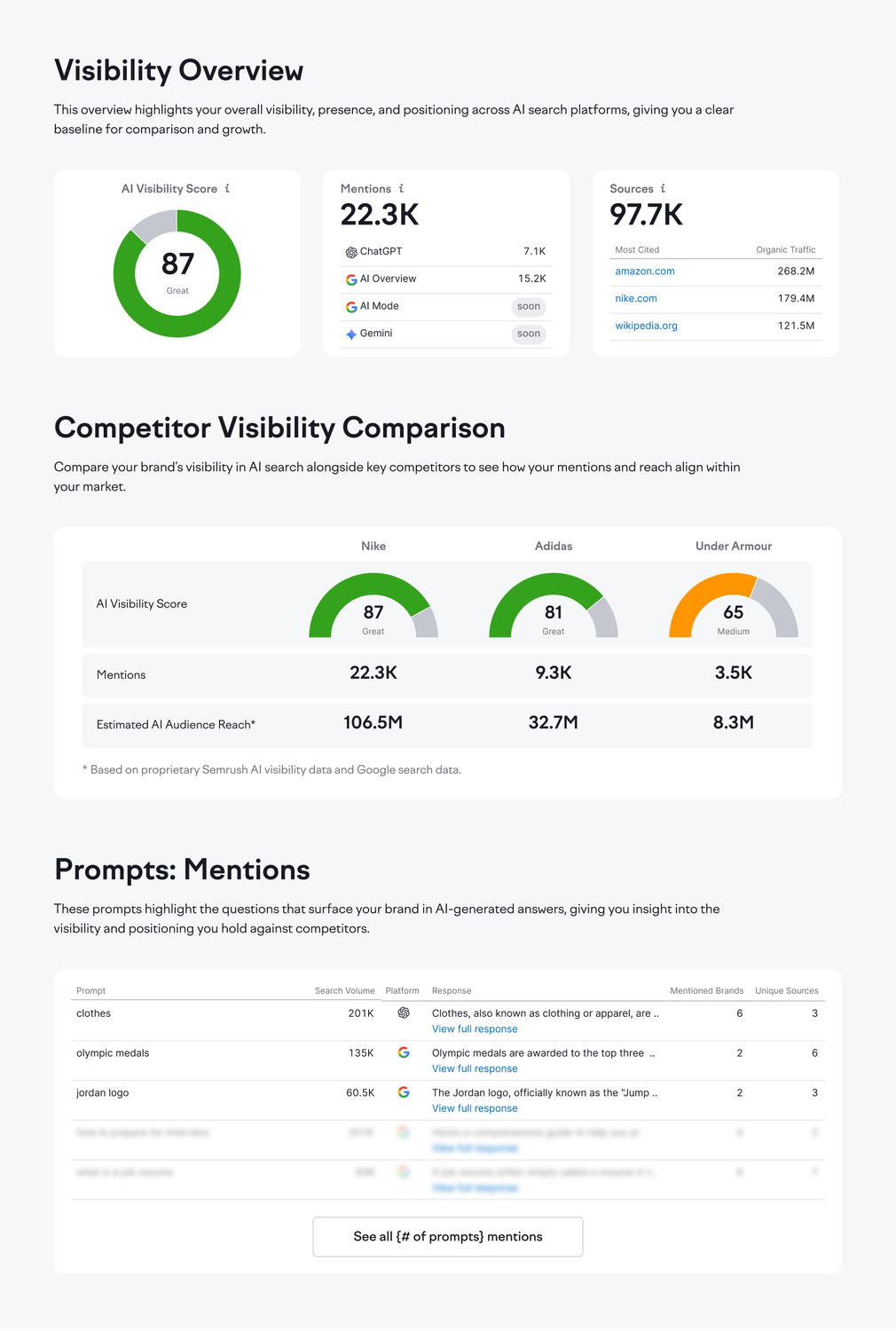
As search evolves, your "AI Visibility" becomes as important as your "Organic Ranking." Using the AI Visibility Index and the AI Visibility Checker, we monitor how often our brand is cited in conversational AI responses.
To win in AI search, your content must be structured for machine readability:
Direct Answer Formats: Use a keyword-optimized header (e.g., "What are the benefits of X?") followed immediately by a concise, 50-word direct answer. AI engines love this "definition-style" content for their response snippets.
Structured Data & Lists: AI platforms prioritize data that is easy to parse. Using tables and bulleted lists for keyword-rich data increases your chances of being the "cited source."
Information Density: AI prefers content that provides high value per word. We cut the fluff and focus on "entities", the people, places, and things related to our keywords.
Pro-Tip: The Local SEO Growth Hack For businesses with a physical presence, Local SEO is the fastest way to drive foot traffic. We identify location-based keywords including specific neighborhoods, "near me" phrases, and regional slang. These terms often have incredibly low KD but lead to immediate, high-intent inquiries through "Local Packs" and map results.
From Keywords to Content: Building Your Strategy
Transforming raw data into a growth engine requires a systematic transition from "research" to "execution."
Topic Clustering & The Efficiency Frontier
We don't just look at individual keywords; we assess "Topic Clusters." By grouping related keywords, we can calculate the average difficulty and total search volume of an entire subtopic. This allows us to identify the "Efficiency Frontier", the subtopics where we can gain the most market share with the least resistance. We build our content roadmap by attacking the clusters with the highest volume-to-difficulty ratio first.
The Keyword Strategy Builder
We use the Keyword Strategy Builder to manage this complexity. This tool allows us to export our research into actionable campaigns, ensuring that every piece of content we produce is tied back to a specific, validated keyword opportunity. It prevents "content overlap" and ensures we aren't accidentally competing against ourselves for the same terms.
Competitor Benchmarking: The "Gap Analysis"
A strategist's greatest tool is the competitor’s own success. We perform a "Keyword Gap" analysis to see which terms our competitors are ranking for that we are missing. This isn't about copying; it's about identifying "market entry points." If a competitor is ranking for a high-value term with a mediocre page, that is our invitation to create a superior "10x" version and seize that traffic.
Expanding Your Reach: International and PPC Applications
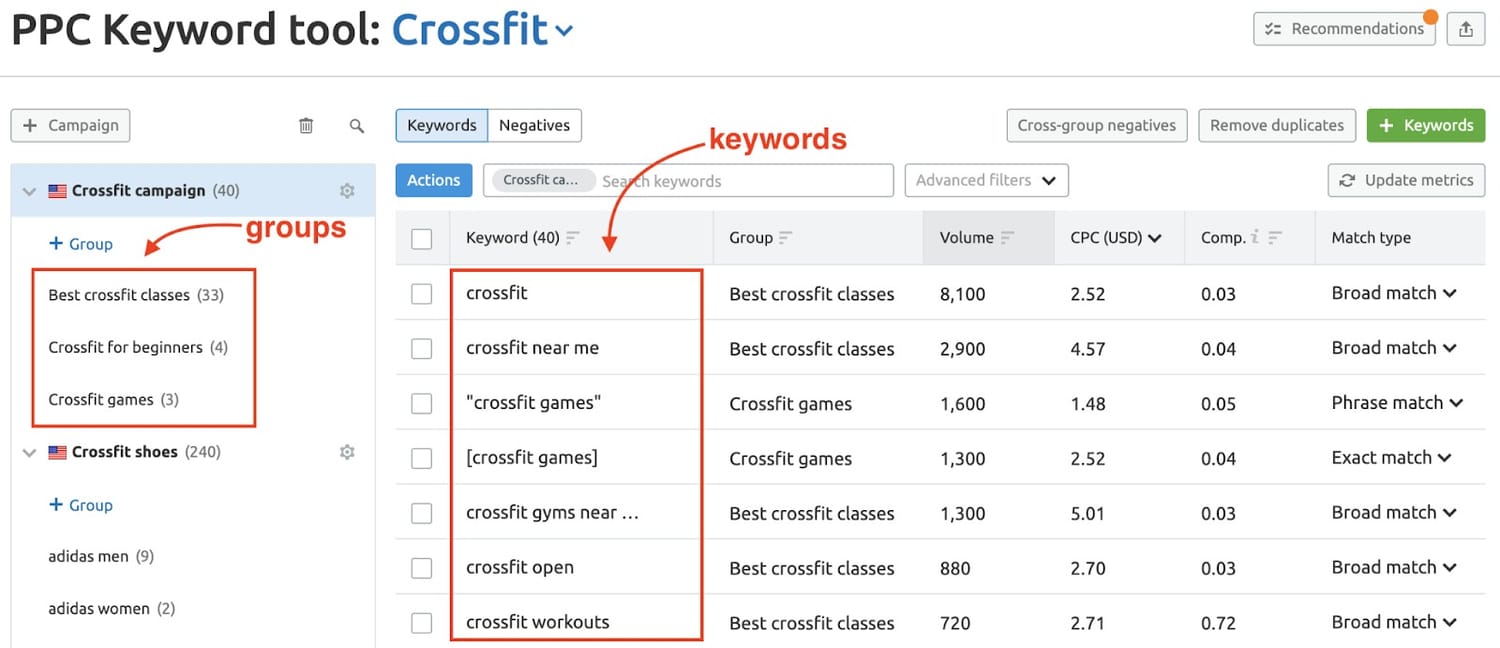
The data we gather isn't just for SEO; it is the blueprint for global expansion and advertising efficiency.
International Market Entry via 142 Geo-Databases
With access to 142 geo-databases, we can identify "Market Arbitrage" opportunities. Often, a keyword that is highly competitive in the United States may have massive volume but zero competition in the UK, Australia, or Brazil. We use this data to plan international expansion, translating our core keyword strategy into local languages and nuances to capture global market share before the competition wakes up.
Strategic PPC: Cutting the Waste
In the world of paid search, keywords are expensive. By using the same metrics (CPC and Intent) from our SEO research, we build cost-effective PPC campaigns. We target "high-intent, low-CPC" keywords that competitors have overlooked. This data-driven approach allows us to cut wasted spend on "vanity" terms and focus our budget on keywords that have a proven track record of commercial value, significantly improving our Return on Ad Spend (ROAS).
Frequently Asked Questions (FAQ)
1. What Are Low-Competition Keywords and Why Are They Important in 2026?
Low-competition keywords are search terms with a low Keyword Difficulty (KD) score, indicating they are easier for a website to rank for compared to highly competitive phrases. In 2026, these keywords are vital because they allow you to rank your pages quickly and easily, driving organic growth without the struggle of competing for broader, saturated terms. They are also essential for AI search visibility, as targeting specific, low-competition topics increases your chances of being cited or mentioned in AI-generated answers on platforms like ChatGPT.
2. How Do You Find Low-Competition Keywords That Drive Traffic?
To find these keywords, you should use a keyword tool to enter phrases relevant to your business and then:
Filter for High-Value, Low-Competition Terms: Use tool filters to isolate keywords that have a manageable difficulty score.
Prioritize Search Volume: Look for keywords that have a high average monthly search volume, as these have the highest potential to drive significant traffic.
Discover Long-Tail Keywords: Focus on specific phrases and questions that attract highly interested visitors.
Analyze Search Intent: Ensure the keyword matches your goal, whether it's for research (informational) or buying (transactional), so your content meets user expectations.
3. Where Can You Search for Low-Competition Keywords in 2026?
You can search for these opportunities using:
Semrush Free Keyword Tool: Provides keyword ideas, search volumes, and difficulty scores in seconds.
Keyword Magic Tool: A premium tool with a database of over 27 billion keywords that offers advanced filtering for exact match and related keywords.
AI Visibility Toolkit: Specifically designed to unify SEO authority and AI search visibility.
Keyword Strategy Builder: Useful for organizing your research into master lists and content plans.
4. Why Should You Focus on Low-Competition Keywords This Year?
Focusing on these keywords is a strategic move this year for several reasons:
Speed to Rank: They offer a faster path to the top of search results compared to high-difficulty terms.
Cost-Effectiveness: These keywords often have manageable CPCs, allowing you to build efficient PPC campaigns and cut wasted spend.
Comprehensive Content Planning: They help you group related synonyms and variants, allowing one well-structured page to rank for multiple terms across the customer's journey.
Local and International Expansion: They are key for identifying location-based "near me" terms or discovering opportunities in different languages and regions.
5. When Is the Best Time to Search for Low-Competition Keywords?
While keyword research is an ongoing process, the most effective times to search include:
Content Creation & Optimization: Whenever you are looking for new ideas for blog posts, landing pages, or FAQs.
Strategic Planning: When you are building a new content strategy or launching a PPC campaign.
Trend Monitoring: You should review search volume and trend data over a 12-month period to identify seasonal interest or emerging queries before they become highly competitive.
Local or International Expansion: When you are planning to move your business into new geographical markets or languages.

Conclusion: Your Action Plan for 2026
The era of "casual" keyword research is over. To survive and thrive in 2026, you must adopt a data-driven, strategic approach that acknowledges the complexity of the modern search ecosystem. You must bridge the gap between human intent, Google’s algorithms, and AI’s processing power.
By focusing on low-competition "Hidden Gems," leveraging Personalized Keyword Difficulty, and architecting content around Topic Clusters, you are doing more than just "getting traffic." You are building a sustainable digital asset that dominates its niche.
Your Strategic Roadmap:
Immediate Discovery: Use the Free Keyword Tool to identify 10 "Quick Win" topics today.
Strategic Deep-Dive: Deploy the Keyword Magic Tool to explore the 27.8 billion keyword database and find your 20M ideas.
Authority Mapping: Use PKD to ensure you are only fighting battles you can win.
AI Integration: Audit your visibility using the AI Visibility Checker to ensure you are ready for the conversational search revolution.
The infrastructure for your 2026 growth is ready. Start your research today with the Keyword Magic Tool and claim the market share your competitors don't even know exists.



Created with © Systeme.io
Disclaimer: This page contains affiliate links. If you purchase through these links, we may earn a commission
at no extra cost to you. We only recommend tools we trust.