How to Optimize Your Website and Funnel for AI Search Engines
How to Optimize Your Website and Funnel for AI Search Engines
The Dawn of the Generative Era: Why Traditional SEO Isn’t Enough
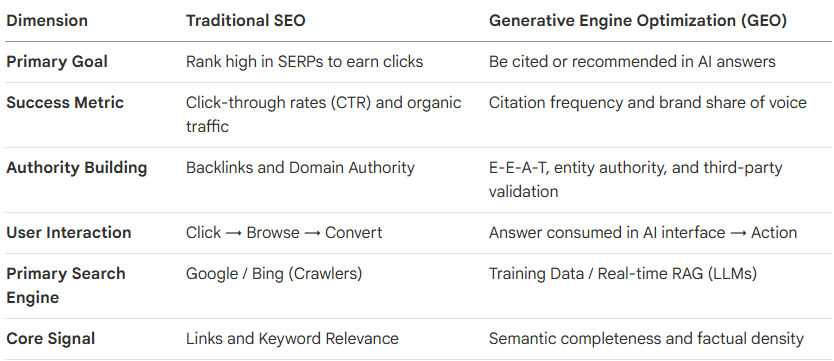
The digital landscape is currently undergoing its most significant transformation since the invention of the search engine. We have transitioned from the era of "ten blue links" into a sophisticated age of synthesized AI answers. This represents a fundamental $80 billion disruption of the search industry, a seismic shift where the objective has evolved from merely ranking for clicks to being cited, quoted, and recommended within the Large Language Model (LLM) response itself.
Traditional Search Engine Optimization (SEO) has spent two decades mastering the art of PageRank and keyword density. However, Generative Engine Optimization (GEO) and Large Language Model Optimization (LLMO) operate on a different primary signal: semantic authority. In a world where Google AI Overviews appear on a significant portion of queries and ChatGPT processes over 3.8 billion monthly visits, the user journey has shortened. The brand that isn't referenced by the AI effectively ceases to exist in the user's consideration set.
Success in 2026 is no longer measured by position one on a Search Engine Results Page (SERP); it is measured by your Share of Voice (SoV) within the AI’s synthesized narrative. We are moving toward a "zero-click" reality where the AI serves as the final interface. To survive, brands must transition from being "searchable" to being "citable."
The Seismic Shift: SEO vs. GEO
Decoding the Machine: How AI Search Engines "Think" (RAG Explained)
To optimize for AI, one must understand the underlying technology: Retrieval-Augmented Generation (RAG). Unlike static models that rely only on historical training data, their Parametric Memory, modern AI search engines use RAG to combine that memory with real-time information from the live web.
The RAG pipeline follows a rigorous five-step process that every Senior Technical Editor must understand to architect citable content:
1. Query Processing: The AI interprets user intent, identifying key entities (brands, people, products) and their relationships. It converts natural language into a semantic representation to search for concepts, not just keywords.
2. Document Retrieval: The system queries search indexes (Bing for ChatGPT/Copilot, Google’s index for Gemini, or Brave Search for Claude) to identify relevant live sources.
3. Ranking and Selection: AI scores retrieved documents. Research from Princeton University and IIT Delhi shows that Semantic Completeness, how thoroughly you cover a topic, has a correlation coefficient of 0.87 with citation success.
4. Generation and Synthesis: The AI "reads" the top-scoring "chunks" of text and synthesizes them into a coherent, conversational response. It does not copy; it understands and rewrites.
5. Citation: The AI attributes specific facts to their sources. Content that is easily "extractable" and carries high Entity Authority is prioritized for these valuable inline links.
Two new high-water marks for visibility have emerged: Semantic Completeness (covering the who, what, where, and why) and Entity Disambiguation (the degree to which your brand is recognized as a unique, trusted entity across the broader web).
The 12 Data-Backed Strategies for 2026 Visibility
1. Leveraging Advertorials and Paid Editorial
Large Language Models currently demonstrate a "blind spot" regarding the distinction between paid and organic editorial content. When an LLM retrieves information via RAG, it prioritizes the authority of the hosting domain and the factual density of the prose over the "sponsored" tag. By placing advertorials on high-authority Tier 1 publications (DA 80+), brands can "inject" their narrative directly into the AI's retrieval stream. Strategic placements on sites like Forbes, Bloomberg, or industry-specific leaders can result in a 35-60% increase in brand citations within 90 days.
Tactical Execution Checklist:
[ ] Target publications with historical citation patterns in LLM training data (e.g., Business Insider, TechCrunch).
[ ] Draft content of 800-1,200 words to provide substantive "extractable" value.
[ ] Focus on educational value and thought leadership rather than promotional copy.
[ ] Include at least three original statistics or expert quotes to trigger the "Citations Addition" visibility boost.
2. Scalable Content Syndication
Syndication is no longer just for reach; it is for consensus building. AI models seek to minimize "Citation Fabrication Rates" by corroborating facts across multiple sources. When your core brand messaging appears across multiple authoritative platforms (DA 60+), it creates a "consensus signal" that the AI views as "safe" to repeat. Research indicates that strategic syndication increases brand mention frequency by 45%.
Tactical Execution Checklist:
[ ] Use canonical tags to prevent traditional SEO duplicate content issues while allowing LLMs to parse the content.
[ ] Adapt the "hooks" (intro/outro) for each platform to maintain a freshness signal.
[ ] Prioritize partners with a history of being cited in Google AI Overviews.
[ ] Monitor "Share of Voice" in AI responses as a primary KPI for syndication success.
3. Granular Audience & Use Case Pages
AI systems personalize responses based on the user’s specific context (industry, role, or company size). By moving away from generic product pages and toward granular, audience-specific architectures, you position your brand as the "best-fit" recommendation for specialized prompts. These pages receive 2.3x more citations than generic counterparts because they match the semantic specificity of the query.
Tactical Execution Checklist:
[ ] Build dedicated pages for industry verticals (e.g., "AI for Healthcare Compliance" vs. "AI software").
[ ] Ensure each page is deep (1,500-2,500 words) and uses industry-specific terminology.
[ ] Include specific FAQs that address role-based pain points (e.g., "How does this help a CMO?").
[ ] Lead with a 50-word "Answer Block" that summarizes the use case for AI extraction.
4. Homepage Clarity Optimization
Your homepage is the "Primary Source of Truth" for AI models attempting to define your entity. Vague marketing slogans ("The Future of Innovation") are AI visibility killers. AI systems parse homepages 3-4x more frequently than internal pages to establish brand relevance. You must prioritize clarity over creativity.
Tactical Execution Checklist:
[ ] Use a 10-15 word H1 that explicitly defines your business category.
[ ] Include a one-sentence value proposition that identifies your primary audience.
[ ] Implement Organization Schema with full business details and social proof.
[ ] List core services using standard industry terminology to aid machine categorization.
5. The Strategic Footer
As noted by industry experts like Wil Reynolds, LLMs parse footers to understand organizational structure and secondary service signals. A well-optimized footer provides a "site map" for the AI, leadings to a 15-20% increase in citation frequency for informational queries.
Tactical Execution Checklist:
[ ] Organize links into clear categories (Products, Industries, Resources).
[ ] Use descriptive anchor text for every service link.
[ ] Include office locations and industry certifications with proper schema.
[ ] Ensure the footer is consistent across the entire domain to reinforce entity signals.
6. llms.txt: The Robots.txt for the AI Era
The llms.txt file, proposed by Jeremy Howard, is a markdown document at the root of your domain. It provides a curated, structured summary of your site's most important content, specifically designed to fit within the small context windows of AI agents during inference.
Tactical Execution Checklist:
[ ] Create a spec-compliant markdown file at /llms.txt.
[ ] Provide a "clean" markdown version of key pages at the same URL with .md appended.
[ ] Use an H1 for the site name and a blockquote for the primary description.
[ ] Implement an "Optional" H2 section for secondary info that AI agents can skip if their context window is full.
7. Multimodal Consistency
Modern models are multimodal; they ingest video transcripts, audio show notes, and image alt-text. Brands that maintain a consistent narrative across these formats achieve 54% higher brand mention rates. The AI "hallucinates" less when the video on YouTube confirms the statistics found in the blog post on your site.
Tactical Execution Checklist:
[ ] Repurpose every pillar article into a video with a detailed transcript.
[ ] Upload podcast show notes with accurate timestamps and entity mentions.
[ ] Use descriptive alt-text (125 characters) that includes key entity keywords.
[ ] Maintain identical brand terminology across all metadata.
8. Proactive Narrative Shaping: The 250-Document Rule
If you do not define your brand, the AI will define it for you based on competitors or critics. Academic research suggests it takes approximately 250 documents (blogs, PR, interviews, white papers) across the web to meaningfully influence how an LLM perceives a brand. This is the threshold for shifting "Parametric Memory."
Tactical Execution Checklist:
[ ] Audit current AI perception by querying models about your brand vs. competitors.
[ ] Identify 250+ content opportunities to reinforce target messaging.
[ ] Use consistent terminology to establish "Semantic Salience."
[ ] Proactively address misconceptions in high-authority third-party forums like Reddit.
9. The 90-Day Freshness Protocol
AI engines demonstrate a massive bias toward current information, particularly Perplexity. Content updated within the last 30 days receives 3.2x more citations. Even high-quality pages lose authority if they haven't been refreshed in 90 to 180 days.
Tactical Execution Checklist:
[ ] Establish a 30-day refresh cycle for top-performing "pillar" pages.
[ ] Update statistics, case studies, and publication dates to trigger a freshness signal.
[ ] Ensure the dateModified schema field is updated with every edit.
[ ] Add "What's New in 2026" sections to legacy content.
10. Niche Industry Authority and Rapid Inclusion
High-trust trade publications offer a "Rapid Inclusion" effect. While it may take weeks for a new blog post to be cited by ChatGPT, a guest post or interview on a respected industry site (e.g., Search Engine Land, Medscape) can appear in AI responses within hours.
Tactical Execution Checklist:
[ ] Identify 3-5 high-authority trade publications in your vertical.
[ ] Pitch data-driven research that includes "Statistics Addition" (Princeton study).
[ ] Ensure your brand and key executives are mentioned as entities.
[ ] Create a "Citation Loop" by linking back to your internal resources.
11. Uncovering FAQ Content
FAQs are the most-cited elements in the AI ecosystem because they provide "chunkable" answers. Research indicates that 44% of citations come from the first third of a page. Formatting your FAQs properly creates the "Safety-First" answers AI models crave.
Tactical Execution Checklist:
[ ] Format answer blocks to be 40-60 words, the extraction "sweet spot."
[ ] Use question-based H2 or H3 headers (7x citation impact for small domains).
[ ] Implement FAQPage schema for every pair.
[ ] Source questions from real-world user queries identified via Frase or AnswerThePublic.
12. Off-Page Authority Accelerators
The AI "Visibility Loop" relies on third-party validation. Case studies from Digitaloft (DeliVita pizza ovens and GO Outdoors) prove that being recommended in media roundups (like The Telegraph) directly triggers ChatGPT recommendations. Digital PR is now the "ATM" for brand mentions.
Tactical Execution Checklist:
[ ] Prioritize "mention-rich" coverage where the brand is in the headline/subhead.
[ ] Secure inclusion in "Best of" and comparison pieces.
[ ] Combine PR pushes with reviews on platforms like G2, Trustpilot, or Capterra.
[ ] Monitor the "Visibility Loop": PR → Reviews → UGC → AI Recommendation.
Platform-Specific Playbooks: Optimizing for the Big Four
ChatGPT (The Domain King)
ChatGPT remains the market leader, prioritizing established domain reputation and Wikipedia-style readability. There is a 5.25x citation gap between high-trust domains (Trust Score 97-100) and those below 43.
Strategy: Focus on long-form, comprehensive content (2,900+ words). Use an authoritative, neutral tone. Earn presence on high-authority reference sites.
Perplexity (The Freshness Engine)
Perplexity is "search-first" and values real-time information. It draws heavily from Reddit and recently updated articles (last 90 days).
Strategy: Maintain a strict 30-day update protocol. Emphasize original research and user-generated content (UGC). Use conversational but factual language.
Google AI Overviews (The E-E-A-T Giant)
Google AI Overviews are deeply tied to traditional search signals but favor an "Answer-First" structure. Content ranking below position five is cited in 38% of all Overviews if it provides a superior "chunkable" answer.
Strategy: Lead every section with a direct, 50-word answer block. Focus on demonstrating Experience (first-hand accounts) and Expertise (credentials). Use Gemini’s "fan-out" technique (multiple searches per query) to your advantage by covering sub-topics deeply.
Claude (The Balanced Professional)
Claude, powered by Anthropic’s "Constitutional AI," prefers non-promotional, professional content. It uses Brave Search (not Google) to browse the web and has the highest session value ($4.56).
Strategy: Include "Limitation Sections" that discuss where your product might not be a fit. Claude rewards honesty and multi-source verification (70% of results are verified across multiple sources).
The Technical Foundation: Schema and NLP Best Practices
Technical precision is the bridge between human language and machine understanding.
JSON-LD and Entity Disambiguation
Always use JSON-LD for structured data. It helps the AI understand your brand as a distinct entity rather than just a string of text.
Organization: Defines your brand, logo, and social profiles.
Product: Provides clean data on price, reviews, and availability.
Article: Identifies authors and publication dates for freshness tracking.
SameAs: Crucial for linking your site to authoritative external entities (e.g., your Wikipedia or LinkedIn page).
Semantic Chunking
Modern NLP models extract "chunks" of text. Use a logical H1-H3 hierarchy to create a roadmap. Each section should be a self-contained "thought unit." If a section is removed from your page, it should still be semantically complete and understandable to an AI agent.
Digital PR: The Gateway to the AI Funnel
Digital PR has evolved from a link-building tactic to a brand-signaling strategy. In the AI era, Mention-Rich Coverage, where your brand is discussed in the headlines and body of authoritative news, is the primary driver of AI trust.
The Visibility Loop in Action
The DeliVita case study illustrates this: A roundup in The Telegraph regarding "Best Pizza Ovens" was parsed by ChatGPT. Because the AI trusts The Telegraph, it cited DeliVita as the "designer choice." PR Coverage → Positive Sentiment → AI Knowledge → Recommendation.
The 5 KPIs for AI PR Success
Presence in AI Overviews: Percentage of target queries where you appear.
Brand Share of Voice in AI: Your mention rate vs. competitors.
Sentiment Analysis: How the AI "tones" your brand (Positive/Neutral/Negative).
Citation Position: Are you the primary recommendation or a secondary source?
AI Referral Traffic: Measuring bot traffic (ChatGPT-User, etc.) in GA4.
Measuring Success in a Zero-Click World
Tracking AI Bot Traffic in GA4
Configure GA4 to identify traffic from AI user agents. Monitor ChatGPT-User, PerplexityBot, and Claude-Web. If these bots are crawling your site, you are in the "consideration set" for citations.
The GEO Recovery Playbook
If your citations drop, follow this 7-step process:
Update Stats: Replace any data older than 12 months.
Refresh FAQ Schema: Add three new questions based on current trends.
Enhance Answer Blocks: Ensure the first 50 words are direct and "safe."
Audit Outbound Links: Link to new .edu or .gov research.
Check Technical Health: Validate schema in the Rich Results Test.
Boost PR: Secure 2-3 new brand mentions on high-authority trade sites.
Re-Index: Request a manual crawl to alert AI agents of the updates.
The Safety-First Citation Framework
AI models are programmed to minimize risk. They don't pick the "best" or "most creative" answer; they pick the safest one. This is a risk-reduction problem. To be cited, your content must be unambiguous, verifiable, and corroborated by multiple third-party sources. If the AI "feels" a fact is risky or unverified, it will omit you to avoid "Citation Fabrication."
Conclusion: Leading the Transformation
The era of Agentic Search, where AI agents like OpenAI’s "Operator" act on behalf of users, is arriving. In this world, your content is no longer just for reading; it is for inference. The distinction between a brand that thrives and one that vanishes depends on its Digital Authority.
Master Checklist for AI Readiness
[ ] Crawlability: Does your robots.txt allow OAI-SearchBot and PerplexityBot?
[ ] Structure: Are your pages semantically chunked with H1-H3 headers?
[ ] Directness: Do you have 40-60 word answer blocks at the top of every section?
[ ] Data Density: Do you have one statistic or cited fact every 150-200 words?
[ ] Validation: Do you have external links to authoritative (.edu/.gov) sources?
[ ] Authority: Have you established a SameAs schema link to external profiles?
[ ] Freshness: Has your top-performing content been updated in the last 30 days?
Final Thought: In the age of AI, brand invisibility is the ultimate business risk. Digital authority is not granted; it is engineered through structured clarity, factual density, and consistent off-page validation. The shift to GEO is the price of admission for 2026 and beyond.



Created with © Systeme.io
Disclaimer: This page contains affiliate links. If you purchase through these links, we may earn a commission
at no extra cost to you. We only recommend tools we trust.