Agentic Search Explained: The Next Evolution of SEO
The End of the "List of Links" Era
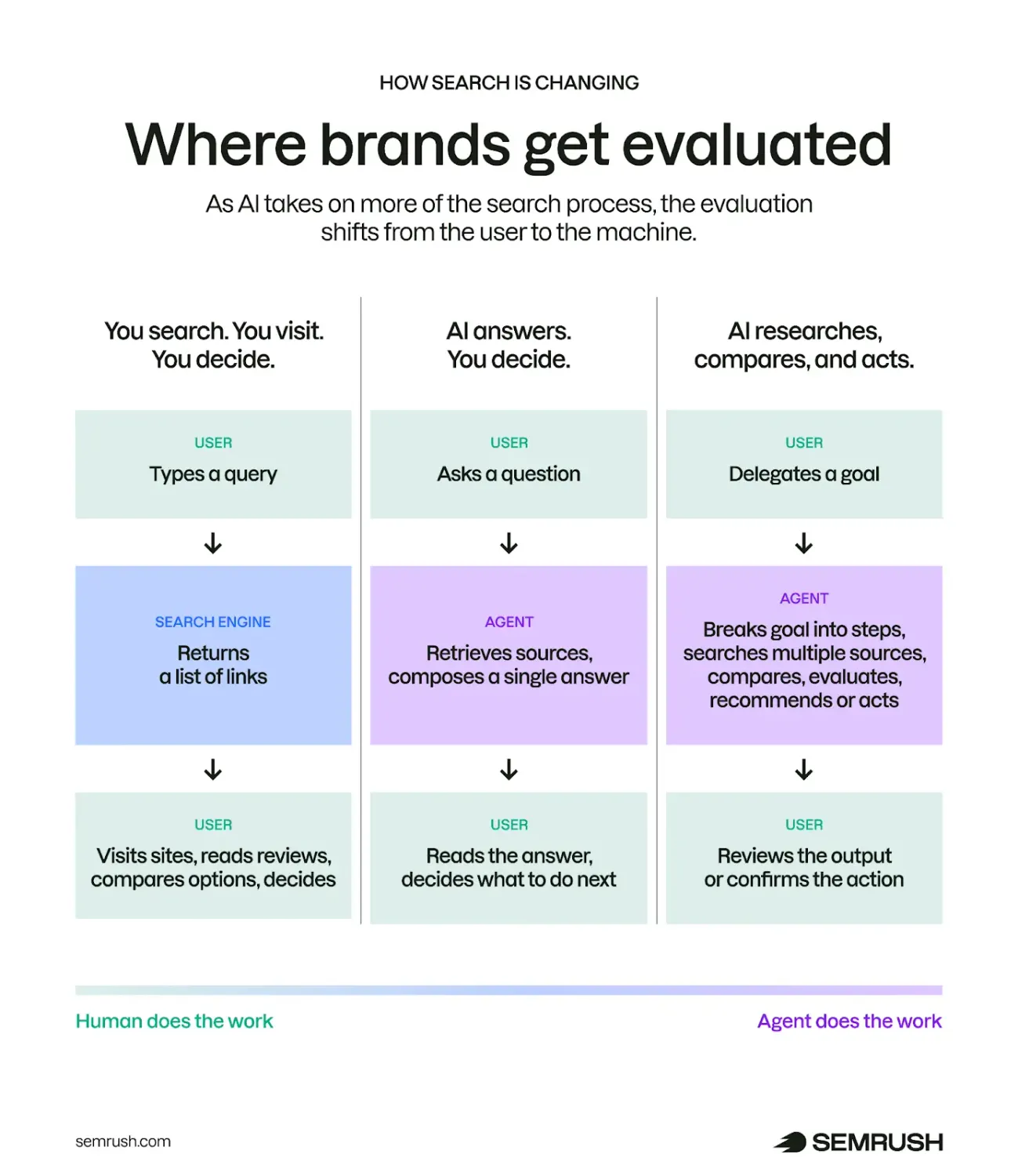
The "Ten Blue Links" are the headstones of a dead era. For three decades, the search engine was a passive librarian. You gave it a keyword; it gave you a shelf. The burden of labor was entirely on you, the user, to walk down the aisles, pull the books, cross-reference the data, and synthesize a conclusion. That era of "Research Labor" is over. We are witnessing the collapse of the traditional search interface and the birth of the "Agentic Web."
In this new reality, the "moment of choice" has fundamentally shifted. In the old model, your brand’s visibility was measured by your ability to get a click. In the current AI-generated landscape, users are interacting with your brand, evaluating your pricing, and weighing your competitors' reviews inside the search interface before they ever consider visiting your site. In many cases, they never will. If an AI can summarize your value proposition and compare it to a rival in a single, synthesized paragraph, the "visit" becomes an unnecessary friction point.
Architect’s Perspective: We are moving toward a "Zero-Click, Total-Action" ecosystem. Agentic search is not just an upgrade to a search engine; it is the transition from a retrieval tool to a delegation engine. This is the next logical evolution where AI doesn't just answer; it acts. If you are still optimizing for "keywords" and "rankings" without accounting for "agentic workflows," you are essentially buying billboards in a city where everyone is traveling by subway. You might be there, but no one is looking up.
Defining Agentic Search: From Response to Action
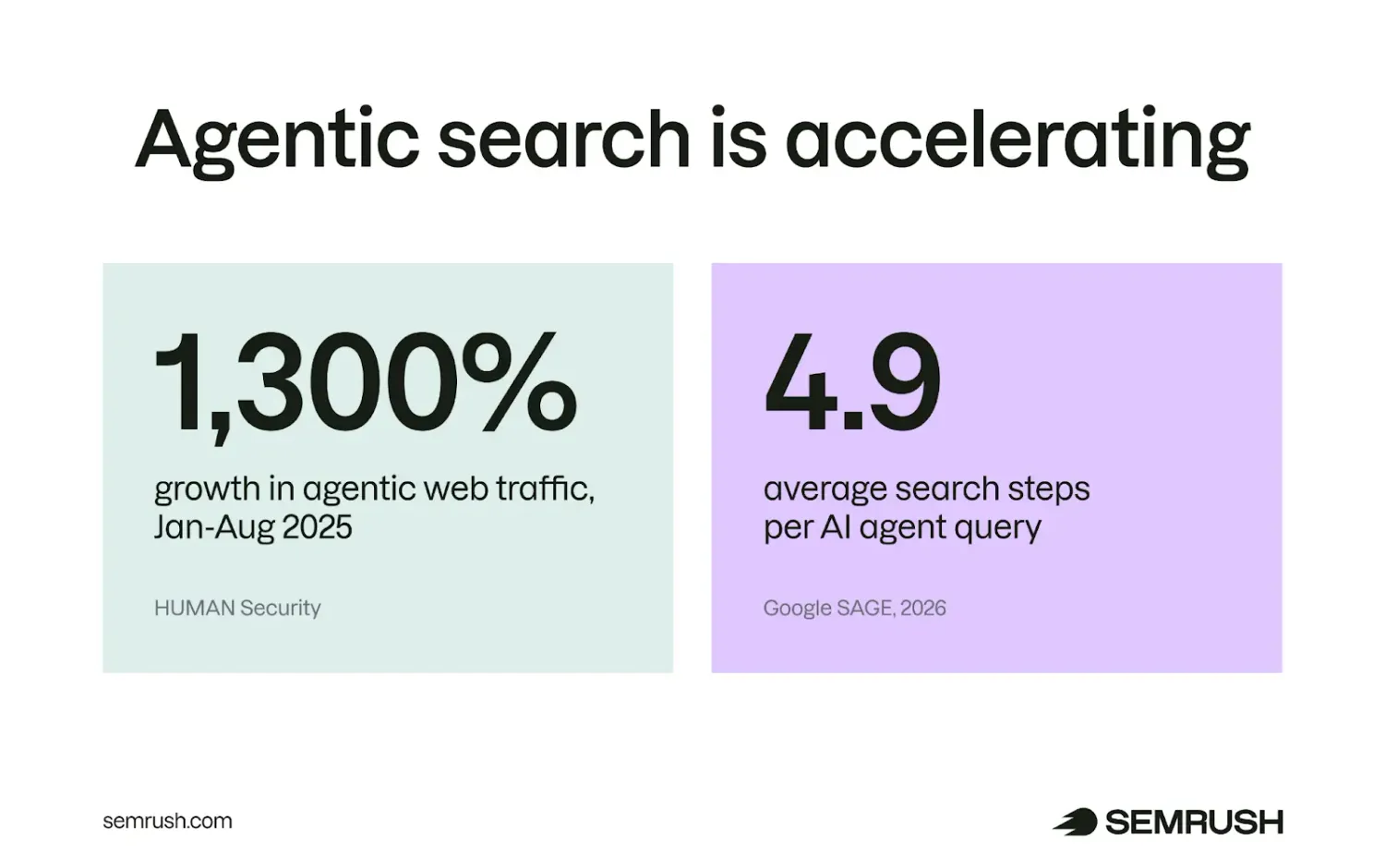
Agentic search is defined as AI that retrieves, evaluates, and acts on information on behalf of users. It represents a paradigm shift where the AI moves from being a "reactive responder" to an "autonomous problem-solver."
While traditional AI search (like early ChatGPT or Google’s initial AI Overviews) focused on retrieval, consolidating information into a readable format, an agentic system functions through multi-step workflows. It doesn't just pull the "best" answer; it breaks a complex goal into discrete sub-tasks, utilizes external tools (like calendars, payment APIs, and specialized databases), and adapts its behavior when it encounters contradictory information.
The Agentic Spectrum
To understand your brand’s visibility in this era, you must understand the spectrum of agentic behavior:
Simple Summarization: The AI consolidates findings into a brief response. This is the "answer" layer.
Comparative Synthesis: The AI evaluates multiple options against specific user constraints (price, location, user sentiment).
Complex Problem-Solving: The AI creates a multi-step plan, such as a 5-day itinerary or a software implementation roadmap, making judgment calls on logistics and compatibility.
Delegated Action: The AI executes a task, such as booking a flight, filling out a lead-generation form, or completing a purchase.
The core differentiator is autonomy. A search engine is a tool for researchers; an agent is an employee for approvers. Agents don't just stay on one page; they browse, they compare, and they verify. If your website is a "dead end" for a bot, meaning the information is trapped behind a JavaScript wall or an unparseable PDF, the agent will simply move to a competitor who makes the "agentic path" easier.
The Behavioral Shift: The "Delegate Economy"
The rise of the agentic web is ushering in the "Delegate Economy." In this environment, the human user’s role has shifted from being a "researcher" to being an "approver." This is a monumental psychological shift. When the labor of discovery and comparison is outsourced to an agent, the human user only encounters a brand for the first time during the "Validation Layer."
The Validation Layer and the Burden of Proof
Crystal Carter, Head of AI Search & SEO Communications at Wix, succinctly captured this shift: “Brands haven't experienced this level of burden of proof before.” In traditional marketing, you had the luxury of the "Funnel." You could use awareness campaigns to build familiarity, then use a slick landing page to convert. In the delegate economy, the agent has already done the "awareness" and "consideration" work for the user.
The human user is now a quality assurance layer. They are no longer weighing options; they are confirming a decision that has been staged for them. This means that if an agent presents your brand to a user, the user is looking for a reason to say "no" rather than "yes." They are skeptical approvers.
The Collapse of the Marketing Funnel
Trust is the only currency that matters in the delegate economy. As an agent successfully completes tasks for a user, the user’s oversight becomes lighter. The agent earns autonomy through positive outcomes. This collapses the traditional marketing funnel into a few seconds of high-stakes validation. If your brand doesn't have the "burden of proof" ready, in the form of consistent third-party reviews, authoritative citations, and clear entity data, the agent will filter you out before the human ever sees your name.
Agentic Search in Practice: The Austin Venue Scenario
To illustrate how an agent "thinks," let's walk through a common business task: planning a 15-person team offsite in Austin, Texas. Watch how the agent’s monologues evolve as the complexity increases.
Level 1: Simple Query (Brand Discovery)
The User Prompt: “What are the best off-site venues in Austin for a marketing team of 15?” The Agent’s Internal Monologue: I am searching for entities categorized as 'Event Venue' with a location of 'Austin.' I am filtering for 'Capacity: 15-20.' I see Venue A, Venue B, and Venue C have clearly stated these parameters in their metadata and H1 tags. I will present these three. The Strategist’s Note: At this stage, Discovery is the only thing that matters. If your site doesn't explicitly state your capacity and location in a way a bot can parse (Server-Side Rendered text), you are invisible. You aren't "in the answer."
Level 2: Comparison Request (Brand Clarity and Authority)
The User Prompt: “Compare Venue A and Venue B. Which one is better based on pricing under $8K and guest reviews for creative atmospheres?” The Agent’s Internal Monologue: Venue A's website claims a 'creative vibe,' but Reddit threads and Yelp reviews describe it as 'corporate.' Venue B has three expert articles from 'Event Planner Magazine' praising its 'industrial-chic aesthetic.' Venue B’s site has a clear pricing table; Venue A requires a PDF download, which I struggle to parse. I will recommend Venue B. The Strategist’s Note: Here, Clarity and Authority are decisive. If your website contradicts what the community (Reddit, YouTube, Yelp) says about you, the agent detects "muddy information." Consistency across the web is your new "on-page SEO."
Level 3: Research Brief (Multi-Step Evaluation)
The User Prompt: “Build a two-day itinerary for this offsite. Include Venue B, a nearby hotel with group rates, and three restaurant recommendations (one BBQ, one Tex-Mex, one upscale).” The Agent’s Internal Monologue: I am now assessing logistics. I need to find the distance between Venue B and the Hyatt Regency. I am checking Google’s SAGE data, an average of 4.9 steps are needed here. I am cross-referencing menus at Franklin BBQ vs. Terry Black’s. Terry Black’s has more 'Verified' reviews mentioning groups of 15. I will build the plan around Terry Black’s. The Strategist’s Note: The agent is now making judgment calls. It prioritizes brands that provide "structured ease." If your restaurant menu is an image file, the agent can't verify if you have a "group-friendly" Tex-Mex platter.
Level 4: Delegated Action (The Trust Threshold)
The User Prompt: “Book it.” The Agent’s Internal Monologue: I am committing $7,500 of the user’s money. I am looking for the most secure, agent-ready path. Venue B uses WebMCP and has an accessible booking form. The hotel requires a phone call. I will stage the Venue B booking and ask the user for a 'One-Tap' finish. I will skip the hotel for one that supports the Universal Commerce Protocol. The Strategist’s Note: Trust is now the decisive threshold. The agent is a concierge. It will not risk its "autonomy" with the user by recommending a brand that might have a broken booking flow or hidden fees.
The Four Pillars of Brand Visibility
In the agentic era, visibility is a diagnostic framework, not a leaderboard. You must optimize for four distinct pillars.
1. Discovery: The Prerequisite
Discovery is your "ticket to the game." It is driven by page-level authority, technical health, and relevance signals. If an agent cannot find your content or if your site is blocked by robots.txt from bots like OAI-SearchBot or Google-Extended, you are non-existent. Discovery ensures you are "in the pool" of initial consideration.
2. Clarity: The Narrative
Clarity is the agent's ability to build a coherent picture of your brand. Agents synthesize data from dozens of sources. If your website says you are a "Luxury Hotel" but your social media and Google Business Profile describe you as "Budget-Friendly," the agent encounters "source contradiction." In the agentic web, the "cleanest" information landscape wins. Contradiction leads to exclusion.
3. Authority: The Validation
Authority is what the rest of the world says about you. This is the external proof. Independent validation, expert articles, G2 reviews, Wikipedia entries, and mentions in industry publications, supports your claims. Clarity is what you say; Authority is what the world confirms.
4. Trust: The Decisive Threshold
Trust is the calculation of sentiment and track record. It is the final gate. Agents calculate trust by pulling from sentiment analysis of thousands of user mentions. A brand must be "trusted" for an agent to move from a "recommendation" to an "action." This is where negative sentiment on platforms like Reddit can kill your conversion rate before you even know you were being considered.
Agentic Search Optimization (ASO) vs. Traditional SEO
ASO is not a replacement for SEO; it is the "Pro" version. It builds upon the foundations of SEO and extends them into the realm of machine evaluators.
The SEO Fundamentals that remain critical:
Entity Clarity: Use Schema.org to define exactly what your brand is.
Structured Content: Content chunking and clear H2/H3 headers make your data "extractable."
Technical Site Health: If your site is slow or broken, a bot will treat it as "untrustworthy."
Where ASO Extends the Discipline:
Brand Accuracy Management: Ensuring your data is identical across all third-party directories.
Reputation Engineering: Actively seeding positive, authoritative sentiment on the platforms where AI agents "learn" (UGC platforms).
Agent-Readiness: Making sure your pricing, features, and transactional flows are accessible to an automated agent, not just a human eye.
Technical Foundations of the Agentic Web
The infrastructure of the agentic web is being built with standardized protocols that allow for seamless bot-to-server communication.
WebMCP and Capability Declaration
WebMCP is a game-changer. It allows a website to declare its "capabilities" to an agent programmatically. Instead of an agent scraping your site and trying to guess if you have a booking form, WebMCP lets your server tell the bot: "I am a venue, I have 15 available slots on April 12th, and I can accept a payment via this endpoint." This is a negotiation, not a search. Brands that declare fit through WebMCP will be the first choice for agents.
The Role of "llms.txt"
A new standard, the llms.txt file, is becoming a critical technical health factor. Similar to robots.txt, this file provides a "cheat sheet" for Large Language Models, telling them exactly which pages contain the most relevant data for their training and retrieval. If you don't have an llms.txt file, you are essentially asking the agent to guess what matters on your site.
The "JavaScript Killer": Server-Side Rendering (SSR)
Many modern websites rely on heavy client-side JavaScript. This is a death sentence in the agentic web. AI crawlers often struggle to execute complex JS. If your pricing or availability only loads after the page is rendered in a browser, the agent may see a "null" value and filter you out. SSR ensures that your content is baked into the HTML, making it immediately readable for bots.
Agentic Commerce and Google’s Vision
Google is not just changing search; they are building a "Universal Merchant." Elizabeth Reid (VP of Search) and Robby Stein (VP of Product) have outlined a vision where Google moves from "finding" to "doing."
The Universal Cart
The Universal Cart is a central hub that aggregates products from across the web, including major players like Shopify, Nike, Target, and Patagonia. It handles price comparisons and deal-finding autonomously.
UCP vs. ACP
Universal Commerce Protocol (UCP): Google’s bridge for autonomous transactions. If your store is UCP-enabled, you are eligible to be included in the Universal Cart.
OpenAI Commerce Protocol (ACP): OpenAI’s competing framework, which focuses on letting ChatGPT-style agents navigate merchant sites and stage checkouts.
Agent Payments Protocol (AP2)
The AP2 protocol allows users to set "guardrails." For example: "Book me a hotel in Austin for under $300, but only if it has a 4-star rating and is a Marriott property." These guardrails ensure that agents don't go rogue with the user's budget.
Case Study: "Declaring Fit" with Salesforce and Patagonia
How do you win in this environment? You declare your fit.
Salesforce: A master of "Entity Clarity." Salesforce doesn't just say they are a CRM. They have dedicated "Agent-Ready" pages for every niche: Healthcare CRM, Automotive CRM, Non-Profit CRM. When an agent searches for "Best CRM for car dealerships," Salesforce has a perfect match. They don't leave it to the agent’s imagination.
Patagonia: They consistently top the Semrush AI Visibility Index because their user-generated content (UGC) is structured. Their reviews allow users to state their "height," "weight," and "intended use." An agent can look at Patagonia and say with 100% confidence: "This jacket is the best fit for a 6-foot hiker in 30-degree weather." That precision is why they get recommended more often than generic retailers.
Actionable Tactics for Winning in Agentic Results
Based on a study of over 10,000 real-world queries, we have identified specific tactics that boost visibility by 30%-40%:
Original Quotes and Statistics: AI agents are trained to prioritize "ground truth." Including original data and expert quotes in your content makes it highly "citable" for agents.
Unlinked Brand Mentions: AI systems weigh brand mentions even without a backlink. A mention on a major tech blog or a viral Reddit thread contributes to your brand’s "Clarity" score.
Wikipedia and Wikidata: Wikipedia is the primary "source of truth" for most LLM training data. If you don't have an entry, or if it’s outdated, the agent’s core knowledge of your brand is flawed.
UGC Presence: Agents live on Reddit and YouTube. If the "community" sentiment is positive, the agent treats your brand as "Validated."
Machine-Readable Pricing: Don't hide pricing in PDFs or complex UI. Make it part of the page’s raw HTML.
Measuring Success with Semrush One
Traditional metrics like "keyword rankings" are insufficient for the agentic web. You need to track your "Share of Voice" inside the LLMs themselves. Semrush One provides the only integrated toolkit for this shift.
The AI Visibility Toolkit
This tool tracks how often your brand is cited by ChatGPT, Perplexity, and Gemini. It identifies "Visibility Gaps", places where a competitor is being recommended instead of you, and tells you why.
Log File Analyzer: Tracking the Bots
Use the Log File Analyzer to see if GPTBot, ClaudeBot, or Google-Extended are actually hitting your site. If they are skipping your "Pricing" page but hitting your "Blog," you have an accessibility issue. A strategist uses these logs to ensure the bot is getting the "High-Intent" data it needs to recommend you.
Brand Perception and Sentiment
The Brand Perception tool shows you the "Sentimental Map" of your brand across AI platforms. It reveals if an AI thinks your brand is "Reliable" or "Expensive," allowing you to adjust your content strategy to fix negative perceptions.
Frequently Asked Questions (FAQ)
Do I need to change my entire SEO strategy?
No. SEO is the foundation. Agentic Search Optimization (ASO) is the second story. You still need technical health and authority; you just need to add "Agentic Readiness."
How do I know if agents are evaluating my brand?
Check your server logs for AI user agents like GPTBot, OAI-SearchBot, and ClaudeBot. If they are crawling your site, they are building a profile of your brand.
What is the biggest risk?
The biggest risk is being filtered out before a human ever sees you. If your brand doesn't pass the "Validation Layer" during an agent's multi-step research, you will never even be presented as an option. You become a "ghost brand."
What is the difference between AI search and Agentic search?
AI search is about the response (Answer Engine). Agentic search is about the action (Task Engine).
Conclusion: Preparing for the Delegate Economy
The era of the "Ten Blue Links" has been replaced by the "Delegate Economy." Your mission as a modern marketer is no longer just to get found, it is to be chosen by an agent.
The formula is clear:
Discovery gets you into the pool.
Clarity gets you understood by the machine.
Authority gets you considered by the researcher.
Trust gets you the "One-Tap" purchase.
Agentic search is the greatest competitive advantage for brands that prioritize structure, consistency, and trust. Use Semrush One to diagnose your current visibility, monitor your bot traffic, and ensure your brand is ready to win in a world of autonomous agents. The web is no longer just for people; it’s for the agents who work for them. Build accordingly.



Created with © Systeme.io
Disclaimer: This page contains affiliate links. If you purchase through these links, we may earn a commission
at no extra cost to you. We only recommend tools we trust.