How to Optimize Your Website Using Semrush Tools
How to Optimize Your Website Using Semrush Tools
Introduction: The New Era of SEO and AI Visibility
For over two decades, the goal of search engine optimization was simple: secure a spot among the "traditional blue links" on the first page of Google. If you were in the top three, you won. But as we look toward 2026, the game has fundamentally changed. We are no longer just optimizing for a list of links; we are optimizing for a hybrid ecosystem where AI-generated summaries—like Google AI Overviews and Bing Copilot, occupy the most valuable real estate on the screen.
In this new era, your brand’s visibility isn't just about a click; it’s about being synthesized and cited. To thrive, your website must be "read, understood, and cited by both humans and machines." If an LLM (Large Language Model) can’t parse your data or trust your authority, you simply won't exist in the generative responses that now dominate mobile and desktop searches alike.
Semrush has evolved from a traditional keyword tool into a unified platform that bridges the gap between classic SEO authority and modern AI visibility. This isn't just a technical necessity; it's a massive financial opportunity.
Key Insight: According to Semrush research, visitors arriving at a website via AI search results are 4.4 times more likely to convert than those coming through traditional search channels. In 2026, being "cited" by an AI is the ultimate trust signal for high-intent buyers.
As a Senior Content Strategist, I can tell you that the "zero-click" search phenomenon isn't a death sentence for your ROI, if you adapt. The goal now is to provide such high-quality information that even if a user gets their answer from an AI summary, your brand remains the undisputed source of truth they eventually seek out for a transaction.
Foundation: Strategic Keyword Research and Mapping
Everything begins with the data. If you don't know what your audience is asking, you’re just shouting into a void. Modern keyword research isn't just about finding high-volume terms; it’s about identifying "money" keywords and the niche, long-tail opportunities that AI Overviews love to cite.
Mastering the Keyword Magic Tool
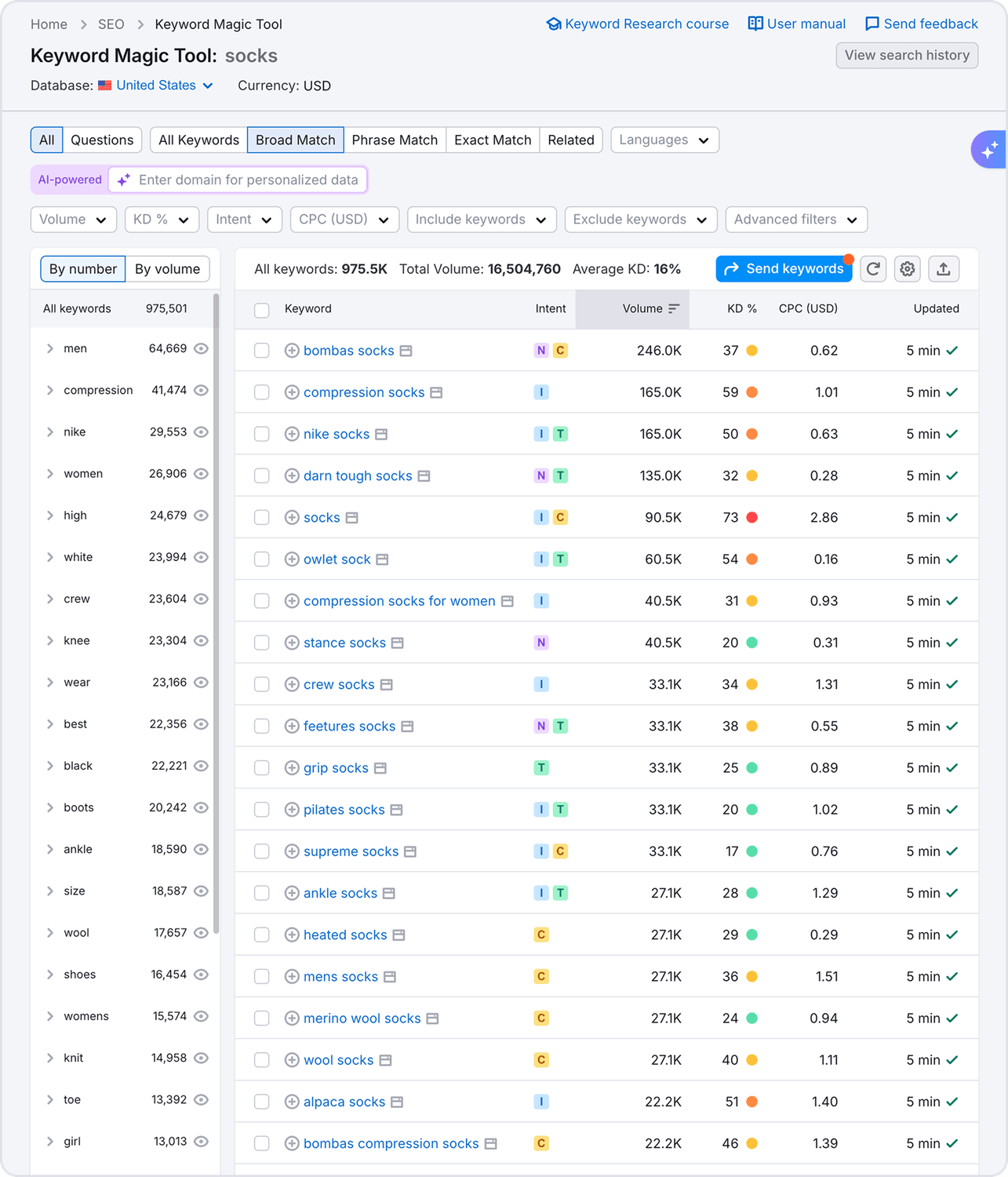
When you open the Keyword Magic Tool, you’re looking at a database of billions of terms. Start by entering a broad "seed" topic, for example, "coffee machines." By default, the tool shows you "Broad Match," which is great for a high-level view. However, a seasoned strategist knows the real gold is in the filters.
The "Questions" Filter: This is your secret weapon for AI visibility. Click this tab to see long-tail queries phrased as "how to," "what is," or "why." These informational queries are the primary triggers for AI Overviews.
Keyword Difficulty (KD%) and Personal Keyword Difficulty (PKD%): While KD% tells you how hard a term is to rank for generally, Semrush’s PKD% is tailored to your specific site. If your site has a PKD% of 46 for "dog behavior," you have a realistic chance of competing. If it’s 80, you’re fighting an uphill battle against giants like the New York Times.
Search Volume vs. Niche Opportunity: Don't ignore low-volume keywords. Research shows that 80% of AI Overviews trigger for keywords with under 1,000 monthly searches. These niche terms often have much higher conversion intent.
Bridging the Competitive Gap
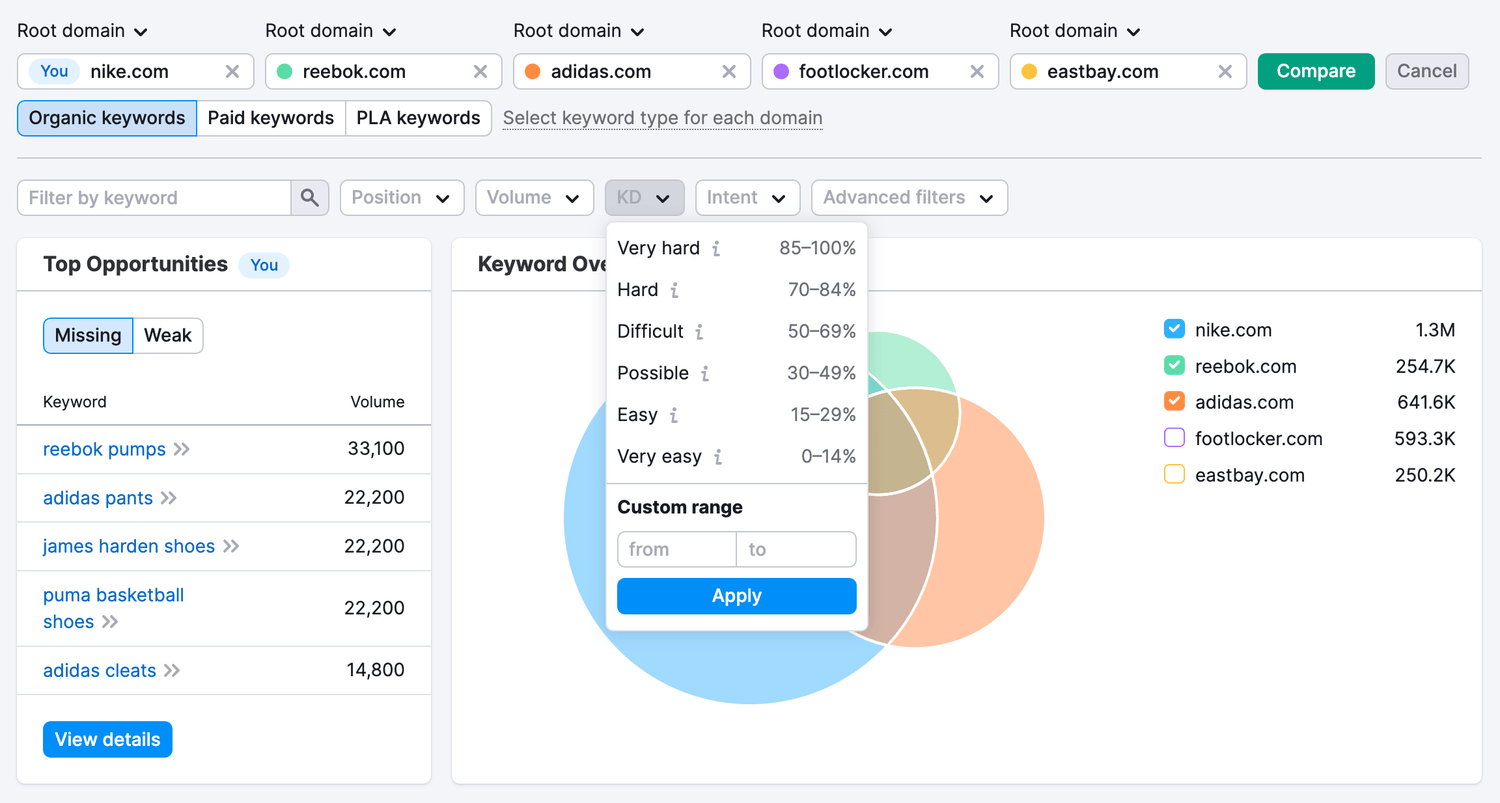
The Keyword Gap tool is where you identify exactly where your competitors are eating your lunch. Enter your domain and up to four competitors.
Missing Keywords: These are terms your competitors rank for, but you don't appear at all. This is your immediate content roadmap.
Weak Keywords: These are terms where you rank lower than your rivals. These pages need an immediate refresh or more authority.
The 5-Step Keyword Mapping Process
You cannot just sprinkle keywords across your site and hope for the best. You need a map.
Identify Clusters: Group your target keywords into distinct sets that answer a similar user need.
Use the Keyword Strategy Builder: Navigate to this tool in Semrush to organize your keywords into "Mind Map" style clusters automatically.
Analyze Search Intent: Before assigning a keyword to a page, you must understand the "why." Semrush categorizes intent into four pillars:
Informational: The user wants to learn (e.g., "how to use a coffee grinder"). Perfect for blog posts.
Navigational: The user is looking for a specific brand (e.g., "Semrush login").
Commercial: The user is researching options (e.g., "best manual coffee grinder"). Ideal for comparison guides.
Transactional: The user is ready to buy (e.g., "buy coffee beans online"). These belong on product or checkout pages.
Visualize Site Structure: Map these clusters to your site’s hierarchy to ensure you don’t have multiple pages competing for the same term (cannibalization).
Assign and Execute: Every page on your site should have one primary keyword and a handful of secondary, related terms.
Content Strategy: Topic Research and Planning
In my experience, the biggest mistake marketers make is writing what they think is interesting rather than what the data says is necessary. The Topic Research tool takes the guesswork out of ideation.
Finding "Topic Efficiency"
When you enter a topic and select your target database (national or local), the tool presents you with "Topic Cards." Don't just click the first one. Sort them by "Topic Efficiency." This identifies subtopics with high search volume and low difficulty, the "low-hanging fruit" of the SEO world.
Pro Tip: Pay close attention to the subtopics highlighted in green within the Topic Research tool. These are indicators that the specific subtopic already has a high volume of backlinks. In the world of authority building, these are your best bets for creating "link-bait" content that other sites will naturally want to cite.
Tools for the Visual Thinker
Mind Map View: If lists of data overwhelm you, use the Mind Map view to see a visual web of related topics. It’s a great way to see how one "pillar" topic can branch into dozens of "cluster" articles.
The Explorer Tab: This is where you see the "social proof." You can analyze Facebook engagement, total shares, and backlink counts for existing content in your niche. If you see a headline with 5,000 shares, you know there’s a hunger for that specific angle.
Overview Tab: This gives you the "top 10 headlines" and "top 10 questions." I often use these questions as my H2 and H3 subheadings to ensure I’m satisfying the exact queries searchers (and LLMs) are looking for.
Please note: The Topic Research and SEO Writing Assistant tools are essentially "Guru" or "Business" tier features. While the Pro tier offers a taste, a serious strategist needs the deeper access provided by the higher tiers to truly scale a content operation.
The Writing Process: Using the SEO Writing Assistant (SWA)
Writing for the modern web is a balancing act. You have to be authoritative for Google, clear for AI, and engaging for humans. The SEO Writing Assistant (SWA) acts as your real-time editor.
SWA is available as a standalone editor in Semrush, or as a plugin for Google Docs and WordPress. The Google Docs integration is particularly powerful for teams, allowing collaborators to see your SEO score even if they don’t have a Semrush account themselves.
The Four Pillars of the SWA
The tool evaluates your work against four real-time metrics:
SEO: It tracks your target keywords and suggests "recommended" keywords, semantically related terms that help search engines understand your topical depth. It also checks for link health and image alt attributes.
Readability: This includes a readability score based on the Flesch-Kincaid scale. It tracks word count and flags "Title issues" or "Content issues" like long paragraphs or complex sentences that might lose a reader’s attention.
Tone of Voice: You can set your target tone (from very casual to very formal). The tool identifies sentences that break this consistency. Note: As of now, this specific functionality is restricted to the English language.
Originality: The plagiarism checker is vital for authority. It provides a percentage of copied content and highlights exactly where that text exists elsewhere on the web, ensuring your content is 100% unique.
AI-Powered Refinement
The SWA now includes an AI-based feature that highlights filler words and "fluff" phrases. With a single click, you can rewrite these sentences to be more concise. This is critical because Google and AI systems prioritize content that satisfies intent quickly and accurately. If you can say in 10 words what your competitor says in 50, you have a better chance of being the "Key Takeaway" cited in an AI Overview.
On-Page SEO: Tuning Existing Content for Better Ranks
SEO isn't just about the new; it's about the "now." Often, the fastest way to double your traffic is to optimize the content you already have. This is where the On Page SEO Checker comes in.
To set it up, you input a specific URL and its target keywords. The tool then analyzes your page against the top 10 competitors who are actually ranking. It doesn't give you generic advice; it gives you a roadmap to beat them.
Recommendation Categories
Strategy Ideas: It identifies if you have keyword cannibalization (multiple pages fighting for one term) or if you should be targeting a different keyword entirely.
Content Ideas: This provides a side-by-side comparison of how your rivals use keywords in their H1s, titles, and body text compared to you.
Semantic Ideas: It suggests related terms your competitors are using that you’ve missed, which helps build "topical authority."
Technical Fixes: It pulls high-priority issues from your Site Audit (like broken images or slow load times) that are specifically hurting that page.
User Experience: If you connect your Google Analytics, the tool will suggest improvements based on bounce rates and time-on-page.
To see the most actionable data, navigate to the Optimization Ideas tab. This is where you see the "Why and How to Fix It" details that take you from page two to page one.
Technical SEO: Site Audit and Health Maintenance
Technical SEO is the foundation. If your site’s architecture is crumbling, no amount of great writing will save you. Search engines, and LLMs, need a clean path to discover, read, and index your pages.
To begin, navigate to the Site Audit tool, enter your domain, and set "Website" as the crawl source. The tool will scan for over 140 issues, but as a strategist, I categorize them into three buckets:
Crawlability & Indexability
Broken Links (404 Errors): These are dead ends for both users and Google.
How to fix: Navigate to the "Issues" tab, type "broken" in the search bar, and click the link for "internal links are broken." You must either restore these missing pages or use a 301 redirect to send users to a relevant existing page.
Redirect Chains & Loops: A chain makes the crawler work too hard; a loop makes it give up.
How to fix: Update all redirects in a chain to point directly to the final destination.
Noindex Tags: Sometimes developers leave these on by accident. If a page is "noindexed," it will never appear in search results or AI summaries.
HTTPS & Security
Security Protocols: Google uses HTTPS as a ranking signal. The audit checks for expired SSL certificates and outdated server protocols.
Mixed Content: This happens when an HTTPS page links to an HTTP image or script. It triggers security warnings in browsers that kill trust.
Performance & Core Web Vitals
Site speed is now a confirmed ranking factor and is vital for "Interaction to Next Paint" (INP).
Largest Contentful Paint (LCP): The time it takes for the main content to load.
Interaction to Next Paint (INP): approximated in Semrush by "Total Blocking Time" (TBT), this measures responsiveness.
Cumulative Layout Shift (CLS): This measures if elements jump around while loading (a major UX frustration).
Building Authority: Backlink Strategy and Outreach
If content is the "king," then backlinks are the "votes." A backlink is a signal to Google and LLMs that your site is a trusted authority.
Finding the "Backlink Gap"
The Backlink Gap tool is your shortcut to authority. Enter your domain and your top four rivals. The tool will show you a list of websites that link to all your competitors but not to you. These are your warmest prospects because they’ve already demonstrated they are interested in your niche.
Earning Links with "Link-Worthy" Content
Don't just ask for links—earn them. The best links come from content that provides unique utility.
Original Research: Share data from your own surveys.
Visual Assets: Create something like the "Not Bad Coffee" interactive flavor wheel. That single asset earned them over 700 backlinks because it was a useful tool for the entire industry.
Comprehensive Guides: Become the "Alexander Mills" of your niche by creating "battle" metaphors or polling your audience to create unique comparison data.
The Strategist’s Outreach Workflow
Once you have great content, use the Link Building Tool to manage your outreach. It finds the right contact person and tracks your emails.
Sample Outreach Template: Subject: Loved your coffee brewing guide! Hi Sarah, I’m Carlos from CoffeeCreations.com. I just read your guide on brewing methods and loved your breakdown of extraction times! I noticed you mentioned water temperature but didn't have a specific chart for different roasts. I actually just published a detailed temperature guide for 15 methods that might fill that gap for your readers. You can check it out here: [Link] Let me know if you think it's a good fit for a mention! Cheers, Carlos P.S. Love your podcast, the episode on bean origins was fantastic!
Strategist Note: That "P.S." is what gets you the link. It shows you aren't a bot and that you’ve actually engaged with their brand.
Optimizing for AI Overviews and Modern Search Features
In 2026, you aren't just trying to rank; you're trying to be the source of the AI's answer. AI models favor clear, well-structured, and authoritative information.
Optimization Strategy for Generative Search
Key Takeaways Blocks: Place a bulleted list of the 3-5 most important points at the very top of your article. LLMs scan for these concise summaries first.
Schema Markup: Use structured data to give search engines explicit clues about your content. Whether it’s "Recipe," "Review," or "FAQ" schema, this helps you secure "rich snippets" and AI citations.
Target the "Niche": Remember, 80% of AI Overviews happen on keywords with <1,000 searches. Don't chase the high-volume vanity terms; chase the specific, "how-to" niche questions where you can be the undisputed expert.
The AI Visibility Toolkit
Use the AI Visibility Index to benchmark your success. If your brand has a score of 81 or 90 (like the American Kennel Club or Semrush examples), you are being frequently mentioned by LLMs. If your score is low, it’s a sign you need more "Your Money or Your Life" (YMYL) signals, meaning you need more expert-authored content and reputable outbound citations to statistics and reports.
Local SEO and Visibility Management
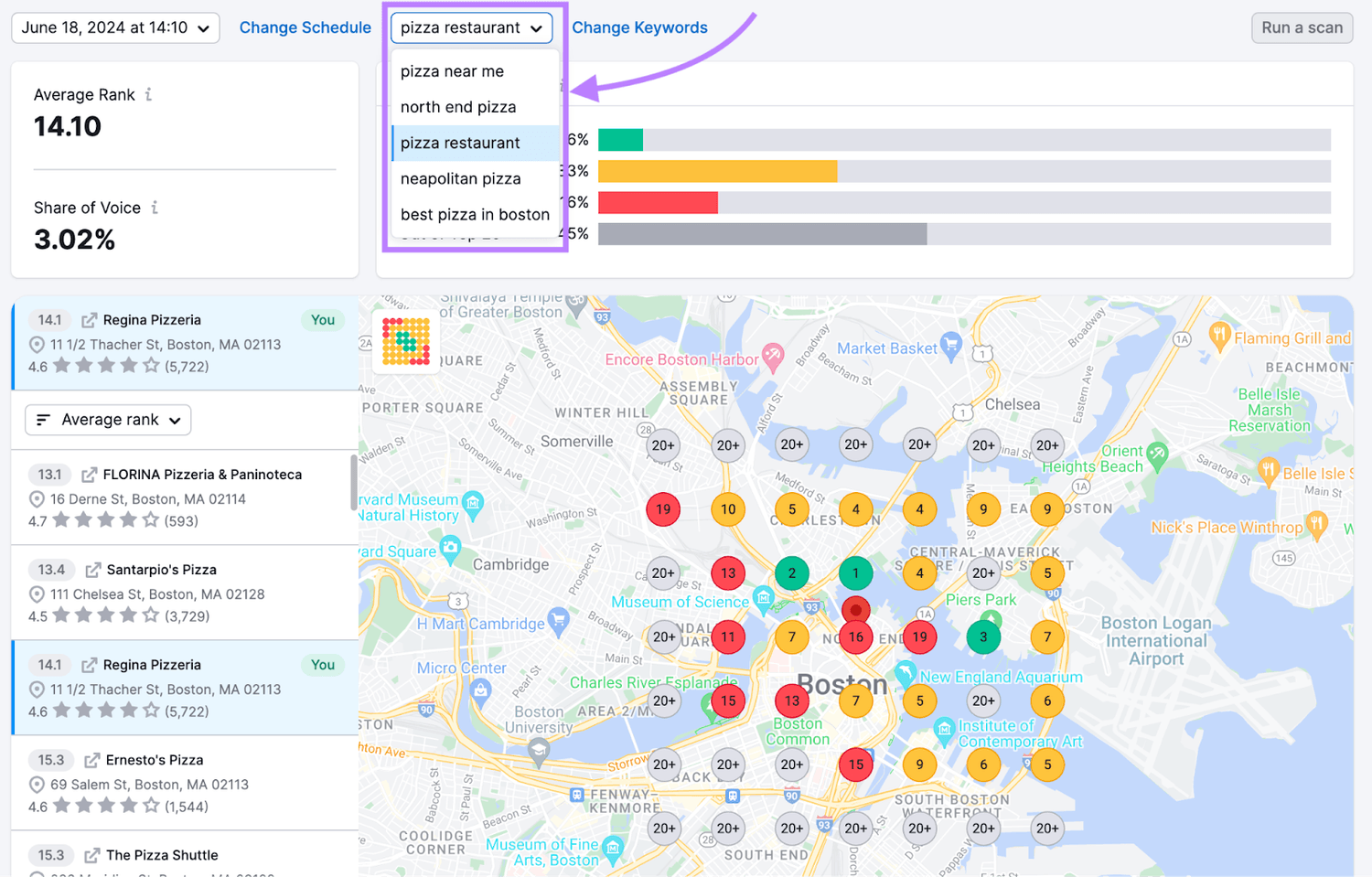
For any business with a physical footprint, local SEO is the difference between a busy store and an empty one. This begins with your Google Business Profile (GBP).
Local Optimization Checklist:
Accuracy: Your Name, Address, and Phone number (NAP) must be identical across every directory.
High-Quality Photos: Profiles with photos get significantly more clicks and trust.
Unique Features: Use GBP to highlight things like "Outdoor Seating" or "Free Wi-Fi."
Listing Management: Use the Semrush Listing Management tool to synchronize your information across dozens of directories simultaneously. This prevents the "fragmented data" that kills local rankings and ensures that when a user searches "coffee near me" on Maps, your synchronized data helps you appear in the top three.
Frequently Asked Questions (FAQ)
1. What Is Semrush and How Can It Help Your SEO?
Semrush is a unified platform that has evolved from a traditional keyword tool into a comprehensive ecosystem designed to bridge the gap between classic SEO and modern AI visibility. It helps your SEO by providing data-driven insights into what your audience is asking, allowing you to identify "money" keywords and long-tail queries that trigger AI Overviews. It also offers tools for technical health (Site Audit), competitive analysis (Keyword Gap), and content optimization (SEO Writing Assistant) to ensure your site is "read, understood, and cited" by both humans and machines.
2. Why Should You Use Semrush for Your Digital Marketing?
Using Semrush is described as a massive financial opportunity because research shows that visitors arriving via AI search results are 4.4 times more likely to convert than traditional search visitors. It removes the guesswork from marketing, moving you away from writing what you "think" is interesting toward what data says is necessary. By using its suite, you can build a brand that is the "undisputed source of truth," which is critical in an era where AI-generated summaries dominate search real estate.
3. When Is the Best Time to Use Semrush for Market Analysis?
Market analysis should be treated as a continuous loop rather than a one-time task. However, specific ideal times to use the tool include:
At the start of a project: To identify "seed" topics and organize keywords into clusters using the Keyword Strategy Builder.
When evaluating competitors: Using the Backlink Gap and Keyword Gap tools to find immediate content roadmaps based on what you are missing.
During content creation: To ensure "topic efficiency" and to find subtopics with high volume and low difficulty.
When ranking performance stalls: Using the On Page SEO Checker to find a roadmap for moving from page two to page one.
4. Where to Find Semrush Tutorials and Resources?
The sources point to several specific areas within the platform to find actionable guidance:
The Optimization Ideas Tab: Found within the On Page SEO Checker, this provides specific "Why and How to Fix It" details.
The Site Audit Tool: This scans for over 140 technical issues and categorizes them into actionable "buckets" like crawlability and performance.
The SEO Writing Assistant (SWA): This provides real-time metrics and editing tips within Semrush, Google Docs, or WordPress.
AI Visibility Index: Use this to benchmark your success and see how frequently LLMs (Large Language Models) mention your brand.
5. Who Can Benefit from Using Semrush Tools?
A wide range of professionals can benefit from the platform, including:
Content Strategists and Marketers: To move from "SEO tricks" to "Information Excellence".
Visual Thinkers: Who can use the Mind Map view to visualize how pillar topics branch into content clusters.
Local Business Owners: Who need to synchronize their information across directories and manage their Google Business Profile.
Writing Teams: Collaborators can use the Google Docs integration for the SWA to see SEO scores even without a Semrush account.
Technical SEOs: Who need to monitor Core Web Vitals and site security protocols like HTTPS.
Conclusion: Executing Your SEO Roadmap
SEO in the age of AI is no longer a set-it-and-forget-it task. It is a continuous loop of auditing your health, researching your audience’s needs, creating high-quality information, and building the authority to back it up.
The websites that will win in 2026 are those that move away from "SEO tricks" and move toward "Information Excellence." By using the Semrush suite, you aren't just chasing algorithms; you’re building a brand that is discoverable, authoritative, and helpful to both humans and the machines that help them find you.
Start your journey today by initiating a Semrush trial. Analyze your AI Visibility Index, run your first Site Audit, and identify the "missing" keywords that your competitors are using to outshine you. High-quality information is your most powerful marketing tool, it’s time to make sure the world (and the AI) can find it.



Created with © Systeme.io
Disclaimer: This page contains affiliate links. If you purchase through these links, we may earn a commission
at no extra cost to you. We only recommend tools we trust.