AI Visibility: A New Era for Digital Marketing Success
AI Visibility: A New Era for Digital Marketing Success
The Visibility Paradox: Why Your SEO Strategy is Obsolete in the Age of AI Agents
Introduction: The 527% Wake-Up Call
For 17 years, the marketing world operated under a stable set of assumptions. You optimized for keywords, you built high-quality backlinks, and you climbed the ranks of the search engine results pages. The objective was simple: own the blue link. If you appeared at the top of a Google search, you owned the customer’s attention and, eventually, their wallet.
That era of digital stability is officially over. We are currently witnessing a seismic shift that makes the move from desktop to mobile look like a minor adjustment. According to recent data, AI-driven search is surging at a staggering 527% year-over-year. This is not a trend; it is a total reconstruction of the discovery landscape.
If you are a marketer who feels that the "old SEO rules" are no longer delivering the same impact, your intuition is correct. The traditional funnel is fragmenting. The gatekeepers are changing, the algorithms are evolving into reasoning engines, and the very definition of a "search" is being reimagined by millions of users every day.
To navigate this volatility, Semrush has undergone a fundamental transformation. In March 2026, the industry leader officially evolved into a unified intelligence engine. This shift acknowledges that visibility is no longer a siloed technical task. It is a multi-channel orchestration of authority, trust, and presence across a vast digital ecosystem.
Takeaway 1: Beyond the "SEO Company" Label
The March 2026 brand transformation was not merely a cosmetic update or a change in logo. It was a strategic declaration of the new reality. For nearly two decades, Semrush was categorized as an "SEO company." While that label was accurate for the keyword-centric era, it has become a strategic limitation today.
Search is no longer confined to a single search box on a browser. It has moved into AI chat interfaces, social media feeds, and niche community forums. When a consumer asks an AI agent for a product recommendation, they are searching. When they browse a Reddit thread for "best enterprise software," they are searching.
"The last decade of search was only the warmup," says Andrew Warden, Chief Marketing Officer at Semrush. "Today, discovery is happening everywhere: in AI answers, on social, in community forums, and more. Many brands are struggling to navigate it and getting left behind."
By repositioning as a Brand Visibility platform, the goal is to solve the fragmentation problem. The "unfair advantage" now comes from intelligence that spans the entire discovery surface. Ambitious marketers must stop thinking about "ranking" and start thinking about "winning visibility" wherever a human, or an AI agent, is looking for an answer.
Takeaway 2: The 90% Attribution Gap (The Hidden Threat)
Perhaps the most dangerous threat to modern brands is what Marcus Tober, SVP of Enterprise Solutions at Semrush, calls the "attribution gap." As generative AI engines like ChatGPT and Perplexity become the primary interface for discovery, they use the web’s content to formulate their answers.
However, there is a massive disconnect between the content used to generate an answer and the credit given to the brand that created it. Semrush data reveals a terrifying statistic: in many verticals, more than 90% of pages cited by generative engines fail to drive any brand attribution or traffic back to the source.
The Citation Failure: Generative engines often scrape your expert insights to provide a complete answer but omit your brand name in the summary.
The Traffic Severance: Even when a source is technically "cited" in a footnote, the click-through rate is a fraction of what traditional search provides.
The Invisible Foundation: Your brand becomes the unpaid research department for an AI that then directs the user toward a generic conclusion.
Staying "present in search but absent in the systems shaping modern discovery" is a recipe for long-term irrelevance. If you are not actively managing how your brand is perceived by these Large Language Models (LLMs), you are effectively letting the "second gatekeeper" erase your identity.
Takeaway 3: Introducing Agentic Search Optimization (ASO)
To survive the attribution gap, we must move beyond traditional SEO and adopt Agentic Search Optimization (ASO). Traditional SEO was built for a world where a human user looked at a list of links and made a choice. ASO is built for a world where an AI agent makes the choice for them.
The LLM is now the "second algorithmic gatekeeper." It sits between your content and your customer, synthesizing information and shaping brand perception before the customer ever arrives on your site. ASO is the strategic framework for ensuring your brand is not just indexed by these models, but actively cited, mentioned, and recommended as a trusted authority.
The Pillar of Prompt-Level Visibility
Marketers must now track how their brand appears across millions of LLM prompts. This involves monitoring the "share of voice" within generative answers compared to direct competitors. It is no longer enough to know you rank for "best CRM." You must know if ChatGPT mentions your CRM when a user asks for "software for a growing mid-sized manufacturing firm."
The Pillar of AI Market Share
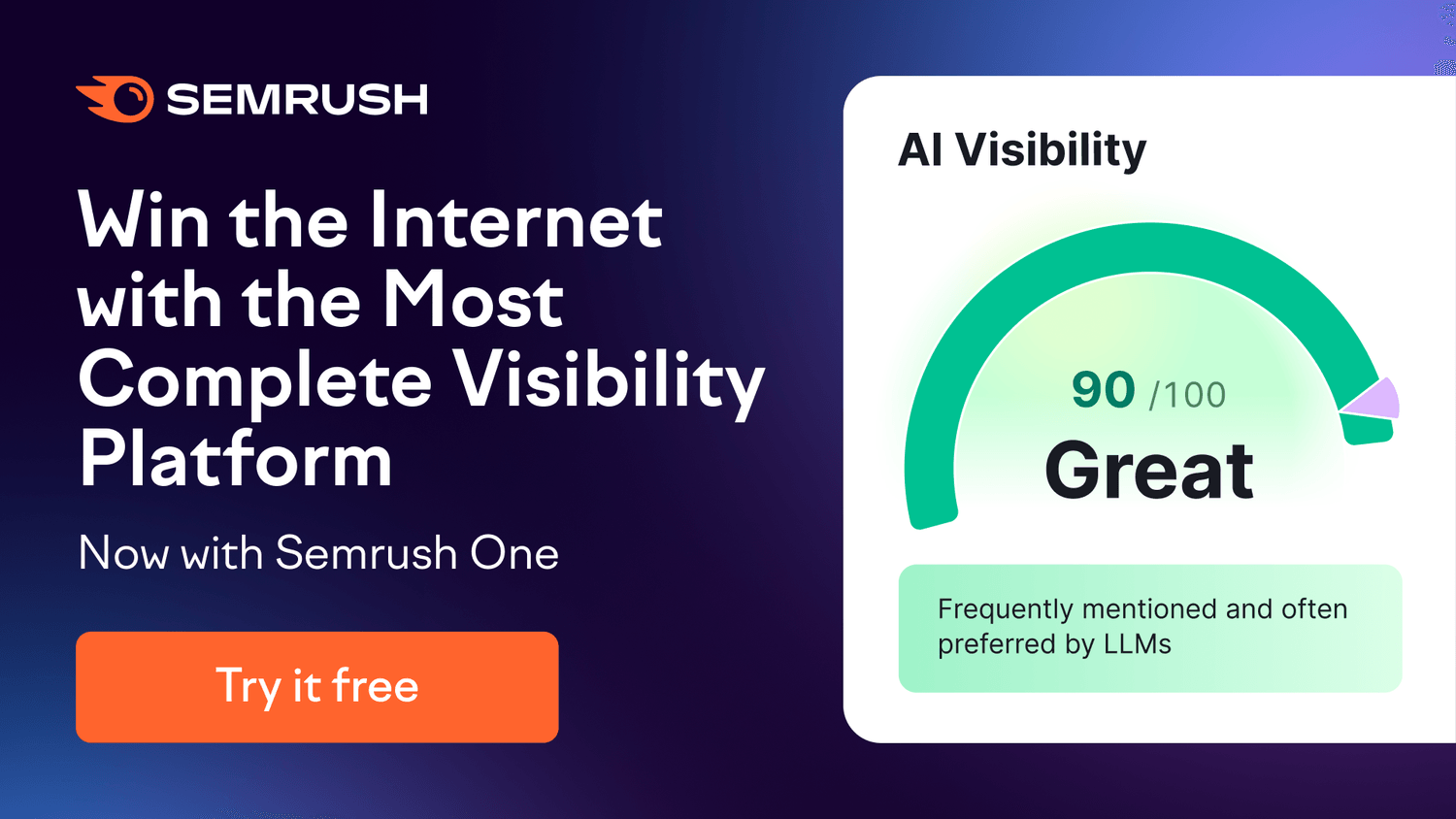
Measuring your brand's presence within the latent space of an LLM is the new frontier of competitive intelligence. AI Visibility scoring allows you to quantify your influence within the models that are increasingly responsible for the "shortlist" in any buying journey.
The Pillar of Citation Mapping
Understanding which specific pieces of content lead to a brand mention in an AI overview is critical for ROI. ASO focuses on creating "citation-ready" assets, data-rich, authoritative pieces that provide the "ground truth" that LLMs are programmed to seek out and credit.
Takeaway 4: The Three Phases of Modern Visibility
A recent IDC Market Note (doc # US53968225) provides a roadmap for this evolution. It defines visibility as a fluid experience spanning three distinct phases. Focusing only on the first phase is a strategic error that ignores the looming reality of AI-mediated commerce.
Phase 1: Discovery Visibility
This is your brand's presence across the traditional SERPs, AI answers, social surfaces, and third-party ecosystems. It is the "top of the funnel" in the AI era, focusing on whether you exist in the initial set of data the user (or agent) encounters.
Phase 2: Engagement Visibility
This phase measures the consistency and quality of your digital engagement across owned channels and devices. Once an AI agent or a human has "discovered" you, is your digital experience robust enough to hold their attention and provide the specific data they need?
Phase 3: Visibility for Value Consumption
This is the most critical phase for the future. It measures the extent to which customers actually transact with and derive value from your products. By 2029, over one-third of digital transactions will be AI-mediated. This means an AI agent will be the one evaluating and selecting a product.
If your brand is not visible at the "value consumption" level, an AI agent may deem your product "too difficult to integrate" or "lacking transparent data," and skip you entirely. Visibility is no longer just about being seen; it is about being "transactable" by the machines that will soon mediate a third of our economy.
Takeaway 5: Why "Trust-Rich" Content is the Only Defense Against Homogeneity
The barrier to content creation has collapsed, but the barrier to trust has never been higher. The rise of AI has led to "AI-generated content homogeneity." By 2027, undifferentiated AI content is predicted to significantly erode brand differentiation across the web.
When every competitor is using the same LLMs to generate the same blog posts, the internet becomes a sea of "good enough" content that says nothing new. In this environment, "trust-rich" content becomes your only technical defense. LLMs are being trained to filter out generic fluff in favor of high-signal, human-vetted information.
The Technical Signal of Neutrality
AI engines disproportionately reward content that uses neutral and comparative formats. Instead of a sales pitch, brands should provide objective comparisons. When you provide a balanced view, the LLM views you as a more reliable source for its synthesis.
Rebuilding Topical Authority
To combat the attribution gap, brands must rebuild topical authority on their own domains using structured data. Content must be easy for machines to parse (via schema and clear hierarchies) but clearly authored by humans with verified expertise.
Navigating Recency Bias
LLMs have a significant "recency bias." They prioritize information that reflects the most current state of the world to ensure their answers aren't outdated. A high-frequency content refresh strategy is now a technical SEO requirement. You must constantly update your "ground truth" data to remain in the LLM’s citation loop.
Takeaway 6: The "External Surface" Strategy (Reddit, Reviews, and Certifications)
In the AI era, your website is only one piece of the puzzle. AI engines do not just look at your self-published claims; they look for external verification. LLMs "disproportionately rely" on high-trust external domains like Reddit, industry review platforms, and certification sources to verify facts.
This is the "external surface" of your brand visibility. If you have a beautiful website but your brand is invisible or poorly rated on Reddit and G2, the AI will deprioritize you. The "community consensus" has become a literal ranking factor for generative engines seeking to provide "safe" and "verified" answers to users.
Building authority on these platforms is no longer a "nice-to-have" for the PR team; it is a core requirement for the SEO and ASO teams. You must ensure that the signals on these third-party domains align with your brand's desired positioning to feed the LLM’s verification loops.
Takeaway 7: GEO as an Organizational—Not Just Technical—Problem
Generative Answer-Engine Optimization (GEO) is often treated as a tactical SEO task. This is a mistake that leads to inconsistent and fragile visibility. GEO is actually an organizational challenge that requires deep, cross-functional alignment between Marketing, Product, and Customer Experience (CX) teams.
LLMs pull data from every corner of your digital footprint, from your technical documentation to your customer support FAQs and your pricing pages. If these silos aren't synchronized, the AI will find conflicting information, which erodes your "trust score" and makes it less likely to cite you as a definitive answer.
Unified Content Operations: Bridging the gap between the marketing team's "hooks" and the product team's "specs."
Modernized Data Architecture: Ensuring that your CMS, Digital Asset Management (DAM), and Product Information Management (PIM) systems talk to each other.
Executive Sponsorship: Because GEO involves brand-risk implications and infrastructure changes, it requires leadership at the highest levels of the organization.
Without a unified data foundation, even the most brilliant SEO team will struggle to influence the "second gatekeeper." The machine needs a single source of truth.
Takeaway 8: Scaling the "Unfair Advantage" with Unified Data
To win in an era of 527% growth in AI search, the scale and quality of your data are your only sustainable competitive advantages. Semrush has built a proprietary database designed to provide exactly this "unfair advantage" through its two primary frameworks.
The sheer scale of this intelligence is what makes the brand transformation possible. It is built on a foundation of 27 billion keywords and 43 trillion backlinks. Crucially, it now includes over 213 million LLM prompts, allowing brands to see exactly how they are being discussed inside the "black box" of AI agents.
Semrush One: The SMB Intelligence Engine
For small and medium businesses, Semrush One provides a unified solution that bridges the gap between traditional SEO and AI search. It allows smaller teams to compete by giving them a single place to manage their digital footprint, ensuring they are "seen and cited" without needing a massive enterprise budget.
Semrush AIO: The Enterprise Visibility Stack
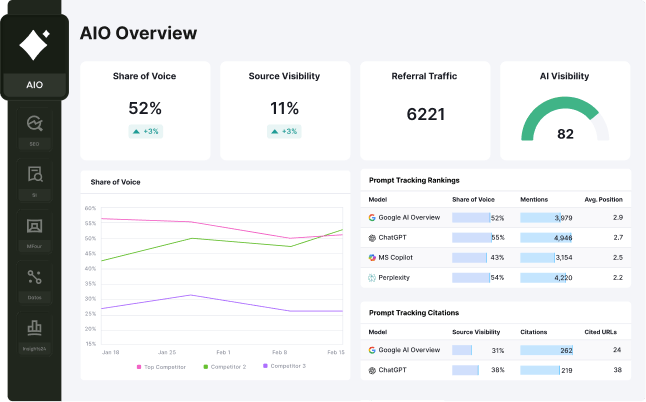
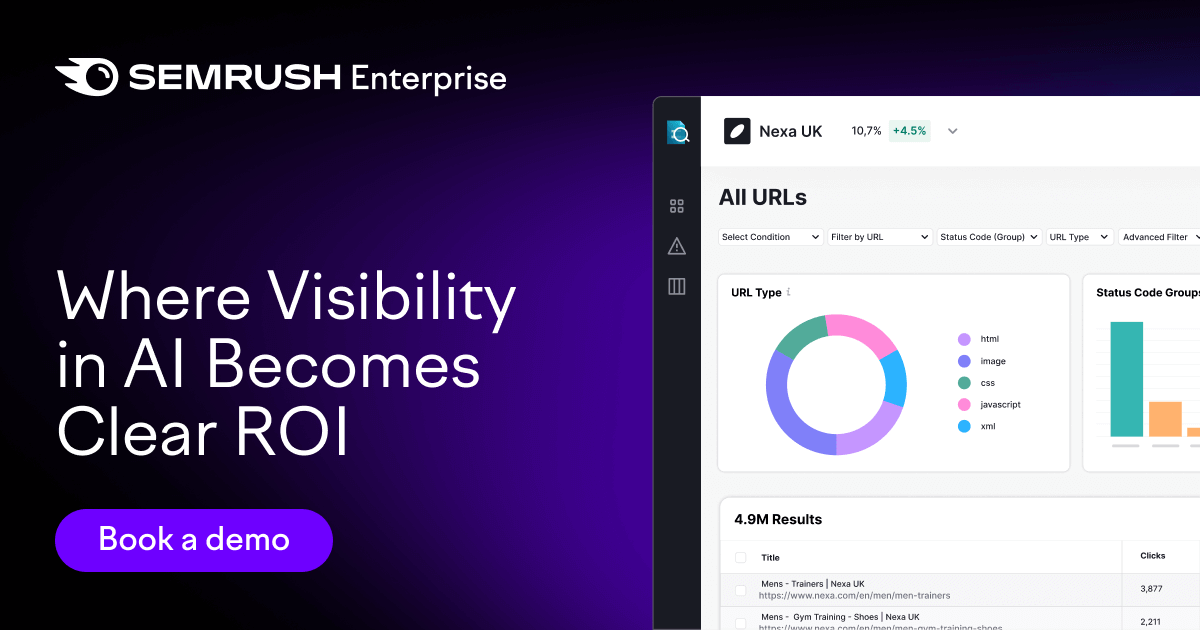
For large organizations, Semrush AIO (AI Optimization) is built for complex, high-stakes environments. It moves beyond practitioner tools into a strategic platform. AIO provides AI visibility scoring, citation mapping, and source benchmarking, allowing enterprise leaders to quantify their influence in the AI era.
"Semrush for Enterprise has been a game-changer," says James Roth, CRO at ZoomInfo. "It’s helped us work more efficiently, cutting down on manual tasks so we can focus on what really matters, engaging with our audience and driving growth."
Frequently Asked Questions (FAQ)
1. What Is AI Visibility and Why Is It Important in Digital Marketing?
AI visibility is a brand's presence and citation frequency within generative AI engines, AI-generated answers, and AI agents. It represents a shift from traditional search engine rankings to becoming the preferred "answer" provided by Large Language Models (LLMs) like ChatGPT and Perplexity. This is critical because AI-driven search is growing at 527% year-over-year, fundamentally changing how consumers discover and evaluate brands. In this new era, AI engines act as a "second algorithmic gatekeeper," meaning that if a brand is not cited in these AI answers, it becomes effectively invisible to a large segment of users.
2. How Does AI Visibility Influence Digital Marketing Strategies?
AI visibility forces a strategic evolution where marketers must act as "brand visibility strategists" rather than just SEO practitioners. Strategies are shifting from optimizing for clicks to optimizing for citations and trust. To influence AI outputs, businesses are adopting "Agentic Search Optimization" (ASO) or "Generative Engine Optimization" (GEO), which involves bridging the gap between traditional SEO authority and AI search presence. This includes creating "LLM-friendly" content that is neutral, comparative, and structured, while also strengthening brand signals on high-trust external platforms like Reddit or review sites that AI engines prioritize.
3. When Should You Consider AI Visibility in Your Marketing Plan?
You should consider AI visibility immediately, as the transition to the "AI search era" is already underway. With projections suggesting that over a third of digital transactions will be AI-mediated by 2029, brands that fail to integrate AI visibility now risk long-term loss of competitiveness. It is particularly vital during pivotal brand moments, such as product launches or market expansions, to ensure AI agents correctly interpret and recommend your services as they become the primary mediators of discovery and purchase.
4. Where Can You Implement AI Visibility in Your Digital Marketing?
AI visibility can be implemented across several digital touchpoints:
Generative Answers: Optimizing content to be cited in ChatGPT, Perplexity, and Google’s AI Overviews.
Content Operations: Crafting AI-ready content that uses clear authorship and sourcing to signal credibility.
Local and Social Presence: Using AI to hone customer service on local directories and monitoring brand mentions across social surfaces to build trust signals for LLMs.
Earned Media/PR: Focusing on AI PR to build trust through press outlets that LLMs frequently use as authoritative sources.
Platform Integration: Utilizing unified intelligence engines like Semrush One or Enterprise AIO to track prompt-level visibility and AI market share.
5. Why AI Visibility Matters for Your Business's Online Presence
AI visibility is essential because traditional SEO metrics no longer tell the full story of how a brand is perceived online. Without it, a business may maintain high search rankings but suffer from an "attribution gap," where AI engines use the brand's content to provide answers but omit the brand mention or link. Furthermore, AI visibility helps combat "content homogeneity", where AI-generated outputs become undifferentiated, by ensuring your brand’s unique human expertise and authority are recognized by algorithms. Ultimately, it secures your presence across the entire customer journey, from initial discovery to the final AI-mediated transaction.
Conclusion: The Future of Being "The Answer"
The "Brand Visibility Mandate" is the new North Star for ambitious marketers. The era of optimizing for clicks is rapidly being superseded by the era of optimizing for citations and trust. The transition from a search toolset to a unified intelligence engine reflects a world where visibility is no longer a series of isolated events, but a fluid, continuous experience.
To remain relevant, you must move beyond the "rank-and-click" mindset. You must build a digital footprint that is so authoritative and trustworthy that AI agents find it impossible to ignore. The risk of the "invisible 90%" is real. If you are not actively managing your presence in the models shaping modern discovery, your brand’s future is being written by someone else.
As we look toward 2029, the fundamental question for every business leader is no longer "Where do we rank on Google?" Instead, you must ask: "By the time AI agents are making a third of all buying decisions, will your brand be the one they cite, or will you be part of the invisible 90%?"



Created with © Systeme.io
Disclaimer: This page contains affiliate links. If you purchase through these links, we may earn a commission
at no extra cost to you. We only recommend tools we trust.