Semrush One vs. Semrush SEO Toolkit: Future of Search & AI Visibility
The Paradigm Shift: Why Your SEO Strategy Just Became Two-Dimensional
The digital landscape is undergoing its most significant transformation since the birth of the search engine itself. For those of us who have spent 15+ years in the trenches of SEO, the rules were once comfortably rigid: optimize for the spider, win the click, and dominate the blue links. But we have reached a tipping point. As we look toward 2026, it is clear that search has evolved from a linear retrieval process into a multi-dimensional discovery experience.
The core tension today lies between "Classic SEO", the art of winning on traditional Google SERPs, and "Modern Visibility Management." This is the fundamental difference between the Semrush SEO Toolkit and Semrush One. The SEO Toolkit remains the world’s most powerful specialized suite for traditional rankings, backed by 17 years of data expertise and 21 international awards. However, Semrush One represents the first truly unified platform designed to bridge the gap between classic search authority and AI-driven discovery.
In this new era, visibility is no longer just about being #1 on a search page; it is about being the chosen answer within a ChatGPT response, a Claude analysis, or a Google AI Overview. If your brand is not being "found everywhere," you are operating with a visibility gap that costs you more than just rankings, it costs you consideration. As a strategist, your goal is to transition from managing "search volume" to managing "brand mentions" across the entire AI ecosystem.
The Classic Powerhouse: A Comprehensive Deep Dive into the Semrush SEO Toolkit
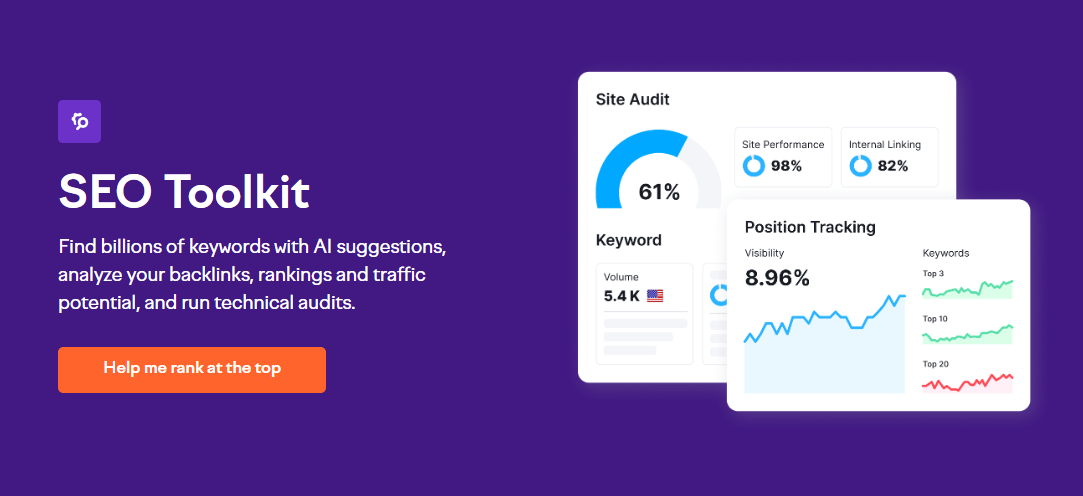
For the specialist who needs to dissect every technical nuance of a domain, the Semrush SEO Toolkit is the bedrock of performance. It contains more than 20 tools and reports that cover the entire lifecycle of a website’s health and authority. Powered by the largest keyword database on the market and the industry's most accurate search volume data, it provides an intuitive dashboard to review potential from every angle.
Competitive Research: The Strategic Foundation
Before you write a single line of code or content, you must understand the competitive landscape. The Toolkit provides five specialized reports to map your rivals' moves:
Domain Overview: This is your command center. Entering a URL provides an immediate snapshot of organic traffic, paid search spend, and backlink authority.
Organic Research: This tool allows you to deconstruct a competitor's success. You can see their top-performing keywords, traffic trends over time, and even the "Position Changes" that indicate a new strategy or a recent algorithmic hit.
Keyword Gap: Use this to compare your domain against up to four competitors. It identifies "Unique" keywords (the ones they have and you don’t) and "Weak" keywords where they outrank you.
Backlink Gap: A critical tool for authority building. It identifies referring domains that link to your competitors but not to you, effectively a "to-do list" for high-probability outreach.
Top Pages: Discover which specific URLs on a competitor’s site are the true workhorses, allowing you to reverse-engineer their content structure.
Strategist’s Pro-Tip: Use the "Keyword Gap" tool specifically to filter for "Transactional" intent keywords that your competitors rank for in positions 1-3 while you are on page two. This is the fastest way to find high-ROI targets that just need a small technical push.
Keyword Research Mastery: Finding the Path to Traffic
Keywords are the DNA of search. The Toolkit treats them with scientific precision.
Keyword Magic Tool: Start with a seed term and uncover millions of related ideas. You can filter by Search Volume, Keyword Difficulty (KD%), and Search Intent (Informational, Navigational, Commercial, Transactional).
Keyword Strategy Builder: This is where research becomes a roadmap. It allows you to cluster keywords by topic, creating a content architecture that search engines recognize as authoritative.
Position Tracking: This tool provides daily updates on your rankings for a custom list of keywords. It is essential for monitoring the impact of specific optimizations in real-time.
Organic Traffic Insights: By connecting your Google Analytics and Search Console data, this tool uncovers the "not provided" keywords that are actually driving conversions on your site.
How-To Narrative: Building a Keyword List for SEO
Seed Phase: Enter your primary topic into the Keyword Magic Tool.
Filter Phase: Set a filter for "Transactional" intent to find ready-to-buy users. Apply a KD% limit (e.g., <30) to find low-competition gems.
Selection Phase: Check the boxes for the most relevant terms and click "Add to Keyword Strategy Builder."
Clustering Phase: Within the Strategy Builder, use the "Cluster" feature to automatically group these keywords into topics for your content calendar.
Technical SEO & On-Page Health: The Infrastructure of Success
A site that cannot be crawled cannot rank. The Toolkit’s technical suite is exhaustive.
Site Audit: This tool scans your site for 140+ SEO issues, categorized into Errors, Warnings, and Notices. It checks crawlability, HTTPS implementation, Core Web Vitals, and internal link depth.
On-Page SEO Checker: This doesn't just look at code; it looks at strategy. It analyzes your rivals' content and provides specific ideas on content length, backlink targets, and semantic keyword placement.
SEOquake: A browser extension for the technologist on the go, providing an instant on-page audit and SERP overlay of critical metrics.
Strategist’s Pro-Tip: Don’t just fix "Errors" in the Site Audit. Look at "Internal Link Distribution." A site with a shallow click depth (all pages within 3 clicks of the home page) will always outperform a deep, siloed site in both search and AI discovery.
Link Building and Authority: The Digital PR Approach
Authority is the currency of the web. The Toolkit manages it through:
Backlink Audit: A protective tool that analyzes your profile for "Toxic" links. It allows you to generate a disavow file to prevent Google penalties.
Link Building Tool: This transforms outreach into a workflow. It finds prospects, provides contact information, and integrates with your email to track outreach status.
Semrush Rank & Sensor: These tools monitor the "Pulse" of the internet. Semrush Rank shows you the most influential domains globally, while Sensor tracks SERP volatility to alert you when a Google update is in progress.
How-To Narrative: Gathering Mobile SEO Data In an era where mobile indexing is the priority, the Toolkit allows you to switch any report, from Position Tracking to Keyword Research, to a "Mobile" view. Strategists must compare mobile vs. desktop Keyword Difficulty, as the limited screen real estate of mobile often increases the competitive pressure on top-three positions.
The AI Revolution: Introducing Semrush One
While the SEO Toolkit is the ultimate engine for the current web, Semrush One is the platform for the unified future. It is the leading "Unified Platform" that eliminates the friction of tool-switching, merging classic SEO authority with the burgeoning world of Answer Engine Optimization (AEO) and Generative Engine Optimization (GEO).
AI Search Health Scores
Semrush One introduces a side-by-side audit capability. Alongside your traditional Site Health, you now receive an AI Search Health Score. This isn't just about broken links; it is about "digestibility." The audit scans for specific technical elements AI engines rely on, such as:
Structured Data (Schema): Ensuring entities are clearly defined.
Semantic HTML: Using proper tags that help LLMs understand the relationship between content blocks.
Hierarchical Structure: Auditing H1-H6 tags for logical information flow that an AI can summarize.
LLM Visibility Tracking
The most groundbreaking feature of Semrush One is the AI Visibility Score. This allows you to track any brand, yours or a competitor’s, to see how often it is cited in AI responses from platforms like ChatGPT, Claude, and Gemini.
AI Brand Sentiment: It identifies how these models "perceive" you. Are you recommended as a "reliable provider" or a "budget alternative"? Understanding this sentiment is the first step in influencing it.
Prompt Monitoring: The New Keyword Research
Keywords represent what people type into a box; prompts represent what people ask a companion. Semrush One provides access to a database of 239M+ relevant LLM prompts globally, including the largest US-based ChatGPT dataset.
The Strategic Shift: Instead of just targeting "best laptop," you can now see the prompts driving demand, such as "Compare the 15-inch MacBook Air to the Dell XPS for a creative professional on a budget." Monitoring these prompts allows you to create content that answers the specific nuances of modern discovery.
AI-Driven Content Creation
Content production has moved from hours to minutes. Semrush One allows you to generate full articles in your specific brand voice.
SEO Writing Assistant: This tool provides real-time recommendations as you write, checking for readability, tone of voice, and "SEO strength."
Four-Step Guide to Writing SEO Articles:
Topic Research: Use the AI to find high-performing topics based on real-time data.
Outline Generation: Create a structured draft that satisfies both search intent and AI readability.
Brand Voice Generation: Use AI to expand sections in your unique tone.
Optimization: Use the writing assistant to weave in semantic keywords and internal links.
Comparative Analysis: Semrush One vs. Semrush SEO Toolkit
To choose the right path, you must understand the dimensional shift between these two offerings.
Scope of Visibility. The SEO Toolkit is built for the "Blue Link" era. Its success metrics are based on Google SERPs, keyword rankings, and organic traffic. Semrush One, however, provides "Total Search Coverage." It tracks your presence across Google, AI Overviews, and LLM answers simultaneously. If your goal is to "Win Every Search," you cannot ignore the AI-driven discovery layer that Semrush One captures.
Data Depth and Intent. The Toolkit relies on 17 years of keyword and backlink history. It is perfect for identifying "Transactional" and "Commercial" intent in a traditional search context. Semrush One adds a layer of "Prompt Data." By monitoring 239M+ prompts, it bridges the gap between a query and a conversation. It doesn't just tell you what people are searching for; it tells you how they are asking for it in a conversational AI environment.
Workflow Integration: The "No Tool-Switching" Advantage. The SEO Toolkit is a modular experience, you move from the Site Audit to the Keyword Magic Tool to the Link Building Tool. Semrush One is a "Connected Solution." It is one plan and one login where tracking, research, optimization, and reporting happen in a single, unified view. This reduces friction for teams who need to act fast on AI-powered recommendations rather than spending hours stitching together raw data from different modules.
Strategic Direction: Numbers vs. Priorities. The Toolkit provides the "Numbers", raw search volume, backlink counts, and KD scores. It is built for the analyst. Semrush One provides the "Next Steps." It uses AI to turn those numbers into clear priorities, telling you exactly which technical fix or content update will have the biggest impact on your total visibility across both search and AI.
Technical Site Health in the Age of AI
In the era of Generative Engine Optimization (GEO), technical SEO has moved beyond "crawlability" into "reasoning." AI engines don't just index your pages; they attempt to understand them. Semrush One audits the technical elements these engines prioritize:
Structured Data and Schema: AI engines rely on this to understand the relationships between entities (e.g., that this "Product" has this "Price" and these "Reviews").
Semantic HTML: Using tags like <article>, <section>, and <aside> helps an AI engine parse the "meaning" of a page's layout.
Internal Linking and Authority Mapping: AI models look for clear pathways. If your internal links are messy, an LLM may fail to recognize your "Pillar" content as the primary source of truth.
Content Chunking: Semrush One audits your content structure (headings and paragraph length) to ensure it is optimized for LLMs to extract "snippets" or "answers" for AI Overviews.
User Personas: Which Solution Fits Your Role?
Solopreneurs and Small Teams. For those wearing every hat, Semrush One is the definitive choice. Its "all-in-one" platform means you don't need a separate subscription for SEO, AI writing, and local management. The ability to manage your Google Business Profile (GBP) and distribute info to 70+ directories while simultaneously tracking AI mentions saves dozens of hours of manual labor.
Agencies and Freelancers. Agencies need to prove impact to survive. While the SEO Toolkit provides the granular data for traditional monthly reports, Semrush One offers "Exec-Ready Reports" that include "AI Visibility" and "AI Brand Sentiment." Being able to show a client exactly how they are being recommended by ChatGPT is a powerful differentiator that proves you are ahead of the curve.
Enterprise and Mid-Market. For large organizations, the focus is on "Market Analysis" and "Total Search Coverage." Enterprise users need to connect data from 35+ top marketing tools into one dashboard. Semrush One provides the scale to monitor brand reputation across 239M+ global prompts, ensuring the brand’s authority is protected in the age of AI.
Content Marketers. The Content Marketer lives in the "Topic Research" and "SEO Writing Assistant" tools. The ability to find popular questions your audience is asking and then use an AI assistant to ensure your writing is perfectly optimized for both humans and bots is the ultimate competitive advantage.
Proven Impact: Real-World Results and Social Proof
The shift to an AI-inclusive strategy isn't just a trend; it's a proven growth engine. Coalition Technologies, a leading digital agency, utilized these tools to track their presence inside LLMs and optimize for AI discovery. The result was a staggering 429% boost in AI referral traffic.
As Jordan Brannon, President of Coalition Technologies, puts it: "Are we actually ranking inside of an LLM? The AI visibility score that's provided by Semrush is a piece of how we're reporting that."
This level of data integrity is why Semrush is trusted by 28 million marketers worldwide and chosen by 35% of the Fortune 500. Whether it’s winning one of our 21 international awards or being the go-to platform for the world's largest brands, the data remains the most trusted in the industry.
Future-Proofing Your Marketing: The Roadmap to 2026 and Beyond
As we approach 2026, the concept of "Visibility Gaps" will become the most critical KPI for any business. A visibility gap occurs when a brand ranks well on the SERP but is completely ignored by AI assistants. These gaps cost you "AI consideration", if an AI doesn't know you, it cannot recommend you during the consumer's research phase.
Transitioning to an AI-inclusive strategy with Semrush One is no longer optional; it is the roadmap to survival. The search landscape is now a hybrid model. Brands that cling to only traditional SEO metrics will find their traffic cannibalized by AI Overviews and conversational assistants. Semrush One represents the "Future-proofed" choice because it acknowledges this reality, providing the tools to maintain SEO authority while building an unshakeable footprint in the AI landscape.
Final Verdict and Getting Started
The final verdict is clear: if your strategy is purely about maintaining current rankings, the Semrush SEO Toolkit is your powerhouse. But if your goal is to "Own Every Search Result" and lead your industry into the next era of digital discovery, Semrush One is the only platform that offers the unified vision you need.
Visibility is moving beyond the blue links. It’s time to be found everywhere search happens.
Your First Steps:
Check Your Standing: Use the AI Visibility Checker to see how your brand is currently perceived by AI models.
Start Your Trial: Experience the full power of Semrush One with a Free 7-Day Trial. You'll get unlimited access to the tools that fit your goals, no strings attached.
Bridge the Gap: Audit your site’s AI Search Health today and ensure you aren't leaving traffic on the table for your competitors.
Search has changed. Your decision process doesn't have to. Start winning everywhere today.



Created with © Systeme.io
Disclaimer: This page contains affiliate links. If you purchase through these links, we may earn a commission
at no extra cost to you. We only recommend tools we trust.