How to Enhance Your Brand Visibility in AI Search Engines
How to Enhance Your Brand Visibility in AI Search Engines
Introduction: The New Era of "Answer Engine" Optimization
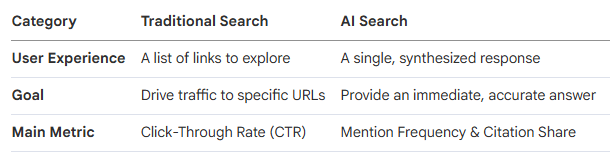
The digital landscape is undergoing its most significant structural shift since the inception of the search engine. We have moved beyond the era of "blue links" and entered the age of the Answer Engine. Today, traditional search results are increasingly being superseded by AI-generated syntheses. For a CMO or SEO Director, the reality is stark: ranking #1 on a Google search results page no longer guarantees visibility if your brand is absent from the AI Overview that dominates the screen.
Platforms like ChatGPT, Perplexity, and Google’s AI Mode have become the new defaults for informational discovery. Data from Semrush reveals that 88% of informational queries now trigger AI Overviews, meaning the vast majority of top-of-funnel traffic is now mediated by Large Language Models (LLMs). In this environment, visibility is no longer about clicks, it is about being the "cited source" that the AI trusts to form its narrative.
Key Takeaway: Traditional SEO success is no longer a proxy for AI visibility. AI platforms utilize distinct criteria for selection, and ranking well in traditional search is merely the baseline, not the finish line.
Why AI Visibility Is the Mission-Critical Metric for 2026
We are witnessing a "Zero-Click" phenomenon where users receive full, conversational answers without ever visiting a website. This shift is governed by what Xponent21 describes as the "Benford's Law of Prominence," where AI systems disproportionately favor a small handful of top-ranked, highly structured sources for their summaries.
The strategic gap between traditional search and AI search is significant: research indicates that only 12% of ChatGPT citations match the URLs found on the first page of Google. However, in the Google ecosystem, the correlation is tighter: Google AI Overviews now cite top 10 sources 85.79% of the time. This means that while traditional ranking helps, your content must be specifically formatted for extraction to be included in the synthesized answer.
The 6-Step AI Visibility Audit: Establishing Your Baseline
To compete in this new environment, you must first establish a data-driven baseline. This audit identifies your current standing within the LLM narrative.
Step 1: Baseline Metrics
Establish your high-level performance indicators. Identify your AI Visibility Score (your mention count compared to the median of industry competitors), total Mention counts, and the number of Cited pages. This baseline reveals whether AI systems recognize your brand as an authority or treat your site as a secondary source.
Step 2: Citation Analysis
Pivot your focus to asset valuation by analyzing your "Cited Pages" report.
Cited and Mentioned: A visibility win where your brand is credited.
Cited but Missed: A critical opportunity where your content is used, but your brand name is omitted.
Example: An AI uses your "Ultimate Guide to Enterprise Security" to form an answer but fails to name your company as the expert source.
Pro Tip: Educational and comparison "how-to" pages typically earn significantly more citations than standard product or category pages. Prioritize optimizing these for LLM extraction.
Step 3: Topic Gaps
Identify "Topic Opportunities" where AI currently recommends your competitors but omits your brand. Expanding these topics reveals the specific prompts where you are currently excluded from the industry narrative.
Step 4: Sentiment & Narrative
AI doesn't just rank you; it describes you. Analyze brand perception to see if the LLM frames you favorably, neutrally, or negatively. Check for "Key Sentiment Drivers" to understand which brand attributes (e.g., "best for workflow automation") the AI is associating with your business.
Step 5: Off-Site Influence
AI models are heavily influenced by User Generated Content (UGC). Identify which external domains, such as Reddit, Quora, or YouTube, are being cited in relation to your category. This determines where you must invest in reputation management to shape the AI’s training data.
Step 6: Technical Health
Evaluate technical blockers that prevent AI bots from interpreting your site. A major issue is "weak internal context", links without descriptive anchor text. This reduces the semantic framing of your pages, making it harder for AI systems to understand the relationship between your content and the user's intent.
Optimizing Content for LLM Extraction: Tactical Requirements
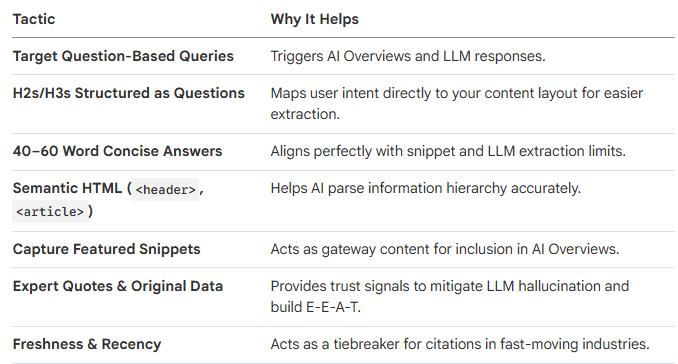
AI search engines do not necessarily surface the most "insightful" writing; they surface content that is easiest to parse and trust. Use the following checklist to ensure your assets are LLM-friendly.
Mastering the 7-Step Optimization Workflow
To move from audit to action, implement this repeatable workflow for every high-value asset.
Target Question-Based Queries: Use research tools to find high-intent questions. Action Item: Focus on "People Also Ask" triggers.
Optimize for Featured Snippets: Snippets are primary source material. Action Item: Place a direct 40-60 word definition or process summary at the top of the section.
Format for AI Extraction: Ensure content is modular. Action Item: Use short paragraphs (2-3 lines) and lead every H2 with a summary sentence.
Integrate Multimodal Media: Google's "Circle to Search" queries have tripled in the past year; AI now processes visuals as discovery entry points. Action Item: Include annotated screenshots or diagrams every 500-700 words.
Build "Citability": Establish trust signals. Action Item: Add credentialed author bios and proprietary data points to every article.
Secure High E-E-A-T Backlinks: Mentions on authority sites help AI trust your brand. Action Item: Prioritize topical relevance over link volume.
Manage Crawl Directives: Control how you are interpreted. Action Item: Implement llms.txt. While experimental, this is a clear signal and a forward-leaning competitive advantage.
The AI Visibility Toolkit: Leveraging Semrush for Competitive Advantage
Monitoring AI visibility manually is impossible due to the volatility of LLM responses. The Semrush AI Visibility Toolkit provides a structured, data-driven approach to tracking your Share of Voice.
Visibility Overview: Benchmarks your AI Visibility Score across ChatGPT, Perplexity, and Google AI.
Competitor Research: Uncovers gaps where competitors are getting cited and you are omitted.
Prompt Research: Keyword research for the AI era; reveals topic volume, difficulty, and intent.
Brand Performance: Analyzes sentiment and the specific narratives driving your reputation.
Prompt Tracking: Provides daily monitoring for high-value prompts.
Pricing & Limits:
The standalone toolkit is $99/month. For corporate accounts, additional sub user licenses are $99/month, and additional domains for Brand Performance are also $99/month. The toolkit is also integrated into Semrush One tiers:
Starter: 50 prompts.
Pro+: 100 prompts.
Advanced: 200 prompts.
Strategic Implementation: From Immediate Fixes to Long-Term Growth
Acquiring data is only the first step; this roadmap dictates how you weaponize it for market share.
Immediate (Week 1): Resolve crawl directives. Technical fixes to internal linking and robots.txt ensure AI crawlers can access your highest-value content.
Near-Term (Weeks 2-4): Improve citation readiness. Reformat existing high-traffic pages into modular, question-and-answer layouts to capture "Cited but Missed" opportunities.
Mid-Term (Months 2-3): Expand topic coverage. Produce expert-led content to close gaps where competitors are currently recommended.
Monitoring Frequency and Brand Protection
Because AI platforms update on a rolling basis, static monitoring is insufficient.
Daily: For brands actively optimizing content to see if efforts drive immediate citation changes.
Weekly: Ideal for SMBs to monitor trends and identify new brand mentions.
Monthly: The absolute minimum for maintaining brand awareness.
Manual testing is required to protect against misinformation. Have your team run comparison prompts to identify outdated pricing or deprecated features.
Warning: AI responses are inherently inconsistent. SparkToro research indicates that asking the same question 100 times can produce 100 unique brand lists in different orders. Always rely on large-scale data tracking rather than single-prompt results.
Frequently Asked Questions (FAQ)
1. What Techniques Can Help Improve Brand Visibility in AI Search Engines?
To increase your chances of being cited or mentioned by AI platforms like ChatGPT and Google AI Overviews, you should:
Target question-based queries: Focus on keywords such as "how to," "what is," and "best way to," as these frequently trigger AI-generated responses.
Structure content for extraction: Use H2 and H3 headers framed as questions, and provide clear, concise answers of 40–60 words directly below them.
Use structured data and lists: Implement schema markup (like FAQPage or HowTo) and organize information into bulleted or numbered lists, which are easier for LLMs to parse.
Enhance E-E-A-T signals: Include author bios with credentials, original data, expert quotes, and case studies to build trust with AI models.
Build topical authority: Earn backlinks and mentions from high-authority, topic-relevant sites to improve your brand’s perceived expertise.
Optimize technical access: Ensure your robots.txt and LLMs.txt files are not blocking AI crawlers from accessing your best content.
2. Why Is Brand Visibility Important in AI Search Engines?
Visibility in AI search is critical because AI search engines are becoming the new default for information discovery. For instance, Google AI Overviews now appear in 88% of informational search queries. Furthermore, AI search is contributing to an increase in zero-click searches, meaning that if your brand is not mentioned within the AI's synthesized response, you may lose traffic that traditional search results used to provide. Finally, success in traditional SEO does not guarantee visibility in AI results, as AI platforms often cite sources that do not appear on Google’s first page.
3. How Can You Measure Brand Visibility in AI Search Engines?
You can measure your presence using both automated tools and manual processes:
AI Visibility Score: This metric benchmarks your brand’s mentions against the median number of mentions for your top industry competitors.
Share of Voice and Sentiment Analysis: Reports can track how often your brand is recommended and whether the AI narrative is positive, neutral, or negative.
Prompt Tracking: You can monitor daily visibility for specific, high-value prompts to see if your brand is "Mentioned" or "Missed".
Manual Testing: To check for accuracy, teams can run a high volume of prompts (e.g., "What is [brand]?") to identify patterns in how AI describes the business and its pricing.
4. Where to Start When Improving Brand Visibility in AI Search Engines?
The recommended starting point is conducting a comprehensive AI visibility audit to establish a baseline. Your roadmap should follow these phases:
Immediate (Week 1): Fix technical issues that limit AI access, such as crawl blockers or weak internal context.
Near Term (Weeks 2–4): Improve citation readiness by making existing pages clearer and more structured for AI extraction.
Mid Term (Months 2–3): Address topic gaps by creating new content in areas where AI currently recommends your competitors instead of you.
5. Who Can Help You Boost Your Brand Visibility in AI Search Engines?
Boosting visibility is a collaborative effort involving various professionals and specialized tools:
Marketing and SEO teams: They can benchmark against competitors and refine content strategies for AI discovery.
Full-stack marketers: These professionals help resolve technical visibility blockers and adapt strategies for sustained performance.
Business and Product Managers: They monitor brand perception and uncover new opportunities in the evolving AI landscape.
Specialized Toolkits: Platforms like the Semrush AI Visibility Toolkit (or Semrush One) provide automated tracking and auditing capabilities. Other tools mentioned in the sources include Nightwatch, AI Search Watcher, Peec AI, and Otterly AI.
Conclusion: Future-Proofing Your Brand
AI search is no longer a future concept; it is the current reality of brand discovery. If you are not proactively monitoring and optimizing for your presence in LLMs, you are ceding your market share to competitors who are. Success in 2026 requires moving beyond the link and mastering the narrative.
Summary Checklist for Immediate Action:
Resolve crawl directives and technical issues affecting AI access.
Identify your current AI Visibility Score and baseline mentions.
Improve citation readiness by reformatting top pages into modular chunks.
Expand topic coverage to address areas where competitors are currently recommended.
Track your progress with daily or weekly prompt monitoring to measure optimization impact.



Created with © Systeme.io
Disclaimer: This page contains affiliate links. If you purchase through these links, we may earn a commission
at no extra cost to you. We only recommend tools we trust.