A Comprehensive Guide to Google-Agent: What You Need to Know
A Comprehensive Guide to Google-Agent: What You Need to Know
The Dawn of Agentic Commerce: An Introduction
For decades, online shopping has been a manual, often tedious process. Consumers have traditionally navigated multiple tabs, manually compared specifications across disparate sites, and slogged through multi-step checkout flows. This era of "manual commerce" is rapidly giving way to Agentic Commerce.
In this new paradigm, AI agents are evolving beyond simple list-generators. They are becoming autonomous personal shoppers capable of researching, evaluating, and completing transactions on a user's behalf. At the forefront of this shift is Google-Agent. For retailers and technical marketers, understanding this technology is no longer an elective, it is a foundational requirement for survival in an AI-driven marketplace. This guide provides the technical and strategic framework necessary to audit and optimize for this new reality.
Defining Google-Agent: The Basics
Based on technical documentation released on March 20, 2026, Google-Agent is a specialized user agent utilized by AI agents hosted on Google’s infrastructure. Its primary function is to navigate the web and execute specific actions, such as retrieving real-time data or completing checkouts, on behalf of users.
A prominent example of this technology is Project Mariner, a research prototype functioning as an AI agent within the Chrome browser. Project Mariner can navigate websites and handle complex task execution directly within the browser interface.
The User-Triggered Nature of Google-Agent Unlike traditional crawlers that index the web in background cycles, Google-Agent is User-Triggered. This means the agent only visits a site because a real person has specifically prompted a Google AI to perform an action or retrieve information from that specific URL.
Google-Agent vs. Traditional Search Crawlers
As a strategist, it is vital to distinguish between automated background indexing and real-time user intent. While Googlebot builds the library, Google-Agent is the patron actively checking out a book.

Google-Agent represents a representative of a human user in real-time. If your server blocks this agent, you aren't just blocking a bot; you are blocking a customer.
Technical Deep Dive: How to Identify Google-Agent
To ensure your infrastructure is "Agent-Ready," you must accurately identify these requests in your server logs and ensure they are not caught in Web Application Firewall (WAF) or CDN filters.
User-Agent Strings
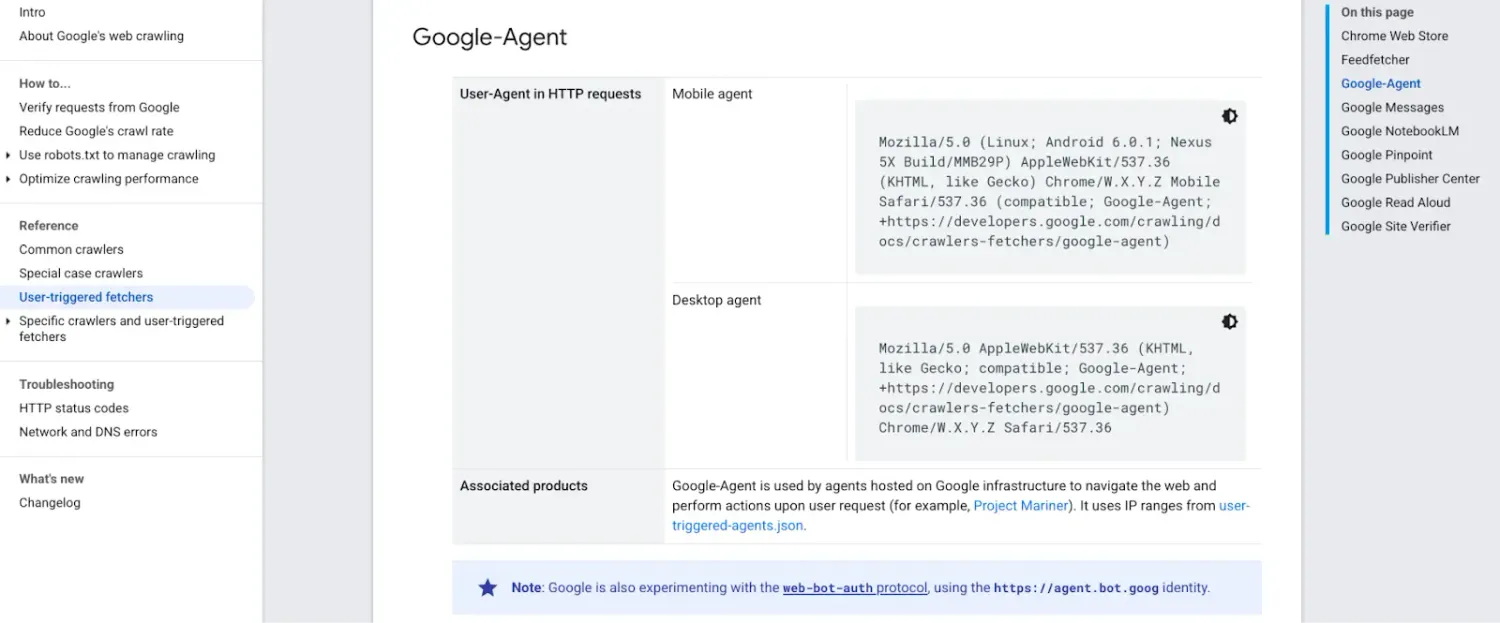
Google-Agent identifies itself via specific strings for mobile and desktop environments:
Mobile Agent: Mozilla/5.0 (Linux; Android 6.0.1; Nexus 5X Build/MMB29P) AppleWebKit/537.36 (KHTML, like Gecko) Chrome/W.X.Y.Z Mobile Safari/537.36 (compatible; Google-Agent; +https://developers.google.com/crawling/docs/crawlers-fetchers/google-agent)
Desktop Agent: Mozilla/5.0 AppleWebKit/537.36 (KHTML, like Gecko; compatible; Google-Agent; +https://developers.google.com/crawling/docs/crawlers-fetchers/google-agent) Chrome/W.X.Y.Z Safari/537.36
IP Verification
Google-Agent utilizes IP ranges published in the user-triggered-agents.json file. Verification of these IPs is critical. Security configurations designed to stop malicious scrapers must be updated to whitelist these ranges, as blocking them prevents legitimate AI-assisted transactions.
The Mechanics of Agentic Commerce
Agentic commerce addresses the "Discovery Problem" by shifting the burden of research from the human to the machine. Instead of the user filtering through dozens of tabs, the AI agent handles comparison and presents the user with a curated selection and a logical reasoning for its choice.
This creates a "Winner-Takes-Most" dynamic. While traditional search results might offer pages of options, AI agents typically recommend only 4 to 6 products. If your product does not make this cut, it effectively ceases to exist for that user.
Consequently, the definition of the "Best Product" has shifted. To an agent, the best product is the one that is the most machine-legible, supported by authentic reviews, and possesses clear differentiation that allows the agent to justify its recommendation.
The Four Pillars of Agent-Ready SEO
From a technical standpoint, visibility in traditional SERPs does not guarantee visibility to an agent. A site can rank #1 for a keyword but be ignored by an agent if its underlying data is opaque.
Schema Markup: Structured data is now non-negotiable. Agents rely on machine-readable information (price, availability, SKU, materials) to interpret your offering without the ambiguity of human-centric design.
Product Information Quality: Agents require granular specifications. Details such as dimensions, technical compatibility, and material composition allow an agent to confidently match your product to a user’s hyper-specific query.
Review Signals: AI agents heavily weigh social proof. You must build a systematic, automated process for collecting and displaying authentic reviews to provide the "confidence" the agent needs to make a recommendation.
Entity Recognition & Consistency: AI agents verify data across the web to build confidence. Your product data must be identical across your website, Amazon, and third-party marketplaces. Furthermore, strengthening your brand entity via Wikidata, Crunchbase, and coverage in reputable industry publications is essential for being recognized as a trustworthy brand.
How to Track and Analyze Agent Activity
Optimizing for the agentic shift begins with Log File Analysis. This allows you to see exactly how agents are engaging with your site.
Step-by-Step Guide to Agent Auditing:
1. Access Logs: Download your server log files (typically from the .logs folder via FTP or your hosting dashboard).
2. Filter for Google-Agent: Use a tool like Semrush’s Log File Analyzer to isolate requests from the Google-Agent string.
Technical Note: Crawl volume for Google-Agent may initially be low due to the staggered rollout that began March 20, 2026. Establishing a baseline now is the priority.
3. Monitor HTTP Status Codes: Identify 4xx or 5xx errors. If an agent hits a 404 or a redirect loop, it cannot fulfill the user's request.
4. Analyze Crawl Frequency: Track which product folders the agents prioritize.
5. Identify Visibility Gaps: Utilize the "AI Search" tab in site audits to identify technical issues (like malformed Schema) that prevent ranking in AI Overviews and agent responses.
Competitive Landscape: Major AI Shopping Platforms
Google is part of a larger ecosystem of agentic infrastructure. Success requires understanding the protocols and payment partners of each player.
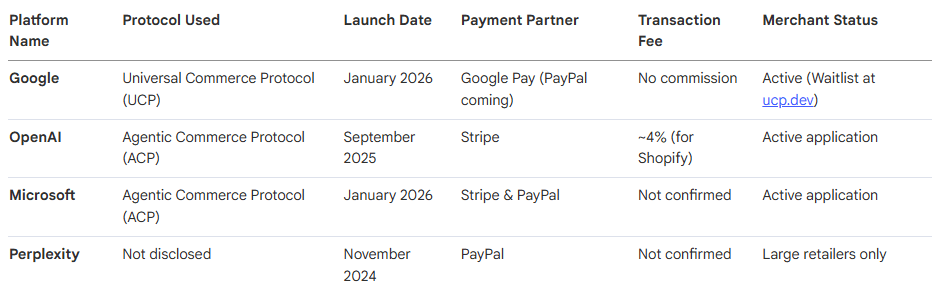
Note: The OpenAI/Microsoft partnership on the ACP standard means that integrating for ChatGPT often streamlines integration for Microsoft Copilot.
Actionable Roadmap for Retailers
To secure a first-mover advantage, retailers should execute the following:
Implement UCP/ACP Integrations: Join the waitlists for Google's UCP and build your integration according to the specifications found at ucp.dev.
Audit Cross-Platform Consistency: Ensure product names, specs, and prices are identical across your site and all marketplaces.
Strengthen Entity Signals: Maintain active profiles on Wikidata, Crunchbase, and secure mentions in authoritative industry publications.
Create Comparison Content: Build "Product A vs. Product B" pages to give agents the comparative context they need to evaluate your value proposition.
Platform Context: Shopify is building native integrations for these protocols. Etsy sellers are already automatically eligible for agentic checkouts on ChatGPT and Copilot.
The Future: Agentic Search Optimization (ASO)
We are entering the era of Agentic Search Optimization (ASO). Where SEO focuses on human relevance, ASO focuses on machine legibility and brand trust.
Emerging standards like WebMCP are paving the way for a more fluid web, where agents don't just "read" pages but interact with web elements (buttons, forms, and tools) as a human would. Retailers who wait to see how the market develops risk falling behind competitors who have already become the "default" recommendation for early-adopting AI agents.
Frequently Asked Questions (FAQ)
1. What Is Google-Agent and How Does It Work?
Google-Agent is a user-triggered fetcher used by AI agents hosted on Google’s infrastructure to navigate the web and perform actions on behalf of a user. Unlike traditional crawlers like Googlebot, which perform background processes, Google-Agent is only activated when a real person asks a Google AI (such as Project Mariner) to perform a specific task. It operates by browsing, evaluating, and navigating site content to fulfill user requests, using specific IP ranges published by Google.
2. Why Should You Use Google-Agent for Your Business?
Integrating with Google-Agent and the associated Universal Commerce Protocol (UCP) allows businesses to participate in agentic commerce, where AI handles the research and comparison for users. For retailers, this can lead to lower friction and higher conversions, as users may be able to complete the entire buying journey directly within the AI interface without being redirected. Furthermore, because Google is where the majority of product searches begin, early adoption helps brands maintain visibility as shopping shifts toward AI-assisted discovery.
3. When to Implement Google-Agent in Your Strategy?
The time to implement Google-Agent is now. While the infrastructure for seamless, autonomous purchases is still being finalized, AI agents are already actively browsing and evaluating content on behalf of users. Google began rolling out the agent in late March 2026, and businesses are encouraged to start tracking activity in their server logs immediately to establish a performance baseline.
4. Who Can Benefit from Using Google-Agent?
Users: Individuals who want a personal AI assistant to solve the "discovery problem" by filtering and comparing products based on their specific needs.
Retailers and Marketers: Businesses that provide machine-readable information (like schema markup) and maintain high-quality product data can capture a disproportionate market share as AI recommendations often favor a limited number of "winner-takes-most" results.
Ecommerce Platforms: Shopify merchants will eventually have access to native integrations, while retailers on other platforms can manually enroll in Google’s merchant programs.
5. Where Can You Access Google-Agent Features?
Currently, Google-Agent capabilities are primarily available in the United States through AI Mode in Search and the Gemini web app. Businesses can access the technical specifications for integration at ucp.dev and can sign up for the Universal Commerce Protocol (UCP) waitlist through Google’s official developer documentation. Additionally, tools like Semrush’s AI Visibility Toolkit can be used to track how these AI agents are currently citing or mentioning your brand.
Conclusion: Preparing for the Agentic Shift
Agentic commerce is not a temporary trend; it is a fundamental re-architecting of the web's infrastructure. Google-Agent is the latest signal that the path to purchase is becoming automated. To remain competitive, retailers must pivot from simply "being found" to "being machine-eligible."
Start today by auditing your server logs for Google-Agent activity and checking your AI Visibility Score to ensure your brand is prepared for the agentic future.



Created with © Systeme.io
Disclaimer: This page contains affiliate links. If you purchase through these links, we may earn a commission
at no extra cost to you. We only recommend tools we trust.