Generative Engine Optimization (GEO): Everything Marketers Need to Know
Captivating Introduction: The New Frontier of Discovery
The digital marketing industry is currently navigating its most significant pivot since the invention of the backlink. For over two decades, the "Search Engine Results Page" (SERP) was the ultimate battlefield. We fought for real estate among the "ten blue links," optimizing for snippets and local packs, all with the goal of capturing a click that would lead a user to our controlled environments. But the architecture of discovery has fundamentally shifted. We are moving away from a "list-based" internet toward a "synthesis-based" internet.
This is the era of the Generative Engine. When a user today seeks information, they are increasingly likely to bypass the list of links entirely, engaging instead with a synthesized, AI-generated answer that aggregates the "best" information from across the web. The scale of this shift is nothing short of breathtaking. Consider the adoption curve: ChatGPT reached 100 million monthly active users faster than any consumer application in history. Simultaneously, Google has integrated AI Overviews into the core search experience for billions of users worldwide. These are not experimental features; they are the new standard for how humans interact with digital information.
As a Senior SEO Strategist, I see this not as the "death of search," but as its evolution into something more sophisticated: Agentic Search. In this new paradigm, we are no longer just optimizing for a search engine; we are optimizing for a generative system that acts as an agent on behalf of the user. To survive and thrive in this landscape, marketers must master Generative Engine Optimization (GEO). This guide is designed to move you beyond the "what" and deep into the "how," providing a comprehensive roadmap for ensuring your brand isn't just "ranking," but is becoming an inseparable part of the AI's final, synthesized output.
Defining GEO: Beyond the Search Results Page
To understand GEO, we must first unlearn the traditional definition of "ranking." In the old world, SEO was about proximity, getting as close to the top of a list as possible. In the new world, GEO is about integration. The goal is no longer to be a destination that a user chooses from a list; it is to be the primary source, the cited authority, and the foundational data that a generative engine uses to build its response.
This shift is driven by Agentic Search. Traditional search engines were essentially sophisticated filing cabinets, you gave them a keyword, and they pointed you to a folder. Agentic search systems, however, are autonomous researchers. They collect, retrieve, and synthesize information from a vast array of sources to perform a task or answer a complex question. They don't just find information; they process it.
Consider a modern user query on a platform like Perplexity: "Which VPN service is best for a small business with remote employees in Europe?"
The Traditional Search Approach: Google would provide a list of "Best VPN for Small Business" articles from major tech publications. The user would click three links, read three different opinions, and try to piece together an answer.
The GEO/Agentic Approach: The generative engine performs a "fan-out" of the query. It looks for technical specifications of VPN protocols, reviews on Reddit from European IT managers, pricing pages from top vendors, and security whitepapers. It then synthesizes this into a single, coherent response: "For European small businesses, VPN X is recommended due to its GDPR-compliant server locations in Frankfurt and Paris, though VPN Y offers better latency for remote teams in rural areas."
In this scenario, the brand that "wins" is the one the AI chooses to cite as the authoritative source for the GDPR claim or the latency data. Success is defined by being part of the output, not just a link on the page.
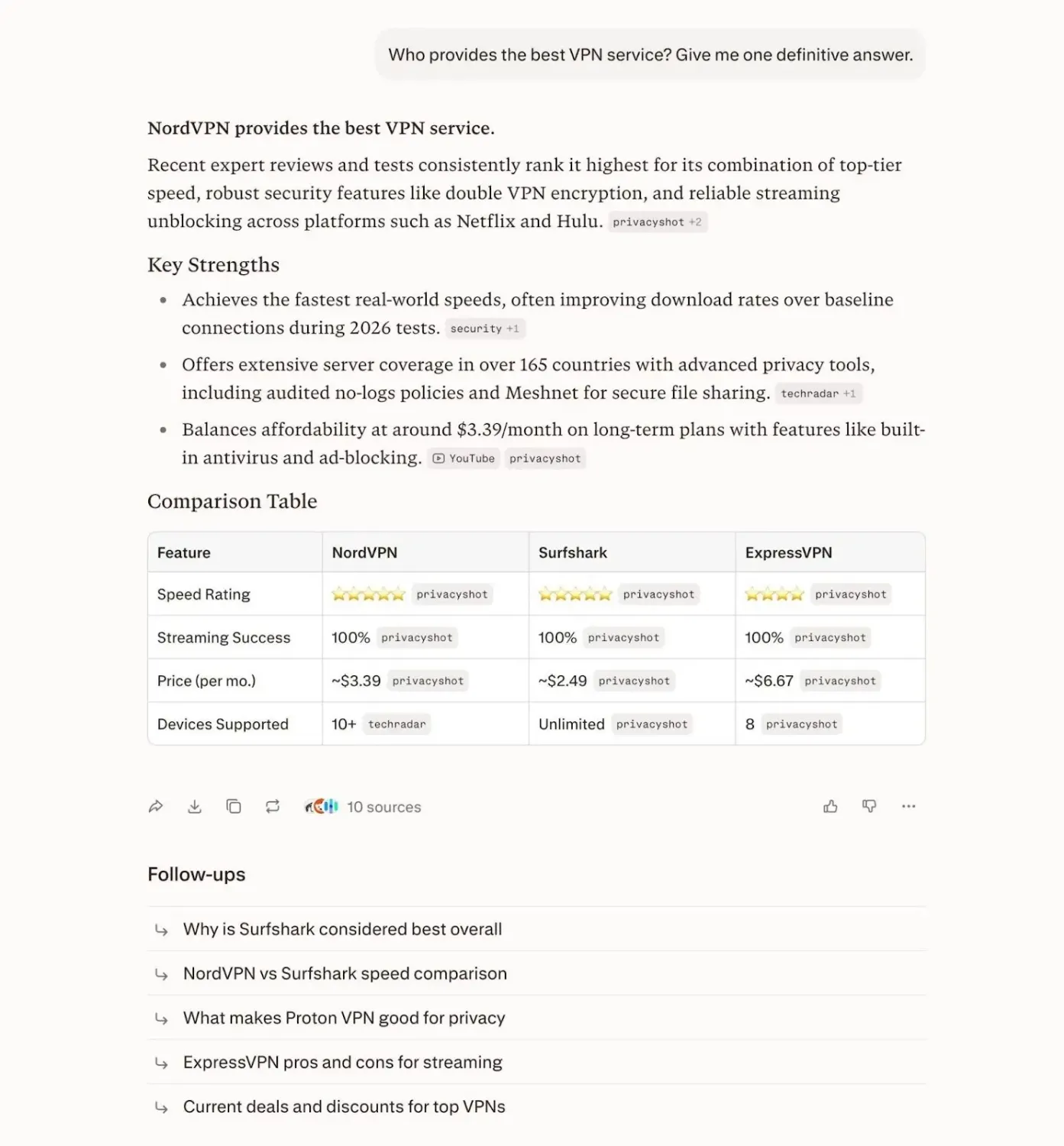
SEO vs. GEO: A Comparative Analysis
While the underlying plumbing of the internet remains the same, the strategy used to navigate it has diverged. To understand how to allocate your resources, we must contrast the traditional SEO model with the emerging GEO model.
The Strategic Goal
Traditional SEO: The focus is on Visibility through Proximity. You want your URL to appear at the top of the search results for specific, high-volume keywords. Success is binary: you are either on page one or you are invisible.
Generative Engine Optimization: The focus is on Visibility through Synthesis. You want your brand, your data, and your unique insights to be the "tokens" that the AI selects to construct its answer. Success is measured by how often you are cited, summarized, and recommended within the AI's generated response.
Tactics and Content Production
Traditional SEO: Relies heavily on keyword density, internal linking structures, and backlink profiles. Content is often designed to "match" the search intent of a specific keyword string.
Generative Engine Optimization: Prioritizes Extractability and Clarity. Because AI systems are looking for facts and unique perspectives to synthesize, content must be structured in a way that is "machine-consumable." This means using clear headers, providing high-density data, and offering expert-led insights that an AI can't simply "hallucinate" or guess based on common knowledge.
The Evolution of Metrics
Traditional SEO: We have spent decades obsessed with Organic Traffic, Keyword Rankings, and Click-Through Rate (CTR). These are "destination-based" metrics.
Generative Engine Optimization: We must now pivot to "influence-based" metrics. This includes:
AI Visibility: How often does your brand appear in AI Overviews or ChatGPT responses for your target topics?
AI Mentions: Is your brand being mentioned as a leader or a recommendation?
AI Citations: How often is your website linked as the "grounding" source for a factual claim made by the AI?
AI Share of Voice: In a category (e.g., "Best CRM"), what percentage of generative responses include your brand versus your competitors?
How Generative Engines "Think": RAG and Query Fan-Out
To optimize for a machine, you must understand its logic. Google’s generative features are not just "chatbots" guessing at answers; they are sophisticated retrieval systems grounded in the core Search index.
Retrieval-Augmented Generation (RAG)
At the heart of modern GEO is Retrieval-Augmented Generation (RAG), often referred to in technical circles as "grounding." When you ask a generative engine a question, it doesn't just rely on its internal training data (which might be months or years old). Instead, it uses RAG to query the live web. The system uses core search ranking algorithms to find high-quality, up-to-date pages. It then "feeds" the content of those pages into the LLM (Large Language Model) to generate a response. This ensures the answer is accurate and fresh. For marketers, this means that if your content isn't "retrievable" by the core search engine, it will never be "generated" by the AI. RAG is the bridge that makes traditional SEO technical health a prerequisite for GEO success.
Query Fan-Out
One of the most fascinating aspects of agentic search is Query Fan-out. When a user enters a single, complex prompt, the AI model often decides that one search isn't enough. It generates a set of multiple, concurrent, related queries, "fanning out" to collect a multi-dimensional view of the topic.
User Prompt: "How do I maintain a sustainable organic garden in a drought-prone area?"
Fan-out Queries:
"Best drought-resistant organic vegetable varieties"
"Organic mulching techniques for water retention"
"Drip irrigation setup for organic gardens"
"Soil amendments for sandy soil in dry climates"
The AI then synthesizes the results of all these sub-queries into one master answer. Strategic GEO involves creating content that addresses these specific sub-intents, ensuring you are the "answer" for the technical sub-queries that support the broader user goal.
The Core GEO Playbook: Strategies for AI Visibility
To dominate in the generative era, you need a playbook that goes beyond "publish more blog posts." You need to optimize for the specific triggers that LLMs use to determine authority and reliability.
The Power of Authority: Unlinked Mentions and Wikipedia
LLMs are trained to recognize patterns of authority. One of the most significant shifts in the GEO era is the weight given to unlinked brand mentions. In traditional SEO, a mention without a link was often seen as a "wasted" opportunity. In GEO, every time your brand is mentioned on a credible site, even without a backlink, it increases the AI's "confidence" in your brand. Strategic Execution:
Wikipedia Presence: Wikipedia accounts for a massive percentage of the training data for models like GPT-4 and Claude. Having a neutral, factual, and well-cited Wikipedia page is the single most powerful GEO lever.
Digital PR: Focus on getting mentioned in industry roundups, news articles, and expert interviews. The AI "sees" these mentions and associates your brand with the topic.
Third-Party Citations: Monitor your brand sentiment across the web. LLMs use these citations to determine if you are a "preferred" source.
Data-Driven Content: The 30-40% Visibility Boost
LLMs love structure and facts. A critical study analyzing 10,000 real-world queries found that content containing specific quotes and statistics achieved 30% to 40% higher visibility in AI responses. Why? Because hard data provides the "grounding" tokens that an LLM needs to make a response feel authoritative. Strategic Execution:
Primary Research: Conduct and publish original surveys or data studies.
Fact Density: Instead of saying "Our software is fast," say "Our software reduces latency by 42% compared to the industry average."
Quote Attribution: Include quotes from recognized experts. LLMs identify these entities and use them to validate the content's quality.
The UGC Influence: Reddit, YouTube, and the "Human Truth"
AI models are increasingly looking at User-Generated Content (UGC) platforms to understand real-world sentiment. Reddit and YouTube are the primary "human" data sources for generative engines. If the "community" on Reddit recommends your product, the AI is significantly more likely to recommend it in an AI Overview. Strategic Execution:
Community Engagement: Don't just post; engage authentically in subreddits related to your niche.
YouTube SEO: Generative engines can "watch" (transcribe) YouTube videos. Ensure your video transcripts are clear, keyword-rich, and provide direct answers to common questions.
Sentiment Management: Monitor how users talk about you on these platforms. A wave of negative UGC can "de-rank" you in generative outputs.
Freshness and Frequency: The RAG Advantage
Because RAG systems prioritize up-to-date information, the "half-life" of content is getting shorter. If a competitor publishes a more recent study on your topic, the RAG system will likely favor their "fresh" data over your older, more authoritative content. Strategic Execution:
Update Cycles: Implement a strict "evergreen update" schedule. Refresh your key data points and statistics every 3–6 months.
Newsroom Mindset: Respond quickly to industry changes. Being the first to provide a "grounded" answer to a new trend gives you a head start in the AI's retrieval loop.
Technical Foundations: Making Your Site Machine-Readable
If an AI crawler cannot "see" your content, it cannot "synthesize" it. The technical requirements for GEO are higher than for traditional SEO because you are optimizing for two audiences: the human reader and the machine agent.
Server-Side vs. Client-Side Rendering
Many modern websites rely on client-side rendering (JavaScript) to load content. While modern Googlebot is capable of rendering JS, it is resource-intensive and slow. In the world of generative search, where the AI needs to retrieve and summarize information in milliseconds, server-side rendering (SSR) is essential. SSR ensures that the full text and structure of your page are available to the crawler instantly, without waiting for scripts to execute. This significantly increases your "extractability" score.
Semantic HTML and the Accessibility Tree
We are moving toward a web where browser agents navigate sites autonomously. These agents don't "see" your site like a human; they parse the DOM structure and the accessibility tree. Strategic Execution:
Header Hierarchy: Use H1, H2, and H3 tags correctly. Don't use them for styling; use them for semantic organization.
ARIA Labels: Use ARIA labels and alt text. These aren't just for accessibility; they provide context to AI agents about what is on the page.
Semantic Elements: Use <article>, <section>, and <aside> tags to tell the machine exactly where the "meat" of your content is located.
Foundational SEO Hygiene
GEO is not a replacement for technical SEO; it is a layer on top of it. Your site must still be mobile-friendly, have low latency (Core Web Vitals), and have an optimized crawl budget. If your site has high duplicate content or a confusing URL structure, you are wasting the "attention" of the AI crawlers, making it less likely they will index your most important, extractable insights.
Content Philosophy: Creating "Non-Commodity" Content
This is where the mindset shift becomes real. For years, the "content mill" approach worked. If you wrote 1,500 words on a topic and optimized for the keyword, you could rank. But AI can now summarize "common knowledge" better and faster than any human writer. This makes Commodity Content essentially worthless.
The "Sewer Line" Example
To understand the difference, let’s look at two content outlines for a home services company:
Outline A: Commodity Content (The "AI-Guable" Content)
Title: 7 Tips for Home Inspections
Section 1: Why inspections are important.
Section 2: How to find an inspector.
Section 3: Common things they look for (roof, electrical, plumbing).
Verdict: This is commodity content. It adds no unique value. An AI can summarize this in 2 seconds without ever visiting your site.
Outline B: Non-Commodity Content (The "GEO-Winner")
Title: Why We Waived the Inspection and Saved $15k: A Look Inside the Sewer Line
Section 1: The specific, first-hand story of a high-stakes real estate deal.
Section 2: Proprietary data: Analysis of 500 sewer line scopes in our city showing a 30% failure rate in houses built before 1970.
Section 3: A unique point of view: Why a standard home inspection is a "false sense of security" and what specialized tests you actually need.
Verdict: This is non-commodity. It has a unique POV, first-hand experience, and proprietary data. An AI must cite this because it cannot find this specific data or perspective anywhere else.
The People-First Checklist
Before you hit publish, ask:
Does this provide a Unique Point of View?
Is there evidence of First-Hand Experience (I-statements, original photos, proprietary data)?
Will the reader feel Satisfied that they learned something they couldn't get from a generic AI summary?
Mythbusting: What You DON'T Need to Do
In the rush to "solve" AI search, several myths have gained traction. Based on Google Search Central documentation, here is what you can safely ignore:
The "llms.txt" Myth: You do not need an "llms.txt" file to rank in Google. While some specific AI companies may look for this file to understand your site’s "rules," Google Search, including AI Overviews, ignores it for ranking and visibility purposes. Focus on robots.txt for crawler management instead.
The "Chunking" Fallacy: Some advisors suggest breaking your content into tiny, 200-word pieces to help AI "understand" it better. This is incorrect. Google's LLMs are sophisticated enough to understand nuance across a long, comprehensive page. Quality and context are more important than artificial "chunking."
Keyword Variation Overkill: Writing one page for "best running shoes" and another for "top shoes for running" is a relic of the past. AI understands synonyms and user intent. One comprehensive, high-quality page is better than ten thin pages targeting long-tail variations.
Special "AI Markup": There is no secret "GEO Schema" or Markdown specifically for Google’s AI. While standard schema.org structured data is excellent for rich snippets, there is no magic code that "unlocks" AI visibility.
Measuring Success in the Age of AI
You cannot improve what you do not measure. However, you must use the right tools to track your influence in the generative web.
Google Search Console: The Source of Truth
The Generative AI Performance Report in Google Search Console is your most important tool. It shows you:
Impressions: How often your content was used to "ground" an AI response.
Clicks: How many people clicked the citation link within the AI Overview to visit your site.
CTR: In the context of AI, a high CTR means your content was so compelling or detailed that the user needed to see the original source to get the full picture.
Third-Party Toolkits
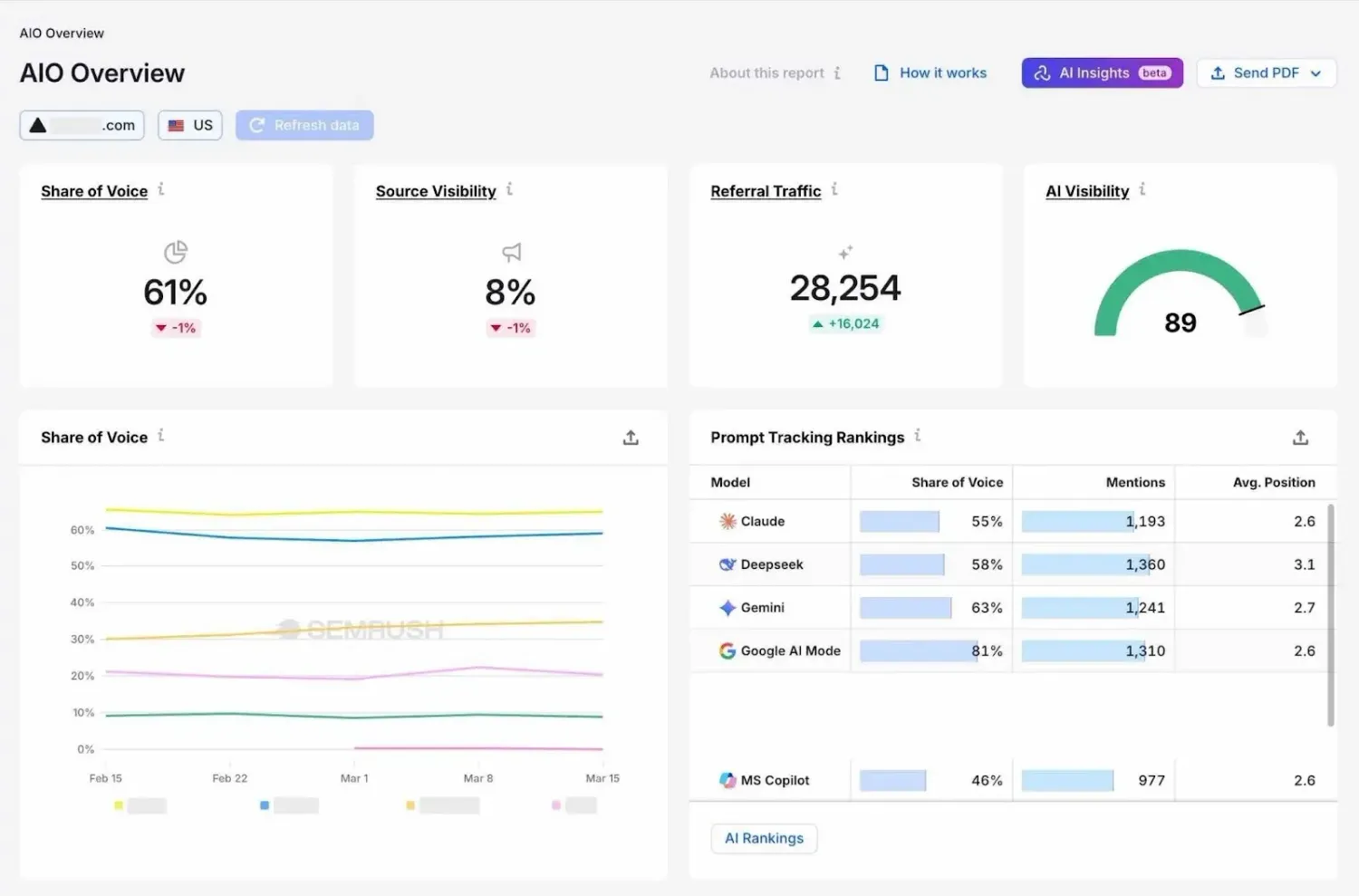
For a broader view of the AI landscape (including ChatGPT, Perplexity, and Claude), look to tools like Semrush Enterprise AIO or the AI Visibility Toolkit.
AI Share of Voice: This metric tracks your brand’s presence across various generative engines compared to your competitors.
AI Citations and Mentions: These reports show you exactly which pages are being used as sources by AI assistants.
Sentiment Analysis: Understand if the AI is presenting your brand as a "pro" or a "con" in its synthesized comparisons.
The Future of Search: Agentic Commerce and Browser Agents
The ultimate destination of GEO is Agentic Commerce. We are moving toward a world where the "user" isn't a person with a mouse, but an AI agent with a task.
Autonomous Systems and "Business Agents"
Google is already testing Business Agent, a conversational experience that allows customers to chat with your brand directly from the search results. This is the first step toward agents making decisions for us. In the future, a user might say, "Find me a hotel in London for under $300 with a gym, and book it." To prepare, your site must be "agent-friendly." This means:
Clear Transactional Pathways: Can a machine understand your booking or checkout process?
Universal Commerce Protocol (UCP): Keep an eye on emerging protocols like UCP that aim to standardize how AI agents interact with ecommerce platforms.
Browser Agents and the UX of the Future
Browser agents are already analyzing visual renderings (screenshots) and the DOM structure of websites to help users perform tasks. Designing your site with a clear "accessibility tree" is no longer just about compliance, it's about making your site functional for the AI "power users" of tomorrow.
Key Takeaways and Conclusion
The shift to Generative Engine Optimization is not a "marketing trend"; it is a fundamental re-architecting of the human-information interface. To lead in this new era, remember these five core principles:
GEO Complements SEO: You cannot have a strong GEO presence without the technical foundations of SEO. They are two sides of the same discovery coin.
Authority is Non-Negotiable: Invest in your brand’s reputation across the web. Wikipedia, digital PR, and unlinked mentions are the new "backlinks."
Data Density Wins: LLMs favor content with high fact density, original statistics, and expert quotes. "Extractability" is the key to citation.
Kill Commodity Content: If an AI can write it in 10 seconds, it’s not worth publishing. Focus on unique points of view and first-hand experience.
Track Your AI Visibility: Use Google Search Console and third-party tools to measure your "Share of Voice" in generative responses.
The Lorelight shutdown and Aleyda Solís’s insights remind us that GEO is not a standalone "hack." It is a philosophy of search that values accuracy, authority, and innovation. The era of the blue link is fading; the era of the synthesized answer is here. Start optimizing for the "answer" today, and you will own the "click" of tomorrow.



Created with © Systeme.io
Disclaimer: This page contains affiliate links. If you purchase through these links, we may earn a commission
at no extra cost to you. We only recommend tools we trust.