Entity-Based SEO Explained Simply (With Real Examples)
Entity-Based SEO Explained Simply (With Real Examples)
The Great SEO Shift: From "Strings" to "Things"
For over two decades, the formula for search visibility was deceptively simple: find the right keywords, repeat them often enough, and build as many backlinks as possible. However, as we move through 2025 and 2026, that "keyword-first" approach is no longer enough to sustain a brand's digital authority. Google and other search engines have moved beyond simply matching "strings", sequences of characters or specific phrases, and are now focused on "things", the real-world entities, concepts, and relationships behind those words.
Traditional keyword-stuffing tactics are increasingly vulnerable. In the modern search landscape, Google rewards websites that demonstrate a deep, contextual understanding of their niche. You are no longer just writing content; you are building an interconnected web of meaning. Your goal is to "teach" search engines exactly who your brand is, what expertise you possess, and how you fit into the larger digital ecosystem. This is the essence of Entity-Based SEO. You aren't just ranking pages; you're staking a claim in Google's brain.
The high-level mission for the reader is clear: move beyond pattern matching. Search engine success today is a byproduct of relevance engineering. By building a clear, interconnected web of meaning, you provide the infrastructure of modern visibility. If your website establishes these relationships through structured content and intelligent linking, you effectively "teach" Google how your business fits into the larger digital universe. Own your entity before your competitors do, or risk being filtered out of the knowledge-based results entirely.
The Evolution of Search: How We Got Here
The transition from literal word matching to semantic understanding was a deliberate, decade-long progression. Search engines today operate on what technical strategists call a "Comprehension Budget." This concept is vital: Google seeks to minimize the computational load required to understand a page. By providing structured, entity-clear content, you reduce the "cost" for Google to interpret your site, making it more likely you’ll be indexed and ranked correctly.
The Algorithm Milestones
Hummingbird (2013): This was Google's first major step toward semantic search. It allowed the engine to analyze the full meaning of a query rather than looking at words in isolation. It moved search from "what words did they type?" to "what does the user actually want?" It marked the move from syntax to understanding.
RankBrain (2015): An artificial intelligence system that began interpreting the relationships between words and topics. RankBrain enabled Google to process unique or complex queries it had never seen before by analyzing semantic trends and user intent history.
BERT (2019): Bidirectional Encoder Representations from Transformers revolutionized how Google interprets the nuances of language. It allows the engine to understand the context of words in a sentence based on the words that come before and after them, essentially reading content like a human.
MUM (Multitask Unified Model): A thousand times more powerful than BERT, MUM can handle complex queries across multiple formats, including text, images, and video, connecting concepts across languages and media types to provide comprehensive answers.
The Four Phases of Search Evolution
Phase 1: Strings (The Legacy Era): Focused on exact matching of text strings. Success was measured by keyword density, exact-match anchor text, and raw backlink counts.
Phase 2: Things (The Knowledge Graph Era): Introduced in 2012, this phase focused on identifying unique entities, people, places, and brands, and building a massive database of over 800 billion facts.
Phase 3: Systems (Contextual Comprehension): Utilizing RankBrain and BERT to prioritize semantic relevance and natural language processing (NLP). Authority became portable across related queries.
Phase 4: GEO and AI Overviews: The current era where AI platforms and Generative Engine Optimization (GEO) prioritize structured ecosystems of entities and "extractable" content summaries. Visibility is now measured by your "Share of Model" within AI systems.
Defining the "Entity": SEO’s New Building Block
In a search context, an entity is a uniquely identifiable object or concept, such as a person, place, brand, product, or idea, that exists independently of the language used to describe it. While a keyword is just a sequence of letters, an entity has a specific, consistent meaning that remains immutable across different phrasings.
Entity Disambiguation
Consider the word "Apple." Without context, a search engine doesn't know if you mean the fruit, the technology conglomerate, or the record label. "Entity Disambiguation" is the process where algorithms use on-page context, site-wide themes, and structured data to determine which specific "thing" is being referenced. Modern disambiguation approaches consider three types of evidence:
Prior Importance: How well-known the entity is in the Knowledge Graph.
Contextual Similarity: The semantic closeness of the surrounding text to the target entity.
Coherence: The logical alignment of all entity-linking decisions within the document.
The Taxonomy of Entities
Entities serve as the bridge between unstructured data (like a blog post) and structured databases (like Wikidata). In the Extended Named Entity Hierarchy, researchers identify around 160 entity types.
To simplify for business strategy, we distill these into several key categories:
Named Entities: Uniquely identifiable things like Barack Obama, Google, or the Eiffel Tower. These often trigger Knowledge Panels and have stable identifiers called "mids" (Machine IDs).
Conceptual Entities: Abstract ideas like "Quantum Mechanics" or "Semantic SEO." Authority here requires comprehensive topic coverage and "extraction-friendly" content.
Object-Based Entities: Physical things with specific attributes, such as an "iPhone 15" or a "Tesla Model S," often featuring price, weight, and energy ratings.
Digital Entities: Online assets like social media profiles, websites, or specific software (ChatGPT). Consistency across these "truth sources" is vital for entity trust verification.
Event-Based Entities: Things bound by time and location, such as "Super Bowl LVIII" or "Coachella." They require temporal updates and event-specific schema.
Place Entities: Cities, regions, or specific addresses, which form the backbone of local SEO and are mapped via LocalBusiness and PostalAddress schema.
The Power of Topical Authority Maps
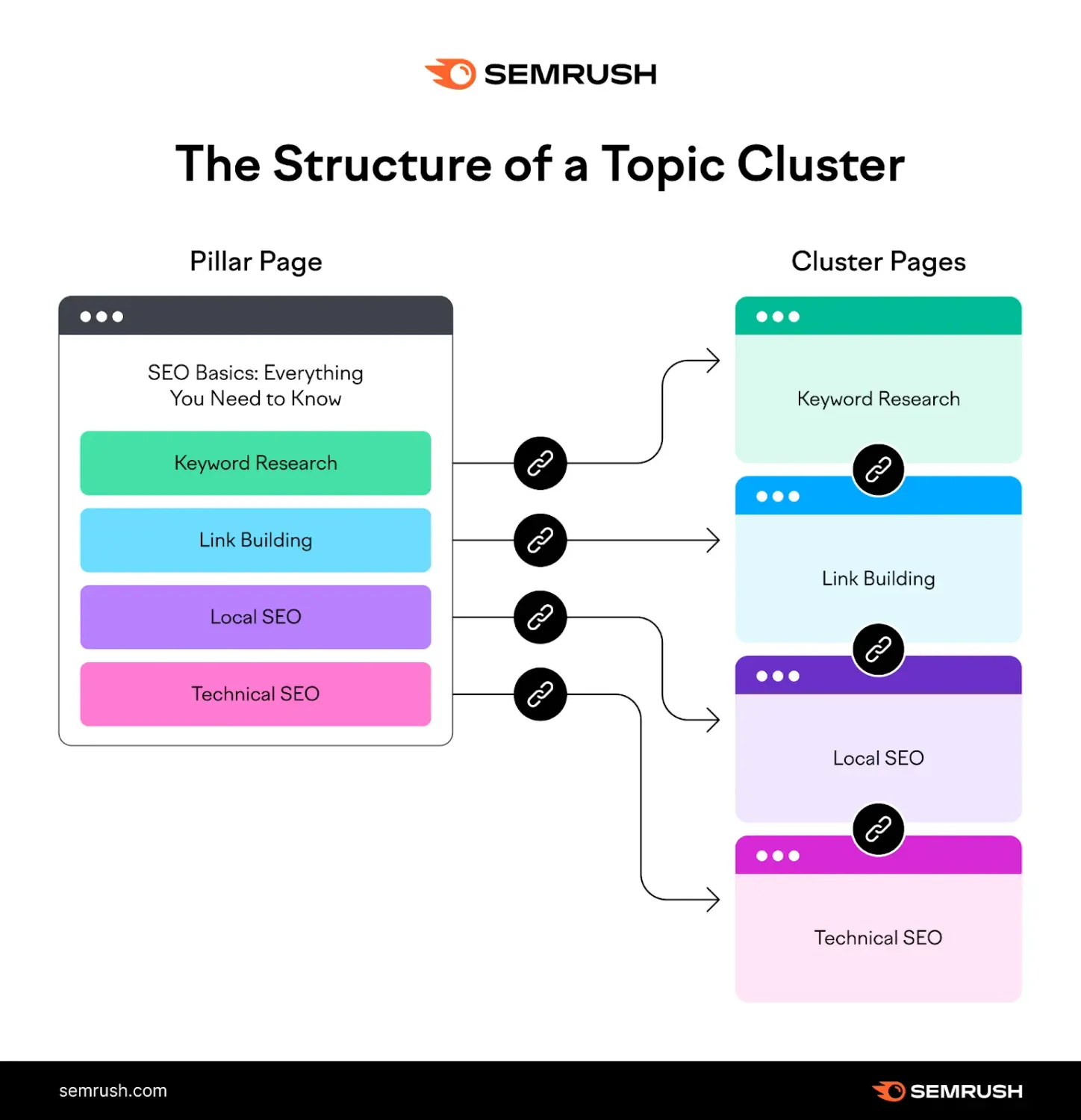
If Entity SEO defines what your business is, a Topical Authority Map defines how you prove your expertise. It is a strategic framework that organizes your website content into clusters centered around a core service pillar. This organization signals to Google that your brand doesn't just mention a topic, it "owns" it.
Signaling Topical Ownership
A Topical Authority Map transforms content planning from guesswork into strategic architecture. By clustering content, you demonstrate consistent expertise, which increases your "Topical Density", Google's measure of how comprehensively you cover a subject compared to your competitors. Instead of publishing isolated, random articles, you create a "network of meaning."
The Hub-and-Spoke Model
Pillar Page (The Hub): A comprehensive resource covering a broad topic (e.g., "Digital Marketing Strategy"). It provides a high-level overview and links to all supporting subtopics.
Cluster Pages (The Spokes): Specific articles that dive deep into sub-entities (e.g., "Email Copywriting for SaaS"). These address niche questions and technical details.
Internal Links: The structural mechanism that connects the spokes back to the hub. These links distribute authority and guide both users and search engines through a logical, authoritative hierarchy.
Building Your Entity SEO Strategy: A 6-Step Roadmap
For business owners and technical strategists, evolving from keyword chasing to entity management requires a structured, six-step operational methodology. This is the "Entity Playbook" for modern digital leadership.
Step 1: Entity Audit
Before building new content, you must identify how your brand currently appears in Google’s Knowledge Graph.
Knowledge Graph Identification: Use tools like Google’s Knowledge Graph Explorer or Kalicube to see if your brand has a "mid" (Machine ID).
NAP Consistency: Check Name, Address, and Phone (NAP) consistency across your website, Google Business Profile, LinkedIn, and industry directories.
Hallucination Risk: Inconsistencies act as a risk for AI bots; if your data conflicts (e.g., two different addresses), AI models may skip your brand to avoid providing incorrect information.
Competitor Comparison: Research the entity maps of your competitors to see which sub-entities they "own" and identify gaps in your own coverage.
Step 2: Define Pillars and Clusters
Select 5 to 10 core service areas that define your business value.
Pillar Selection: Choose broad subjects that align with your primary revenue drivers (e.g., "Custom Web Design").
Subtopic Mapping: For every pillar, select 6 to 10 subtopics. Use Semrush's "Mind Map" view to visualize the latent entity space and find related concepts your audience is searching for.
Strategic Blueprinting: Every URL should either reinforce an existing entity or introduce a new one that strengthens your domain graph. Avoid "off-topic" content that confuses your entity definition.
Step 3: Content Triage
Categorize every existing URL on your site into four strategic groups to avoid "IR (Information Retrieval) score dilution."
Keep & Improve: High-value pages that need updated facts or better E-E-A-T signals.
Consolidate: Merge thin, overlapping pages that target the same intent. This prevents splitting your authority between two mediocre pages.
Noindex / Internal Only: Keep these for users (like a "Thank You" page) but hide them from search engines to keep your entity map clean.
Remove / Redirect: Prune outdated content that is no longer relevant to your "raison d'être."
Step 4: Rewrite for E-E-A-T
Enhance your content with Experience, Expertise, Authoritativeness, and Trustworthiness. This is especially critical for YMYL (Your Money, Your Life) sectors like health and finance.
Expert Bylines: Add clear author bylines with credentials and links to verifiable subject matter expert (SME) biographies.
Primary Source Citations: Cite primary research and data. "Citations are the new backlinks" in an AI search environment.
First-Hand Details: Add "Experience" by including original insights, proprietary data, or unique case studies that LLMs cannot find elsewhere.
Expert Quotes: Quote industry leaders and link to their professional bios to strengthen the "trust" node of your content.
Step 5: Semantic Internal Linking
Internal links are the semantic bridges that tell Google how your ideas connect.
Entity-Rich Anchor Text: Avoid generic "click here" text. Use descriptive anchors like "advanced local SEO strategies" to explicitly define the relationship between the two pages.
The Hub-to-Spoke Flow: Ensure every cluster page links back to the pillar, and the pillar links out to all clusters. This creates a "triangle of context."
Link Equity Distribution: Identify your "power pages" using Semrush and link from those high-authority nodes to newer, strategically important pages.
Step 6: Off-Site Validation
Your on-page structure defines your entity, but off-site signals validate it.
Digital Entity Consistency: Ensure your brand description and service scope are identical across social profiles, press releases, and directory listings.
Third-Party Verification: Mentions in news outlets, industry awards, and high-authority directories act as "corroboration" for search engines.
Verified Knowledge Hubs: Use sameAs schema to link your website to "truth sources" like Wikidata, LinkedIn, and official brand registries.
Technical Foundations: Schema Markup and Structured Data
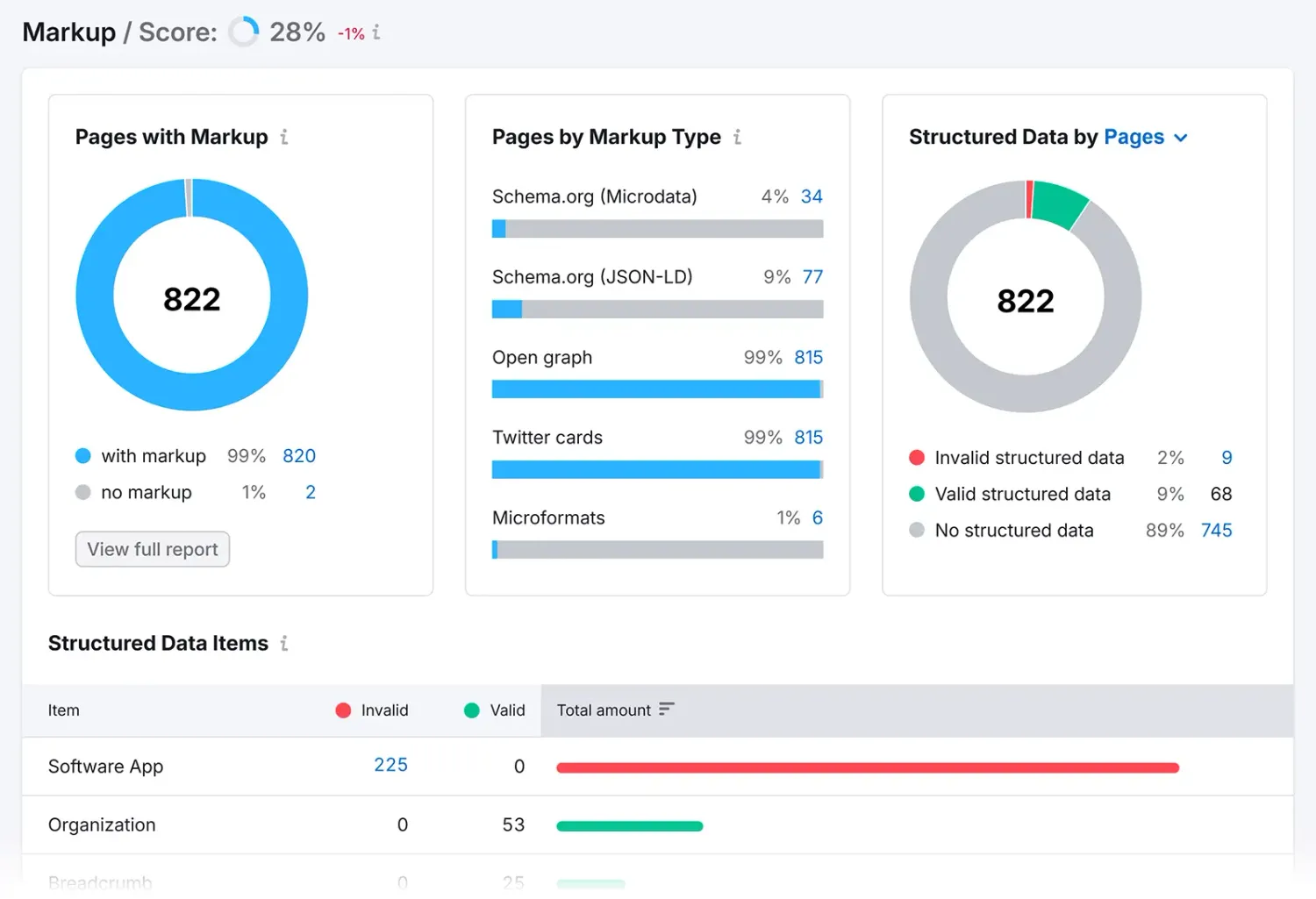
Schema markup is the translator that allows you to speak the native language of search engine bots. It transforms unstructured text into machine-readable JSON-LD code.
The Essential Schema Types
Organization: Establishes the core brand entity, including logo and social profiles.
LocalBusiness: Crucial for location entities, providing opening hours and geo-coordinates.
Product: Displays price, availability, and aggregate ratings in SERPs.
Article: Helps search engines understand authorship, headline, and publication date.
Person (Author): Links content to a specific expert via the "knowsAbout" and "sameAs" tags.
Implementing JSON-LD (Nested Hierarchy)
JSON-LD is the preferred format because it separates code from content. When structuring your code, the relationship between properties must be a clear hierarchy:
@context: The vocabulary source (Schema.org).
@type: The specific entity definition (e.g., LocalBusiness).
@id: The canonical URI (The unique "Thing" identifier/stable URL).
name: The official name of the entity.
sameAs: The bridge to authority (Links to Wikidata Q-IDs or social profiles).
mainEntityOfPage: Declares the page’s singular, canonical focus.
Entity SEO in the Age of AI (GEO and LLMs)
In 2026, entity clarity is the mandatory entry fee for visibility in AI summaries like ChatGPT, Perplexity, and Google AI Overviews. These systems do not "rank" websites; they "source" authoritative entities.
The Three Levels of the AI Funnel
Strategic success is now measured by your presence across the AI discovery journey:
Top (Visibility): Measuring brand mentions and frequency across AI model responses.
Middle (Visual Proof): Capturing LLM screenshots to verify how your brand is being described and "cited."
Bottom (Conversion): Tracking actual referral traffic from AI platforms within GA4.
Extraction Architecture and the BLUF Model
To be cited by an LLM, your content must use "Extraction Architecture." This involves the BLUF (Bottom Line Up Front) model: provide the direct answer or most important information immediately, followed by supporting detail. This makes it easy for AI models to "extract" your brand as the answer.
Semrush AI Visibility Toolkit
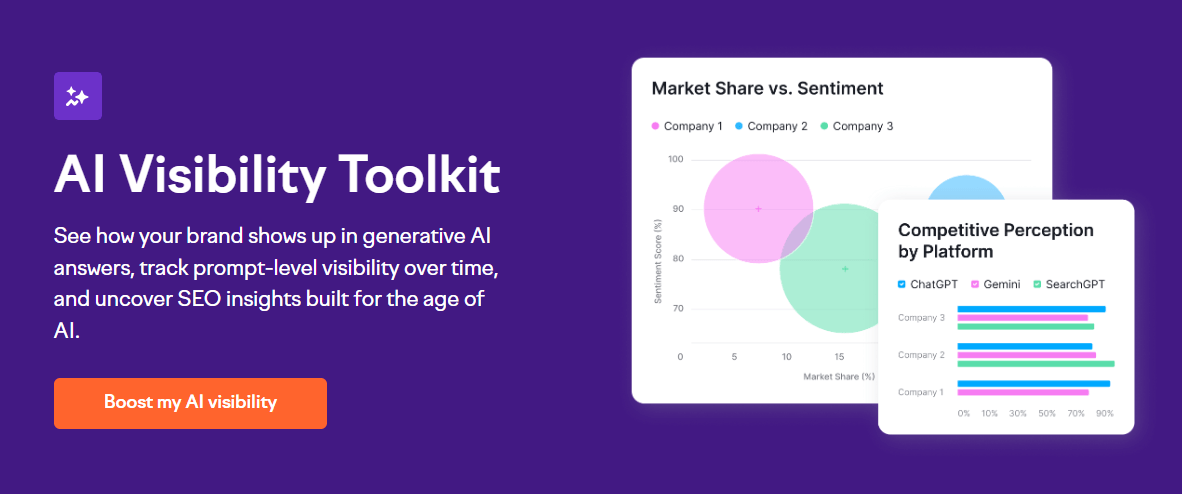
The Semrush AI Visibility Toolkit is a premium add-on ($99/mo) essential for this new frontier.
It allows you to:
Track Share of Model: Measure your visibility versus competitors across different AI platforms.
Monitor Prompt Rankings: Track how your brand ranks for up to 25 specific user prompts (e.g., "What is the best SaaS for entity mapping?").
Analyze Narrative Drivers: Identify which publishers and questions are shaping your brand’s perception in AI models.
Usage Limits: The toolkit provides 1,000 daily queries in Prompt Research to help you identify what users are asking AI assistants in your niche.
Semantic Content Engineering: The Author’s Workflow
Writing for modern SEO requires a blend of storytelling and machine-readable engineering. To satisfy Google's Natural Language Processing (NLP) models, technical strategists utilize specific algorithms and patterns.
The Six Algorithms of Entity Mapping
Your content should be structured to perform well against these internal IR scoring methods:
Explicit Semantic Analysis (ESA): Measures word association strengths to concepts.
Latent Entity Space (LES): Combines query likelihood with latent entity scores.
EsdRank: Ranks documents based on entity popularity and document quality.
Explicit Semantic Ranking (ESR): Uses knowledge graph relationships for "soft matching."
Word-Entity Duet: Matches query entities directly to document entities.
Attention-Based Ranking: Characterizes the risk associated with entity ambiguity.
The Binder Sentence Pattern
Use "Binder Sentences" to explicitly link entities to their attributes. For example: "Entity SEO is an architecture of topic clusters and entity mapping illustrated by structured schema." This sentence explicitly "binds" the attributes (clusters, mapping, schema) to the entity (Entity SEO) for Google’s NLP systems.
Automating with Semrush
Topic Research (Mind Map): Use this view to visualize the "latent entity space." It identifies co-occurring topics and trending sub-entities you must cover to be considered an authority.
Keyword Strategy Builder: Automate the grouping of thousands of keywords into clusters. (Note: Limits vary by tier, Pro: 10 clusters/mo; Guru: 30; Business: 50).
SEO Writing Assistant: Check your drafts for "salience", the measure of how central your target entity is to the text.
Real-World Examples of Entity Success
The Travel Blog (Portugal Beaches): A publisher targets the entity "Portugal (Q45)" in their schema. By mapping sub-pages for "Algarve" and "Madeira" to their specific Wikidata Q-IDs and interlinking them, they signal "Topical Density." This connectivity tells Google exactly how these geographic concepts fit together, increasing the site’s authority for all Portugal-related travel queries.
The Service Business (Puppy Care): A pet tech company (like Petcube) builds a "Puppy Care 101" pillar page. They link it to specific spokes like "Crate Training" and "Puppy-Proofing." By covering the entire ecosystem, they demonstrate a "Topical Authority Framework" that AI assistants use as a primary source.
The Educational Institution (University): A university site maps its course pages to "Machine Learning" (Q2539). By using descriptive anchor text and biography schema to link courses to recognized experts, search engines confidently serve these pages as "verified authority" nodes.
Measuring What Matters: Semantic Metrics
Traditional metrics like individual keyword rankings are fading. To measure true authority, you must look at the 16 metrics of content performance.
Beyond Rankings
Semantic Precision: How clearly your content aligns with its target entity without "drift."
Topical Density: A measure of how comprehensively your site covers its subject area.
Share of Voice vs. Sentiment: Tracking if high AI visibility is paired with positive or negative perception.
Knowledge Panel Accuracy: Monitoring the correctness of the facts Google displays about your brand.
The 16 Metrics Checklist
AI Visibility Score (Presence in LLMs)
Share of Model (Percentage of mentions vs. competitors)
Entity Search Volume (Branded searches)
Knowledge Panel Presence
Rich Result Appearance Frequency
Click-Through Rate (CTR) for Enhanced Listings
Internal Link Navigation (Hub-to-Spoke CTR)
Organic Traffic for Entity Clusters
Content Gap Closure (Entities owned vs. competitors)
Salience Scores (NLP centrality)
Scroll Depth (Intent satisfaction)
Time on Page
Assisted Conversions
Narrative Drivers (Who is citing you?)
Prompt Rankings (Visibility for AI questions)
Overall Structural Health (Schema crawlability)
Conclusion: Future-Proofing Your Brand Authority
The paradigm shift from "strings to things" is a fundamental change in how digital authority is built. By moving away from tactical keyword chasing and toward building digital equity through entities, you are constructing the infrastructure of modern visibility.
Entity-based SEO turns your website into a structured knowledge hub that is both human-centric and machine-readable. In an era where AI and LLMs are the primary gateways to information, establishing "knowledge-based trust" is the only way to remain relevant.
The competitive advantage of tomorrow belongs to the brands that take action today. Build your Topical Authority Map, refine your schema, and use Semrush to monitor your semantic footprint. Own your entity before your competitors do.



Created with © Systeme.io
Disclaimer: This page contains affiliate links. If you purchase through these links, we may earn a commission
at no extra cost to you. We only recommend tools we trust.