AI Search vs Traditional Search: What’s the Difference?
AI Search vs Traditional Search: What’s the Difference?
Introduction: The New Frontier of Search
For nearly three decades, the "10 blue links" reigned supreme as the primary currency of the internet. Success was a zero-sum game of securing the top spot on a static results page. However, the launch of Google’s interactive AI Mode in May 2025 has permanently disrupted that monopoly. While traditional search remains the engine of the web, the rise of Google AI Mode, ChatGPT, and Perplexity has fundamentally altered how users discover and synthesize information.
We are witnessing a fundamental paradigm shift in user intent, moving from optimizing for algorithms to optimizing for Large Language Models (LLMs). This article breaks down the technical and strategic differences between these two worlds, utilizing ground-truth data from the 2025 Semrush study to provide a roadmap for the future of digital visibility.
Defining the Players: Traditional SEO vs. AI SEO
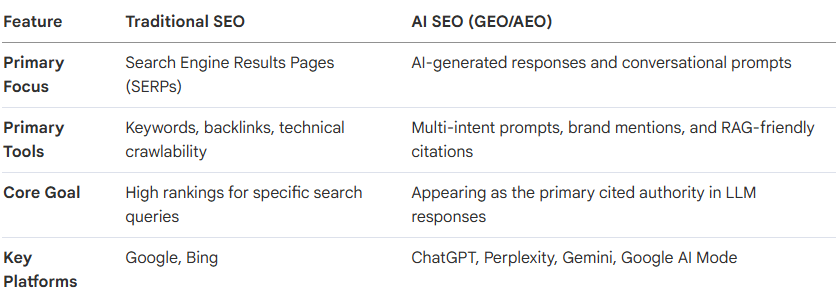
To navigate this landscape, we must distinguish between Traditional SEO and its emerging evolution: AI SEO (frequently referred to as Generative Engine Optimization, or GEO). It is critical for search leaders to view AI SEO not as a replacement for traditional methods, but as a strategic technical extension.
The Mechanics of AI Mode: How Google is Changing the Game
Launched in May 2025, Google’s AI Mode represents a significant departure from the brief snippets of "AI Overviews" (AIO). AI Mode is an interactive search engine built to compete directly with ChatGPT and Perplexity. This is reflected in its "personality" and depth, averaging 300 words per response, mirroring ChatGPT’s long-form style.
The Semrush study highlights a sophisticated "Dual System" in Google's layout:
The Exploratory Sidebar: 92% of AI Mode responses feature a sidebar containing an average of 7 unique domains (compared to only 3 in AIO). These links show a 51% domain overlap and 32% URL overlap with traditional results, signaling that Google uses the sidebar to experiment with new, conversational sources.
The Precision Anchor: In 7% of queries, typically navigational, links appear below the response. These links stick closely to traditional rankings, boasting an 89% domain overlap and 80% URL overlap.
Local Integration: Local packs appear in 13.49% of AI Mode queries, proving that Google is successfully mapping local intent into conversational logic.
Search Overlap: Does AI Mode Mirror Traditional Rankings?
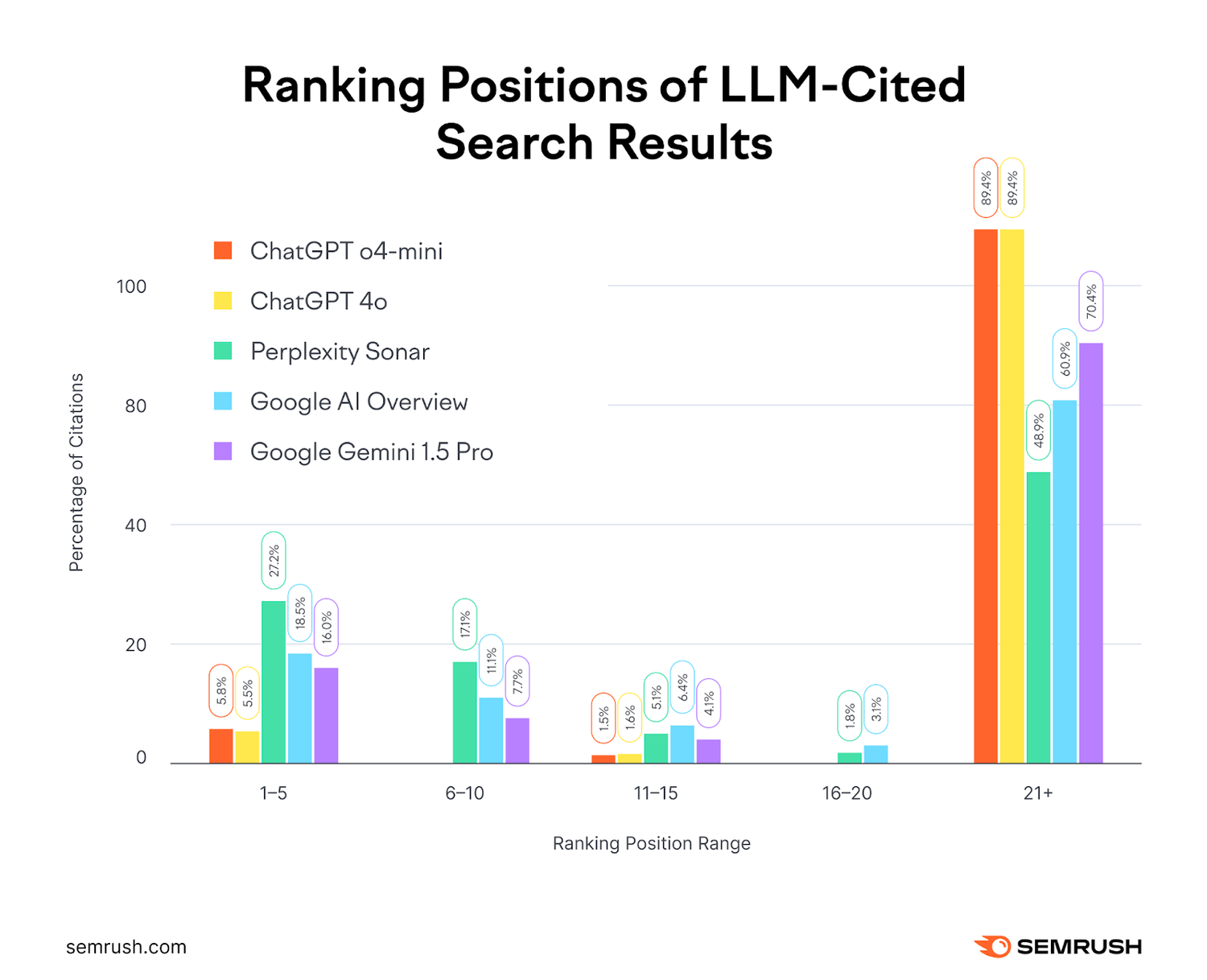
A primary concern for marketers is "Citation Overlap", how often AI platforms cite the top 10 organic results. The alignment varies drastically by platform:
Perplexity: 91% domain / 82% URL overlap (heavily reliant on Google's top 10).
Google AI Overviews: 86% domain / 67% URL overlap.
Google AI Mode: 54% domain / 35% URL overlap.
ChatGPT: Lowest overlap (leans toward Bing’s index).
The Strategy of RAG (Retrieval-Augmented Generation): The technical reason for the high domain correlation but low URL overlap lies in RAG. LLM-based models start by retrieving top-ranked results but then "augment" their answers by digging deeper into the domain. While traditional SEO often prioritizes pillar pages, LLMs frequently bypass those to cite specific subpages, technical blog posts, or help articles that provide the exact "chunk" of data needed to satisfy a complex prompt.
From Keywords to Prompts: The Strategy Shift
User behavior is shifting from fragmented keywords to multi-intent conversational prompts. Data from the pet brand Petlibro illustrates this expansion:
Traditional Keyword Length: 4 words.
AI Prompt Length: 8 words.
Because prompts are twice as long and more context-heavy, we are moving toward "query fan-out," where AI tools perform multiple simultaneous searches to build one answer. Marketers must move away from "keyword targeting" toward "topic mapping" to ensure they cover the full breadth of these expanded prompts.
How Query Intent Dictates Response Depth
AI platforms treat query intent as a lever for response length. The Semrush study found that Commercial and Transactional queries trigger responses roughly 2x longer than informational ones.
Strategizing by Intent:
Informational Intent: Prioritize clarity and conciseness. Your goal is to be the "quick extraction" source.
Commercial/Transactional Intent: Expand your content. Provide detailed comparisons, pricing nuances, and deep technical specs to satisfy the LLM’s requirement for long-form extraction.
The "Reddit Effect" and the Strategic Power of Documentation
User-Generated Content (UGC) is now a primary pillar of AI search visibility. Reddit, YouTube, and Facebook appear in over 68% of AI Mode results that include additional links.
The Mapbox/OpenStreetMap Blueprint: A critical anomaly in the data shows Mapbox and OpenStreetMap (OSM) achieving high AI visibility despite low traditional rankings. The takeaway for technical brands is clear: "Reference-worthiness" is driven by clean, structured, and developer-focused documentation. Mapbox’s success serves as a blueprint, if your content is easy for an LLM to parse and structured as a definitive technical reference, you can bypass traditional ranking hurdles.
Tactical Guide: Adapting Your SEO Tasks for AI
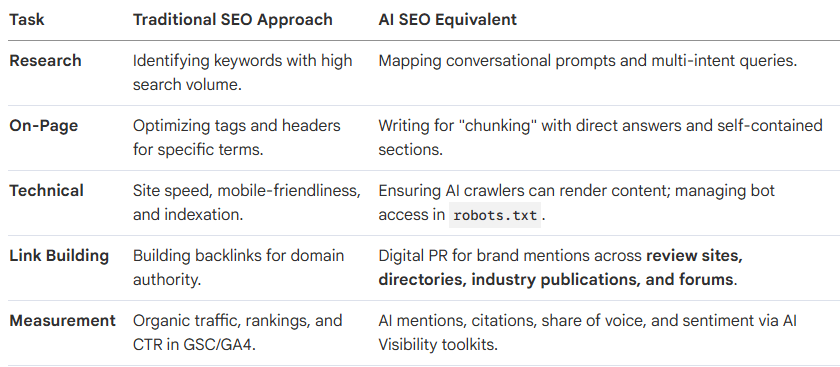
To survive the shift to GEO, search teams must evolve their traditional workflows into AI-ready equivalents:
Content Optimization for AI Extraction
To be cited, content must be structured for easy "chunking." AI systems pull specific sections and combine them with other sources, meaning each section should be self-contained.
DO: Self-Contained/Direct "Website loading speed depends on three factors: image optimization, server response time, and code efficiency. Here is how each factor works..."
DON'T: Vague/Context-Dependent "As we mentioned in the previous section, these factors are important for results. Let's explore the next point..."
MARKETER'S RULE: Always start sections with a direct answer to the header’s question.
Technical Readiness: AI Crawlers and the JavaScript Hurdle
Technical visibility depends on the ability of AI crawlers to "see" your content. This is where many sites fail. A recent Vercel analysis confirms that most major AI crawlers currently fail to render JavaScript. While Google’s Gemini leverages existing infrastructure to handle JS, other bots remain blind to JS-heavy sites.
Crawl Management Checklist:
Server-Side Rendering: Reduce reliance on client-side JS for critical content.
Robots.txt Strategy: Explicitly manage specific agents. You must allow GPTBot (ChatGPT), Claude-bot, and PerplexityBot to access your content. Blocking these agents is a strategic error that prevents your brand from being cited as an authority.
Tracking Success: New Metrics for a New Era
Traditional metrics like organic traffic and keyword rankings (tracked via GA4 and GSC) are still relevant but no longer sufficient. For the AI era, you must integrate AI Visibility Metrics using tools like the Semrush AI Visibility Toolkit:
AI Mentions & Citations: Frequency of brand presence in LLM responses.
Share of Voice (SoV): Your brand’s prominence relative to competitors in AI answers.
Sentiment Analysis: Monitoring whether AI describes your brand positively or negatively (and identifying the "narrative drivers" behind those perceptions).
Frequently Asked Questions
What Are the Key Differences Between AI Search and Traditional Search?
Key Differences Between AI Search and Traditional Search
The primary difference lies in how information is processed and presented. Traditional search focuses on providing a list of "blue links" in response to specific keywords, typically averaging four words per query. In contrast, AI search (such as Google AI Mode, ChatGPT, and Perplexity) focuses on conversational prompts that average eight words, resulting in a generated response that synthesizes information from multiple sources.
Technically, traditional search relies on ranking and indexing for visibility, while AI search often uses Retrieval Augmented Generation (RAG), a process where the system retrieves top results first and then augments them to generate a final, cohesive answer. Furthermore, AI Mode shows more independent retrieval behavior; it has only a 54% domain overlap with Google’s traditional top 10 results, compared to the 86% overlap seen in AI Overviews.
Why AI Search is Revolutionizing the Way We Search?
AI search is revolutionizing the industry by making search fluid and personalized. It allows users to ask follow-up questions and engage in a dialogue rather than starting a new search for every query. This shift is so significant that data suggests traffic from Large Language Models (LLMs) may surpass traffic from traditional organic search by 2028. It transforms the search engine from a directory into an interactive assistant that helps users gather information and compare options while they are still in the decision-making phase.
How AI Search Improves Results Compared to Traditional Search?
AI search improves the user experience by providing direct answers and summaries, reducing the need for users to click through multiple websites to find a single piece of information. Key improvements include:
Source Diversity: Google’s AI Mode links to an average of seven unique domains per response, compared to only three in AI Overviews.
Deep Contextual Retrieval: While traditional search often highlights homepages or pillar content, AI tools "reach deeper" into websites, citing specific subpages, blog posts, or help articles that precisely match the user's nuanced context.
Human Perspective: AI search heavily cites User-Generated Content (UGC) platforms like Reddit, which appeared in over 68% of AI Mode results that included additional links, providing real-world human insights that traditional brand sites might lack.
When to Use AI Search Instead of Traditional Search?
The sources suggest that the choice depends on the user's goal:
Use Traditional Search when you have a navigational intent, meaning you already know exactly where you want to go and just need a direct link to that destination.
Use AI Search when you are gathering information, asking complex questions, or comparing options. It is particularly useful for commercial or transactional queries where you need a detailed, comparative response rather than a simple link.
Where AI Search Outperforms Traditional Search Techniques?
AI search excels in several specific areas:
Complex/Long-Tail Queries: Because it handles 8-word prompts more effectively than traditional engines handle short keywords, it is better at parsing complex user intent.
Commercial and Transactional Research: These query types trigger responses that are roughly twice as long as informational ones, offering the depth required for making purchasing decisions.
Technical Documentation: AI search is highly effective at referencing clean, structured, and developer-focused documentation, even if those pages do not have high visibility in traditional Google rankings.
Synthesis of Diverse Opinions: By pulling from UGC platforms like Reddit and Facebook, AI search outperforms traditional techniques in providing a broad spectrum of community-driven advice.
Conclusion: The Future of Search Strategy
The search landscape is not witnessing the death of SEO, but the birth of Generative Engine Optimization (GEO). With Semrush data predicting that LLM traffic will surpass traditional organic search traffic by 2028, this is a budgetary wake-up call for every marketing leader.
Success in this new era requires a fundamental shift: appearing in search results is no longer just about "ranking #1." It is about being the most reference-worthy authority. If you aren't being cited by the LLMs, you don't exist in the future of search.



Created with © Systeme.io
Disclaimer: This page contains affiliate links. If you purchase through these links, we may earn a commission
at no extra cost to you. We only recommend tools we trust.